 Bullish Portfolio
Introduction to the Rule of 72 in Wealth Building
The Rule of 72 is a straightforward mental math shortcut that reveals how long it takes for an investment to double at a fixed annual return rate. For anyone pursuing financial independence (FI) in 2026 and beyond, this tool turns abstract compounding into concrete timelines, motivating consistent investing habits. Whether you are new to markets or refining an intermediate strategy, mastering this rule clarifies the power of patience and reinvestment. Compounding returns accelerate wealth when gains generate their own gains over repeated periods. The Rule of 72 approximates the years needed without complex spreadsheets, making it ideal for quick scenario planning during 2026 market conditions. Many investors overlook how small differences in return rates compound dramatically over decades, which is why visualizing doubling periods helps maintain discipline during market volatility.
Financial independence often hinges on understanding these timelines rather than chasing high-risk returns. The rule provides a foundation for setting realistic milestones, such as reaching a portfolio size that supports withdrawal rates without depleting principal. By applying it early, beginners can build confidence while intermediate investors refine asset allocations to optimize doubling speed.
The Simple Formula Explained
Divide 72 by your expected annual return percentage to estimate doubling time. For example, at 8% returns, 72 divided by 8 equals 9 years. This works best for rates between 1% and 20% and assumes annual compounding with reinvested earnings. The formula originates from the mathematical approximation of the natural logarithm of 2 multiplied by 100 for percentage convenience. At higher rates like 12%, the calculation yields 6 years, while lower rates such as 6% extend the period to 12 years. Investors should note that the approximation grows slightly less accurate above 20% or below 1%, where logarithmic adjustments become preferable.
Variations include using 69.3 for continuous compounding or 70 for more conservative estimates in certain bond scenarios. Practice the formula with different rates to internalize its implications. For instance, comparing a 7% diversified equity portfolio against a 4% fixed-income allocation immediately highlights why equities often accelerate FI timelines despite short-term fluctuations.
Real-World Examples Across Asset Classes
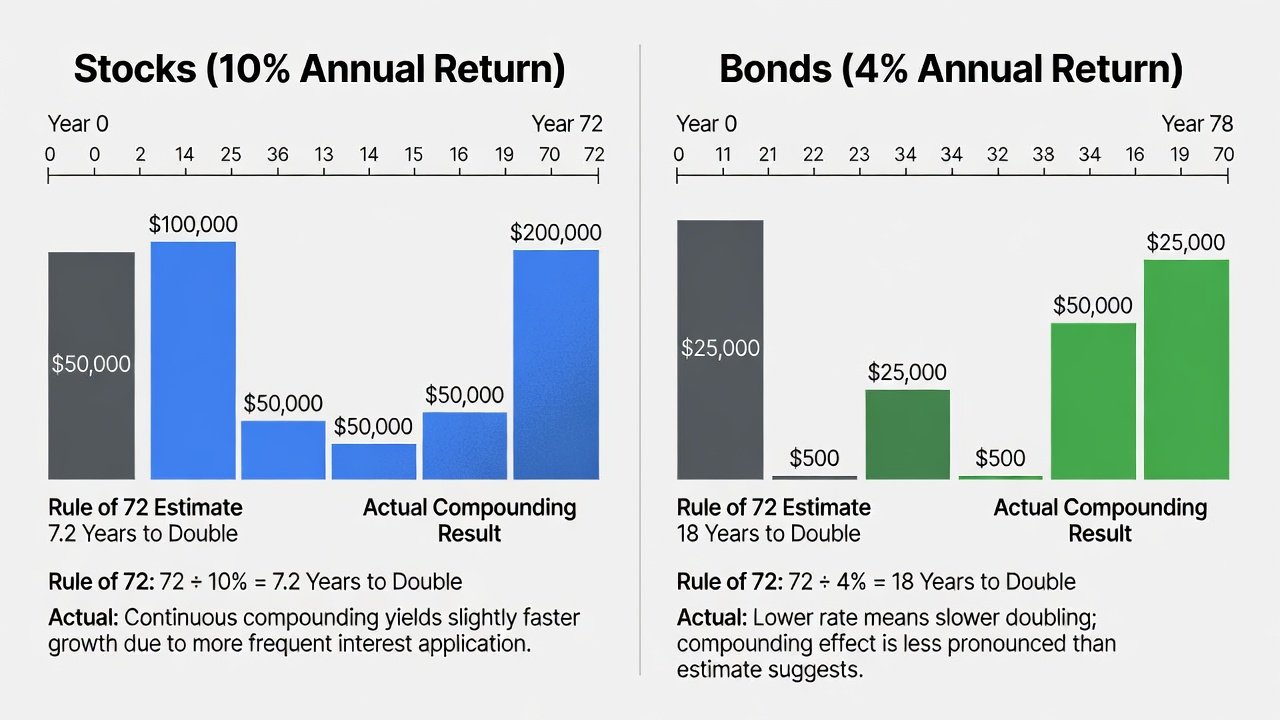
Consider stocks with historical average returns near 10%. Applying the rule: 72 divided by 10 yields roughly 7.2 years to double. Bonds at a conservative 4% would take 18 years. A diversified portfolio blending both might average 7%, doubling in about 10.3 years. Real estate investment trusts (REITs) historically near 8-9% follow similar patterns, while international equities may average slightly lower at 7-8% depending on currency effects. Even peer-to-peer lending or high-yield savings accounts at 4-5% provide doubling estimates of 14-18 years, useful for emergency fund planning.
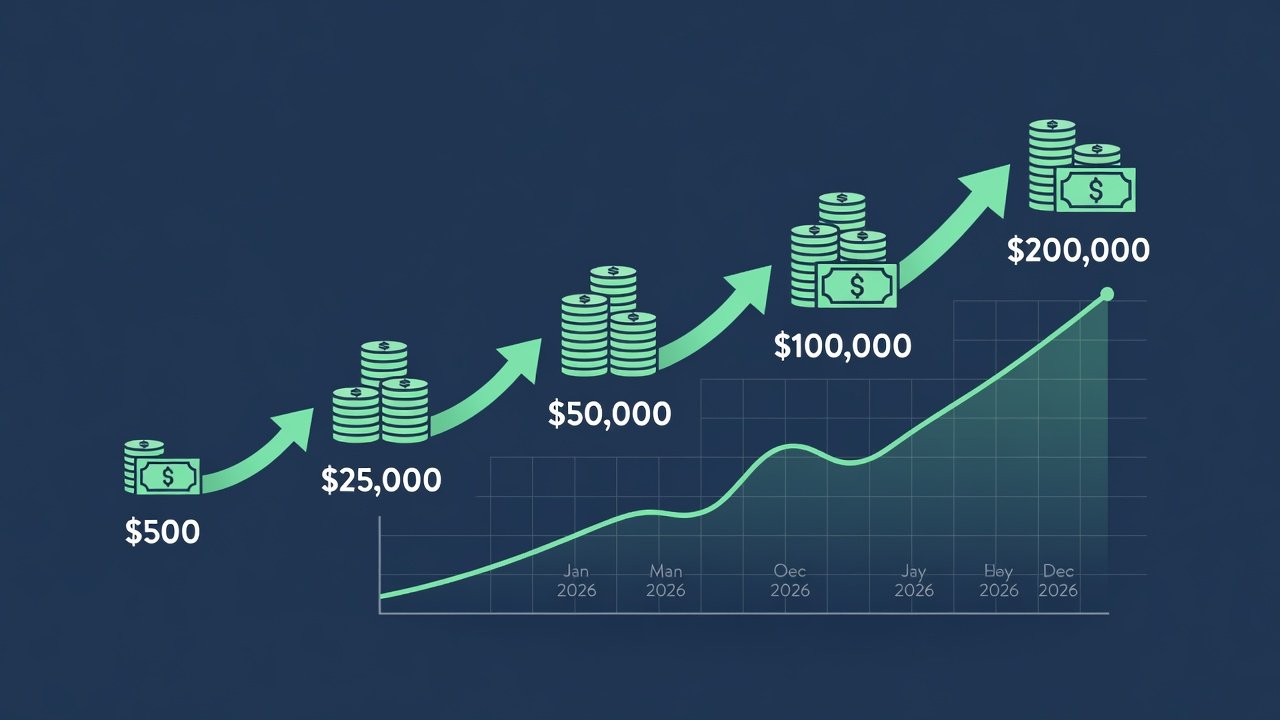
These estimates help visualize FI timelines. An investor starting with $50,000 at 8% sees it reach $100,000 in nine years, then $200,000 in 18 years, illustrating exponential growth. Adding monthly contributions of $500 accelerates results beyond pure doubling, as new capital compounds alongside existing principal. The rule encourages focusing on consistent allocation rather than timing markets.
Estimated vs Actual Compounding Results
Real markets fluctuate, so compare estimates to actual outcomes. Historical S&P 500 data shows periods where 10% averages held, but drawdowns extend timelines. The rule assumes constant rates, yet volatility means actual doubling may vary by a few years. Tools from Investopedia allow backtesting these scenarios. For example, the 2000-2010 decade delivered lower annualized returns near 1%, stretching a projected 7.2-year doubling to over 20 years in some portfolios.
Inflation further impacts real returns. Subtracting 3% inflation from nominal 8% returns leaves 5% real growth, extending doubling to 14.4 years. Tracking both nominal and real figures supports accurate 2026 planning. Taxes on dividends or capital gains reduce effective rates by 1-2% for many investors, requiring an upward adjustment to the estimated period. Regular rebalancing and tax-advantaged accounts like IRAs mitigate these drags.
Actionable Steps to Integrate the Rule into 2026 Financial Planning
Integrating the Rule of 72 starts with assessing your current portfolio. Calculate your portfolio's expected return using recent asset allocation data. Apply the rule to set milestone targets, such as doubling emergency funds or retirement accounts. Review annually and adjust for new rates or contributions. Combine with dollar-cost averaging to smooth volatility effects. Model multiple scenarios at 6%, 8%, and 10% to prepare for varying market conditions. Track progress quarterly using simple spreadsheets that incorporate the formula for forward projections. Consider automating contributions to maximize the compounding effect highlighted by the rule. Revisit allocations if personal risk tolerance changes or economic indicators shift expected returns.
These steps turn the rule into a practical habit rather than a one-time exercise. Pair projections with broader financial plans, including debt reduction and income growth, for holistic wealth building.
Case Studies of Investors Reaching FI Milestones
One investor began with $25,000 in a broad stock index at an estimated 9% return. Using the rule, doubling occurred every eight years. After consistent additions, the portfolio reached six figures within 12 years, aligning closely with projections despite minor market dips. A second investor allocated primarily to bonds and dividend stocks averaging 5%. The rule predicted 14.4-year doublings. Steady contributions accelerated the timeline, achieving FI at age 48 through disciplined reinvestment. A third case involved a couple using a 60/40 stock-bond mix at 7% average. They applied the rule to forecast doubling every 10.3 years while increasing savings rates annually. By age 42 they reached a portfolio supporting 4% safe withdrawals, retiring early with buffer for sequence-of-returns risk.
These stories highlight how the rule visualizes progress and encourages persistence across different risk profiles and life stages.
Common Mistakes to Avoid When Using the Rule
Many beginners apply the rule to short-term or highly volatile assets where it loses accuracy. Avoid ignoring fees, which can extend timelines by several years. Do not forget inflation's impact on real purchasing power. Over-optimism with projected returns leads to disappointment; base estimates on long-term historical averages rather than recent bull markets. Finally, treat the rule as a guide, not a guarantee, and combine it with diversified strategies recommended by sources such as SEC.gov.
FAQ: Common Misconceptions and Limitations
Does the Rule of 72 work for all investments?
It performs best with fixed-rate or average-return assumptions. Variable assets like individual stocks require averaged historical data for accuracy.
How does inflation affect the rule?
Always consider real returns after inflation. Nominal figures overstate purchasing power growth.
Can fees change the timeline?
Yes. Expense ratios of 0.5% or more reduce effective returns and extend doubling periods. Factor them into your rate before applying the rule.
Is it useful for short-term goals?
The rule shines for multi-year horizons. For periods under five years, more precise calculators outperform approximations.
What about taxes on investment gains?
Taxes lower net returns, so adjust your percentage downward before calculating doubling time to maintain realistic expectations.
Can the rule predict exact future values?
No. It offers approximations only. Market conditions, additional contributions, and economic changes introduce variability.
How often should I recalculate?
Review annually or after major life or market events to keep projections aligned with current allocations and rates.
Conclusion
The Rule of 72 empowers 2026 wealth builders by translating compounding into understandable timelines. Pair it with disciplined investing, regular reviews, and authoritative resources like SEC.gov for ongoing education. Start applying it today to map your FI journey with clarity and confidence, adjusting as new data emerges throughout the year.


No comments yet. Be the first!