 Bullish Portfolio

Introduction: Why Inflation Threatens Your Compounding Journey in 2026
Inflation remains a persistent challenge for investors pursuing financial independence (FI). Even modest rates can significantly erode the real value of returns over decades. This article explores proven methods to select assets that outpace inflation while maximizing compounding effects, tailored for 2026 FI timelines. Rising prices reduce purchasing power, meaning a dollar today buys less tomorrow. For those building wealth through compounding, ignoring inflation leads to shorter retirement durations or delayed independence. Investors must focus on real returns rather than nominal figures to ensure sustainable growth.
Understanding real returns—nominal returns minus inflation—is essential. Without this adjustment, apparent growth can mask actual losses in purchasing power. In 2026, economic forecasts suggest continued volatility from supply chain issues and policy shifts, making proactive strategies more critical than ever.
Calculating Real Returns and Their Impact on FI Timelines
Real return calculations form the foundation of inflation-adjusted planning. The formula is straightforward: Real Return = Nominal Return - Inflation Rate. For compounding, apply this annually to project future portfolio values accurately. Consider a portfolio targeting 7% nominal annual returns. If inflation averages 3%, the real return drops to approximately 4%. Over 25 years, this difference dramatically extends the time needed to reach FI targets by reducing effective growth.
Stress-testing involves modeling multiple inflation scenarios, such as 2%, 4%, and 6% sustained rates, to evaluate how each affects withdrawal sustainability and timeline extensions. For example, a $1 million portfolio growing at 4% real return reaches $2.67 million in 25 years, but drops to $2.09 million at 3% real if inflation rises unexpectedly. These projections highlight why FI timelines can stretch by several years under adverse conditions. Investors should incorporate tax implications and sequence-of-returns risk into calculations for realism.
Inflation-Adjusted Portfolio Allocation Strategies
Effective allocation balances growth assets with inflation hedges. A typical structure might include 50-60% equities for long-term compounding, 20-30% commodities or real assets, and 10-20% TIPS for direct inflation protection. Within equities, tilt toward sectors like energy, materials, and consumer staples that historically perform well during inflationary periods. Real estate investment trusts (REITs) can add another layer of protection through rental income adjustments.
Rebalance annually to maintain these ratios, as market movements can shift exposure. This approach ensures compounding continues on inflation-resistant components. Diversification across geographies also helps, as inflation impacts vary by region. For instance, emerging markets may offer higher nominal growth but require careful monitoring for currency effects tied to inflation differentials.
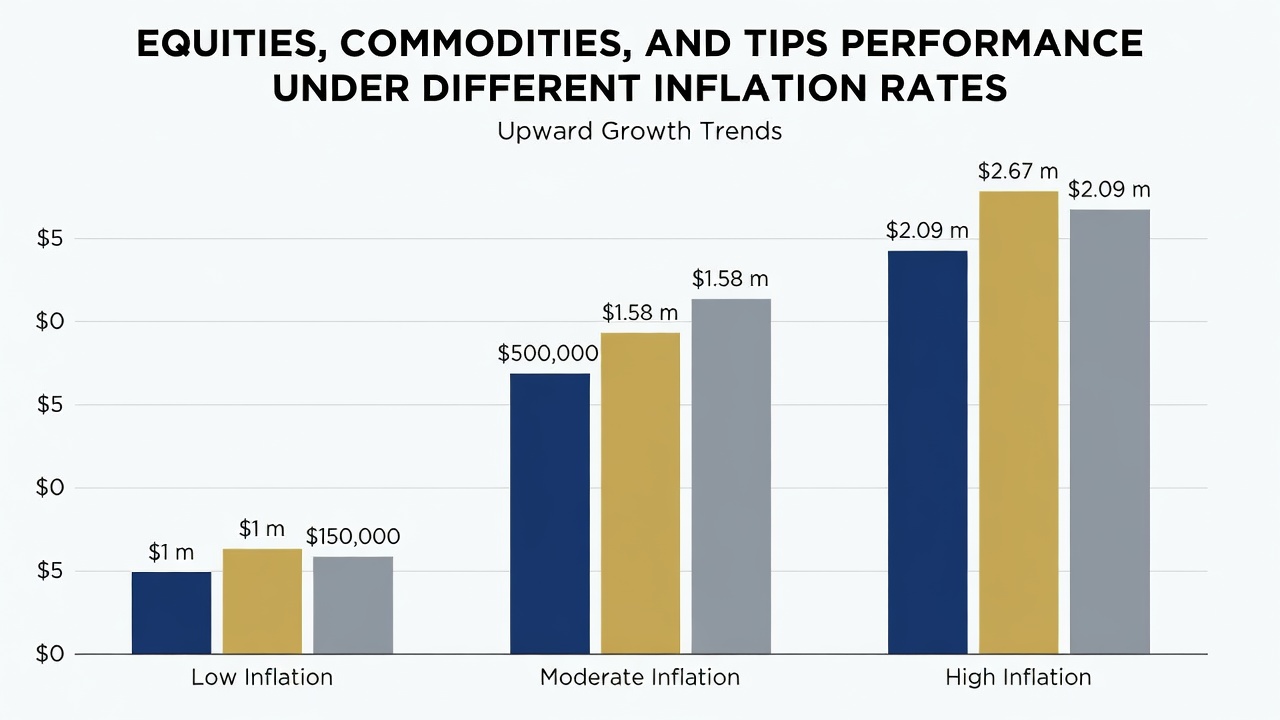
Side-by-Side Comparison: Equities, Commodities, and TIPS
- Equities: Historically deliver strong real returns through earnings growth, though short-term volatility can challenge FI plans during high inflation periods. Broad market indexes like the S&P 500 have averaged around 7% real returns over long periods, but individual stocks in defensive industries provide better stability.
- Commodities: Provide direct inflation correlation via price increases in energy and materials, offering diversification but with higher volatility than stocks. Gold and oil often serve as classic hedges, though storage costs and lack of dividends reduce compounding efficiency compared to equities.
- TIPS: Treasury Inflation-Protected Securities adjust principal and interest with CPI changes, guaranteeing real returns while preserving capital for conservative FI portfolios. Their yields have fluctuated, but they excel in protecting against unexpected inflation spikes without sacrificing safety.
Equities often lead in moderate inflation environments, while commodities and TIPS shine during spikes above 4%. Combining all three creates a resilient core that supports steady compounding regardless of economic cycles.
Step-by-Step Guide to Stress-Testing Investments Against Inflation Scenarios
- Define baseline assumptions using current economic data from authoritative sources like the Federal Reserve. Gather historical inflation averages and forward-looking estimates.
- Project portfolio values under low, medium, and high inflation paths over 10-30 years using spreadsheet tools or financial software. Include variables for contribution rates and withdrawal needs.
- Incorporate withdrawal rates and test sustainability using Monte Carlo simulations or spreadsheet models to account for market variability.
- Adjust allocations iteratively based on shortfall risks identified in each scenario, such as increasing TIPS exposure if high-inflation cases show depletion.
- Document triggers for reallocation, such as inflation exceeding 5% for two consecutive quarters, and review annually with professional input if needed.
Real-World Numerical Examples Using 2026 Projections
Imagine an investor starting with $500,000 aiming for FI in 15 years. Under a 3% inflation baseline with 8% nominal returns, the portfolio grows to about $1.58 million in real terms. If inflation rises to 5%, real growth slows, requiring an extra $150,000 in contributions or delayed retirement by three years. These examples underscore the value of dynamic adjustments, such as adding commodity ETFs during forecasted supply disruptions.
Actionable Checklist for Immediate Implementation
- Review current portfolio for inflation exposure using real return metrics and categorize holdings by inflation sensitivity.
- Allocate at least 15% to TIPS or similar protected instruments via TreasuryDirect to build a foundation of guaranteed real growth.
- Stress-test three inflation scenarios this week using free online calculators and refine based on personal risk tolerance.
- Schedule quarterly rebalancing reminders and track performance against inflation benchmarks.
- Educate yourself further with resources from the U.S. Securities and Exchange Commission on inflation-protected products.
- Consult tax implications of reallocations to avoid eroding compounding through unnecessary fees.
FAQ: Common Myths About Inflation and Compounding
Myth 1: Cash savings keep pace with inflation. Reality: Most savings accounts offer rates below inflation, leading to negative real returns and stalled compounding over time.
Myth 2: Equities always outperform inflation long-term. Reality: While true historically, sector selection and valuation matter; broad diversification is key to consistent results.
Myth 3: TIPS eliminate all inflation risk. Reality: They protect principal but may lag in very low inflation or deflationary periods, requiring complementary assets.
Myth 4: Commodities are too volatile for FI portfolios. Reality: When limited to 20-30% allocation, they enhance overall stability without derailing long-term compounding.
Mistakes to Avoid When Implementing These Strategies
Common pitfalls include over-allocating to one asset class, ignoring fees that compound negatively, and failing to update projections annually. Avoid chasing recent high performers without stress-testing them first. Another error is neglecting international diversification, which can leave portfolios vulnerable to domestic inflation spikes.
Conclusion: Building Resilience for 2026 and Beyond
By integrating inflation-adjusted allocations, rigorous stress-testing, and ongoing monitoring, investors can safeguard compounding growth against rising prices. Start applying these strategies today to strengthen your path to financial independence and achieve lasting security.

No comments yet. Be the first!