 Bullish Portfolio
Introduction to Compounding Frequency and Financial Independence
Financial independence requires strategic decisions about how returns are calculated and reinvested over decades. Compounding frequency determines how often interest or investment gains are added to the principal, directly influencing the speed at which wealth accumulates. This comprehensive guide examines the mathematical impact of different frequencies, provides concrete examples across multiple time horizons and rates, and offers practical steps to optimize accounts for faster independence. Whether you are managing a retirement portfolio, high-yield savings, or taxable brokerage accounts, understanding these mechanics can add thousands of dollars to your net worth without increasing contributions or taking additional risk.
Understanding the Mechanics of Compounding
Compounding occurs when earnings generate additional earnings on top of the original principal. The core formula is A = P(1 + r/n)^(nt), where A is the future amount, P is the principal, r is the annual rate, n is the compounding frequency per year, and t is time in years. Higher n values accelerate growth because interest is calculated and added more often. Continuous compounding uses the limit as n approaches infinity, represented by A = Pe^(rt). Even small differences in n become substantial over 20 or 30 years because each additional compounding period allows earlier earnings to begin earning returns themselves.
Daily vs. Annual Compounding Breakdowns
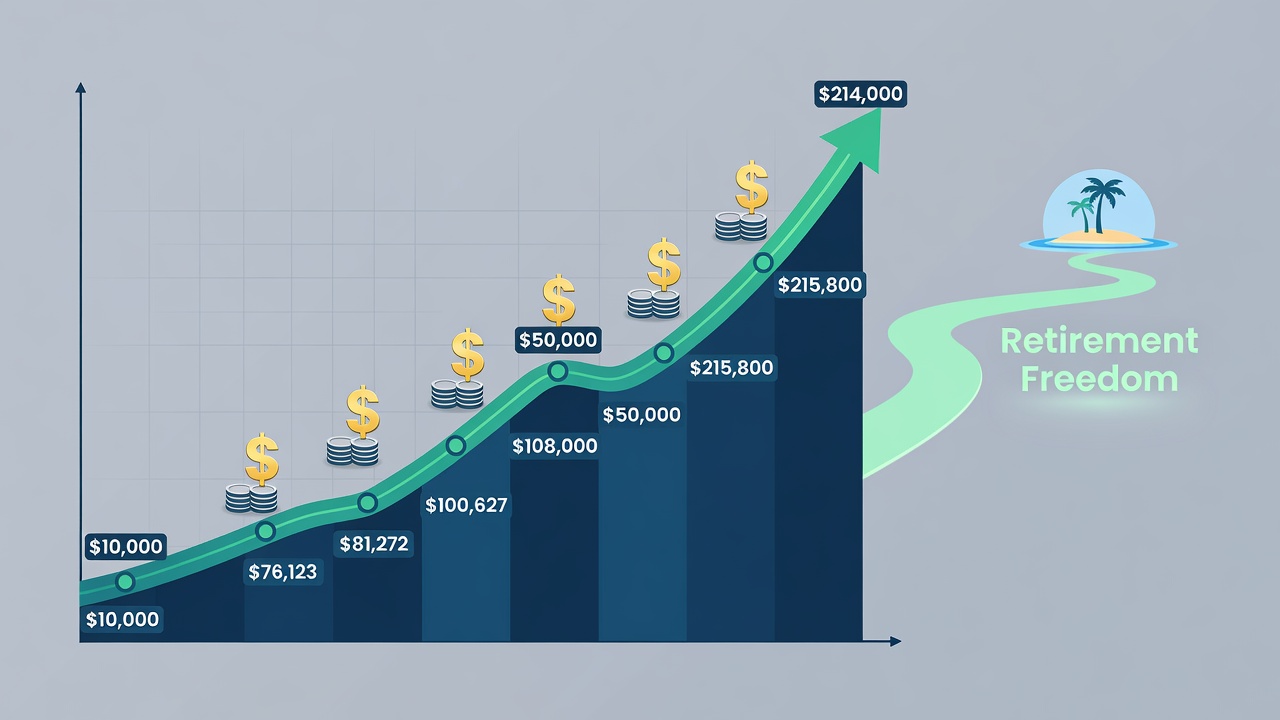
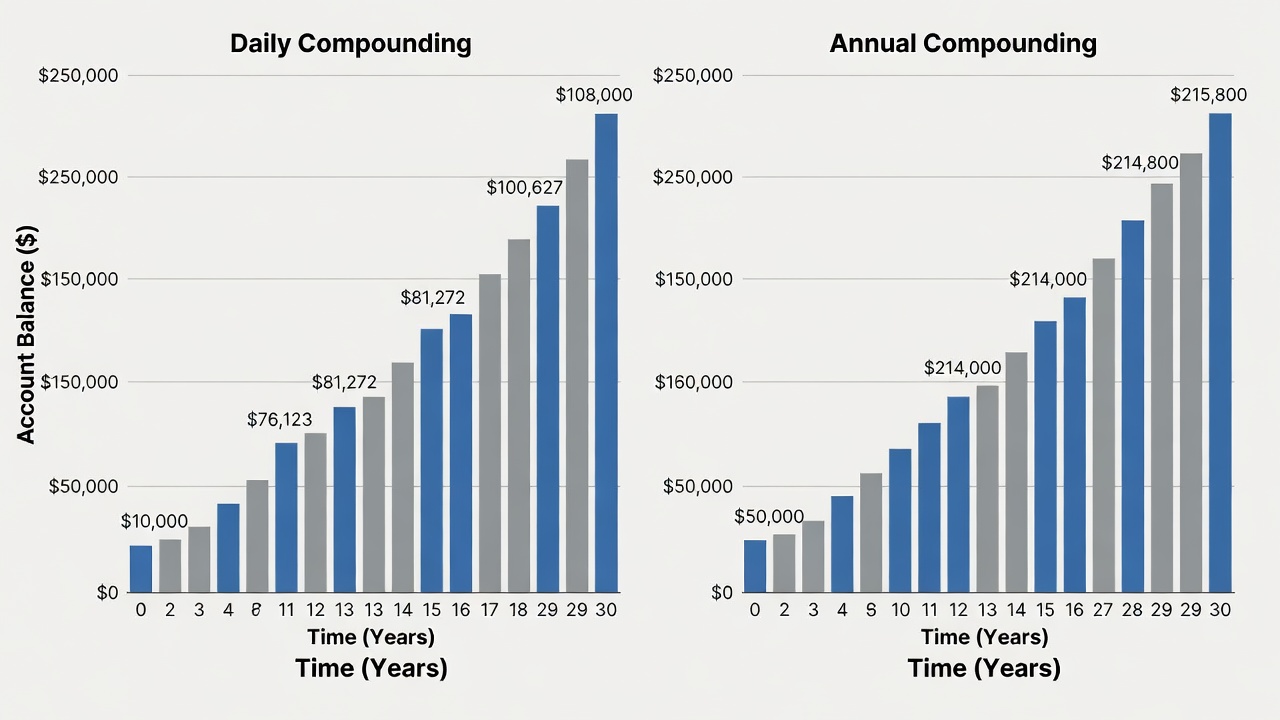
Annual compounding applies interest once per year, while daily compounding applies it 365 times. Over decades, the difference compounds significantly. For a $10,000 investment at 7% over 30 years, annual compounding yields approximately $76,123, whereas daily compounding produces about $81,272. The extra frequency captures incremental gains that annual methods miss. When the rate rises to 8%, the gap widens further: annual reaches $100,627 while daily reaches $108,000. Investors should always request the effective annual yield (APY) rather than the nominal rate to see the true impact of frequency.
Real Investment Examples with Growth Comparisons
Consider two investors starting with $50,000 at a 6% annual rate for 25 years. The monthly compounding account grows to roughly $215,800 while annual compounding reaches $214,000. Extending the horizon to 35 years increases the monthly advantage to nearly $12,000. Another scenario involves $100,000 at 5% for 20 years: quarterly compounding yields $265,330 compared with $265,330 for annual, but daily pushes the total to $271,800. Side-by-side tables in tools like online calculators reveal how even small frequency increases matter over long horizons. These differences become more pronounced when contributions are added regularly through dollar-cost averaging.
Step-by-Step Frequency Selection Process
- Assess your current accounts and note existing compounding terms listed in the fine print or account agreements.
- Compare available options across banks, brokerages, and retirement plans by requesting APY disclosures for each product.
- Calculate projected outcomes using the compound interest formula or free online tools from reputable sources, inputting your exact principal, rate, time horizon, and contribution schedule.
- Factor in fees, liquidity needs, and tax implications before switching, as early withdrawal penalties can erase frequency benefits.
- Implement changes by transferring funds or adjusting reinvestment settings and monitor performance annually against benchmarks.
Actionable Tips for Adjusting Accounts
Move high-yield savings to institutions offering daily compounding such as many online banks. In retirement accounts like IRAs, confirm dividend reinvestment settings to mimic higher frequency automatically. Review brokerage statements to ensure automatic reinvestment of interest or distributions occurs on the same day they are received. For real estate or peer-to-peer lending, seek platforms that credit returns monthly or quarterly rather than annually. Consider Treasury bills and money market funds that often compound daily through their pricing mechanisms. Rebalance tax-advantaged accounts first since they allow compounding without annual tax drag.
Potential Pitfalls to Avoid
Overlooking fees that erode compounding benefits is common; even 0.5% annual expense ratios can offset frequency advantages. Switching accounts too frequently can trigger taxes or penalties that reduce overall growth. Ignoring inflation-adjusted returns leads to overstated expectations of purchasing power at retirement. Always verify the effective annual rate rather than nominal rates advertised by financial institutions. Another frequent mistake is assuming all high-interest accounts compound daily; some traditional banks still use quarterly or annual schedules despite competitive headline rates.
Tools and Calculators for Accurate Projections
Free compound interest calculators available on financial education sites allow users to model daily, monthly, quarterly, and annual scenarios side by side. Spreadsheet software can replicate the formula with custom contribution schedules. When evaluating new accounts, request the APY calculation method in writing. Government resources such as those from the Federal Reserve explain how different compounding conventions affect consumer products. Investors can also consult detailed guides at Investopedia for deeper mathematical breakdowns and historical examples of compounding effects.
FAQ: Common Timing Questions
How often should I check compounding frequency?
Review account terms annually or when rates change significantly. Small adjustments made early in an investment timeline produce the largest long-term differences.
Does frequency matter more than the interest rate?
Rate remains primary, but frequency amplifies its effect, especially over 20+ years. A 0.25% rate increase with daily compounding often outperforms a higher nominal rate with annual compounding.
Can I change compounding frequency mid-investment?
Some accounts allow transfers to higher-frequency products; others require closing and reopening. Consult plan documents first to avoid tax events.
What about taxes on compounded gains?
Tax-deferred accounts like 401(k)s and IRAs let compounding occur without annual tax drag. See official guidance at IRS.gov.
Is continuous compounding available to retail investors?
While theoretical, some money market funds and certain brokerage cash sweeps approximate continuous compounding through daily crediting.
How do contributions interact with compounding frequency?
More frequent contributions benefit from higher compounding frequencies because new money begins earning returns sooner within each period.
Conclusion
Optimizing compounding frequency is a high-impact, low-effort lever for reaching financial independence sooner. By understanding the math, running personalized comparisons across multiple scenarios, and making targeted account adjustments, investors can maximize every dollar's growth potential without increasing risk or contributions. Consistent application of these principles compounds into meaningful wealth over a lifetime of saving and investing.
No comments yet. Be the first!