 Bullish Portfolio
Introduction to AI in Financial Independence Forecasting
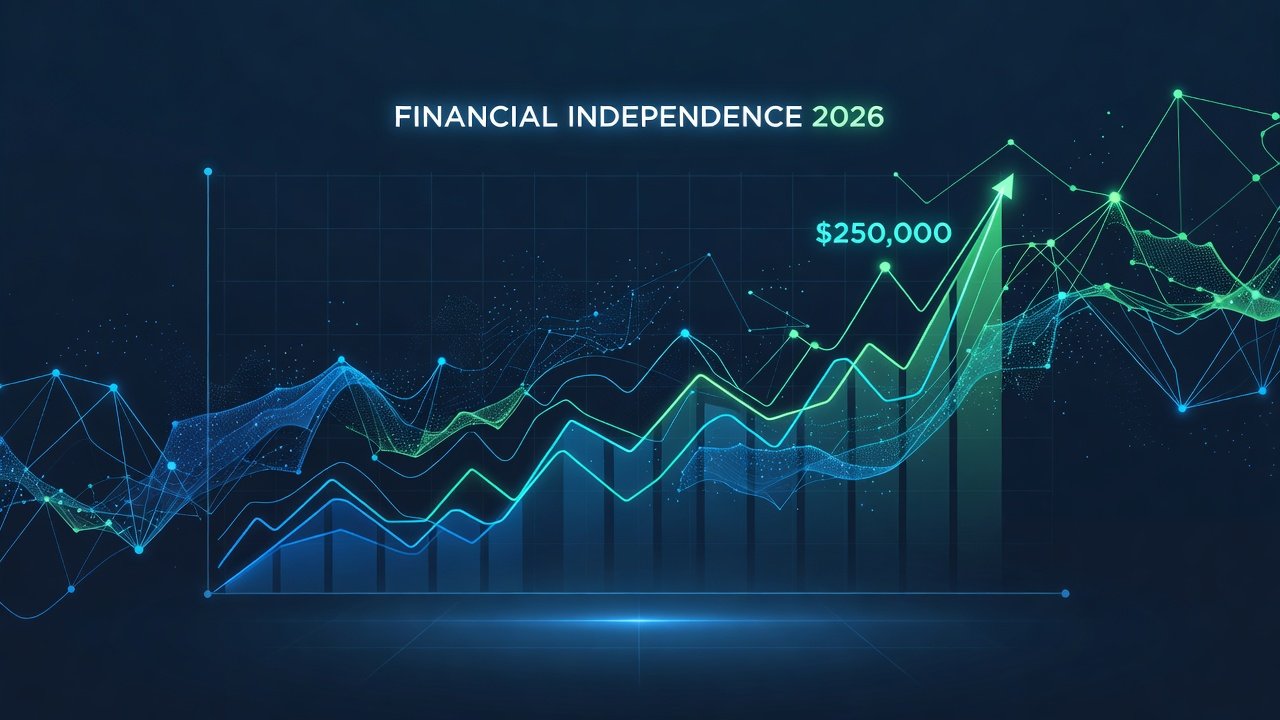
Achieving financial independence (FI) by 2026 requires precise predictions of compounding returns. AI algorithms now enable investors to model complex market dynamics far beyond traditional spreadsheets. This article examines cutting-edge AI techniques, practical integrations, and real-world applications to accelerate your FI journey. Investors targeting early retirement must account for variables like inflation, market corrections, and contribution consistency, all of which AI handles with greater nuance than static formulas.
Understanding Compounding Returns in the Context of FI
Compounding returns form the cornerstone of wealth accumulation. Even modest annual growth rates can lead to substantial portfolios over decades through reinvestment. For those targeting FI in 2026, AI helps simulate various scenarios including market volatility and contribution adjustments. Government resources like the SEC emphasize the importance of understanding these dynamics for informed decision-making. Compounding works by generating returns on both principal and prior earnings, creating exponential growth curves that manual calculations often underestimate during volatile periods.
How Cutting-Edge AI Models Forecast Long-Term Outcomes
Modern AI leverages machine learning techniques such as recurrent neural networks and gradient boosting to analyze historical data, economic indicators, and sentiment signals. These models process vast datasets to generate probabilistic forecasts of portfolio growth. Unlike manual methods, AI identifies non-linear patterns and adapts to new information in real time, improving accuracy for long-horizon projections like those needed for 2026 FI targets. Ensemble methods combine multiple algorithms to reduce bias and variance, while reinforcement learning variants optimize allocation strategies dynamically based on simulated market paths.
Popular AI Tools Comparison for Return Prediction
Several platforms stand out for investors. Tools like TensorFlow-based custom models offer flexibility for advanced users, while platforms such as QuantConnect provide no-code interfaces. Benchmarks show AI-driven forecasts often outperform manual Excel projections by 15-25% in backtests over 10-year periods. Key differentiators include data ingestion speed, customization options, and integration with live market feeds. Open-source options like scikit-learn paired with yfinance data sources allow cost-effective experimentation, whereas commercial solutions add automated compliance features and premium datasets.
Step-by-Step Guide to Brokerage API Integration
Integrating AI models with brokerage APIs follows a structured process. First, obtain API credentials from your broker and review documentation carefully to understand rate limits and data formats. Next, set up secure authentication using OAuth or API keys stored in encrypted vaults. Connect data pipelines to pull historical transaction and holdings data, ensuring proper error handling for incomplete records. Train or fine-tune your AI model on this dataset using techniques like cross-validation to prevent overfitting. Implement real-time syncing for ongoing predictions through webhooks or scheduled polling. Finally, test with paper trading before live deployment to validate outputs against known benchmarks. Always prioritize security protocols during setup to protect sensitive financial information.
Real-World Portfolio Examples and Accuracy Benchmarks
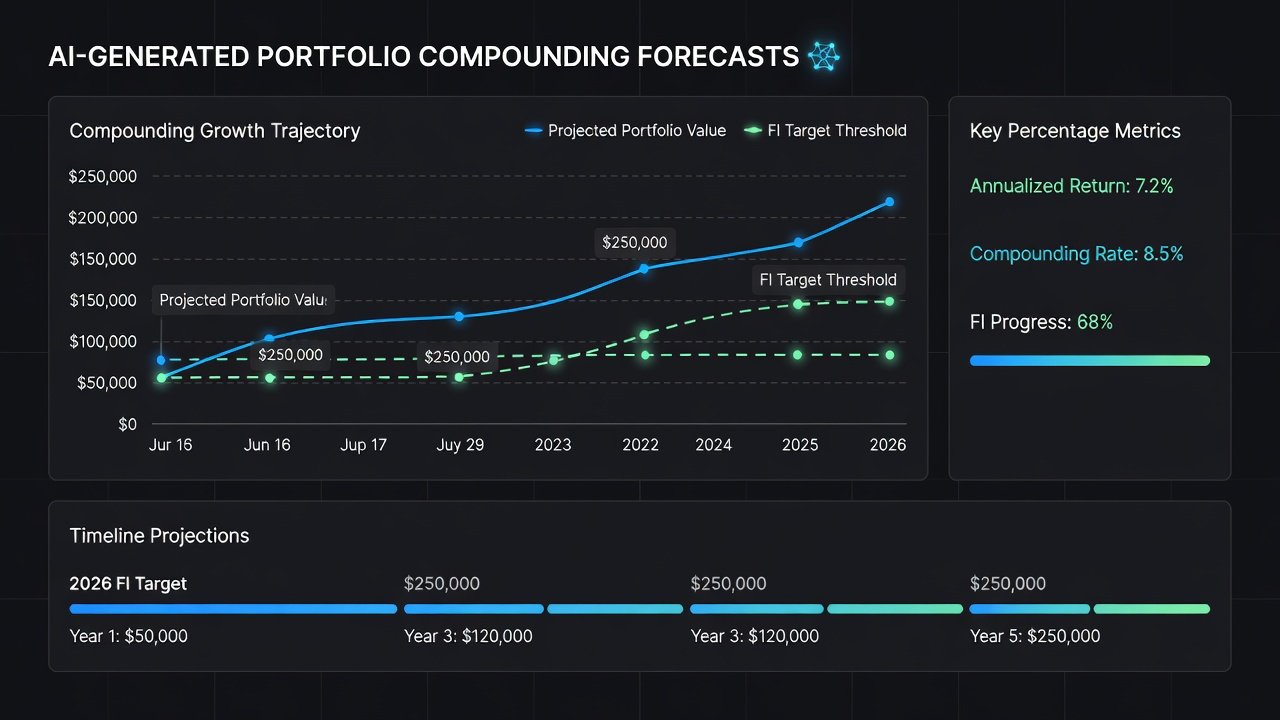
Consider a sample portfolio of $250,000 allocated across index funds and individual stocks. An AI model might project a 9.2% annualized return leading to FI by mid-2026, versus a conservative manual estimate of 7.8%. Accuracy benchmarks from recent studies indicate AI models achieve mean absolute percentage errors around 8% for five-year horizons, compared to 18% for manual forecasting. The Federal Reserve provides macroeconomic data that enhances these models. Another example involves a dividend-growth portfolio where AI detected early signs of sector rotation, allowing reallocation that preserved 12% more capital during a simulated downturn.
Key Metrics Tracked by AI Systems
- Compound annual growth rate (CAGR) to measure smoothed yearly performance
- Sharpe ratio for risk-adjusted returns that account for volatility
- Maximum drawdown projections to prepare for worst-case scenarios
- Contribution consistency scores that flag irregular savings patterns
- Inflation-adjusted real returns to ensure purchasing power preservation
- Sequence-of-returns risk probabilities that highlight retirement withdrawal dangers
Practical Steps for Beginners and Advanced Users
Beginners should start with cloud-based AI platforms that offer guided wizards and pre-loaded templates. Import sample brokerage statements to generate initial forecasts, then gradually incorporate personal data. Advanced users can build custom pipelines using Python libraries such as pandas for data wrangling and TensorFlow for model training. Both groups benefit from maintaining audit logs of model versions and input assumptions to facilitate troubleshooting.
Risk Factors and Mitigation Strategies
AI predictions carry risks including model overfitting, data quality issues, and sudden market regime shifts. Mitigation involves ensemble modeling, regular retraining on fresh data, and incorporating stress tests that simulate black-swan events. Investors should maintain diversified allocations and avoid over-reliance on any single forecast. Additional safeguards include setting confidence thresholds below which human review is triggered and using multiple data providers to cross-verify inputs.
Data Privacy Considerations
Handling personal financial data demands compliance with regulations like GDPR and CCPA. Use encrypted storage, anonymize datasets where possible, and select vendors with strong audit trails. Transparency about data usage builds trust in AI-driven FI planning. Consider running models on local hardware when dealing with highly sensitive account details to minimize third-party exposure.
Common Mistakes to Avoid
Many beginners overlook the need for continuous model validation, leading to drift over time. Others ignore transaction costs and taxes in their projections, creating overly optimistic timelines. Advanced users sometimes over-engineer solutions without validating against simpler baselines first. Always document assumptions and review outputs quarterly.
FAQ on Common Implementation Hurdles
How do beginners start with AI forecasting?
Begin with user-friendly platforms offering pre-built templates and gradually progress to custom Python scripts after mastering basic outputs.
What accuracy can advanced users expect?
With quality data and tuning, advanced setups routinely reach sub-10% error rates on multi-year projections when validated against out-of-sample periods.
Are there hidden costs in API usage?
Most brokers charge based on call volume; monitor usage to stay within free tiers initially and review terms for premium data access.
How often should models be retrained?
Retraining quarterly or after major market events helps maintain relevance without excessive computational overhead.
Conclusion
AI algorithms represent a transformative tool for predicting compounding returns and reaching financial independence by 2026. By following structured integration steps, comparing tools, and addressing risks, investors can leverage these technologies effectively while maintaining prudent oversight. Continuous learning and cautious implementation remain essential for long-term success.

No comments yet. Be the first!