 Bullish Portfolio

Introduction to Coordinating Pensions, Roth IRAs, and 401(k)s in 2026
Retirement planning in 2026 requires careful coordination of traditional pensions with modern tax-advantaged accounts like Roth IRAs and 401(k)s. This approach helps maximize after-tax income while minimizing risks from market volatility and tax changes. Many retirees now blend these vehicles to create reliable income streams that adapt to evolving IRS rules and personal circumstances. Pensions provide guaranteed monthly payments, but they often come with limited flexibility and potential tax inefficiencies when combined with other accounts. Roth IRAs offer tax-free growth and withdrawals, while 401(k)s provide tax-deferred growth with employer matching opportunities. Successfully integrating all three demands attention to timing, tax brackets, and income needs projections.
Understanding how pensions interact with Roth conversions, contribution limits, and tax brackets is essential. This guide provides step-by-step strategies, real-world examples, and a comparison of growth characteristics to help you build a resilient retirement plan that accounts for longevity, inflation, and changing tax laws.
Understanding Pension Offsets and Their Impact
Traditional pensions often reduce other retirement benefits through offsets, particularly with Social Security. These reductions can affect overall income if not planned correctly. In 2026, retirees should calculate net pension income after any offsets to determine how much to draw from Roth IRAs or 401(k)s. Offsets occur when pension payments are considered in benefit formulas, potentially lowering Social Security amounts by up to two-thirds in some cases. Review your pension summary plan description early and model scenarios to avoid surprises.
Practical steps include reviewing your pension summary plan description and using Social Security Administration tools to model combined benefits. This ensures you avoid over-reliance on any single source and maintain balanced cash flow throughout retirement.
Timing Roth Conversions Alongside Pension Income
Roth conversions can be powerful but must align with pension payments to stay in lower tax brackets. Pension income counts toward your modified adjusted gross income, potentially pushing you into higher brackets during conversion years. Spreading conversions strategically over multiple tax years prevents bracket creep and reduces future required minimum distributions. Consider converting during years when pension payments are lower or before required minimum distributions begin. A common strategy is spreading conversions over several years while monitoring annual tax brackets. For example, a retiree receiving $40,000 annually from a pension might convert $20,000 from a traditional 401(k) in a year with room in the 12% bracket, then pause if pension income rises due to cost-of-living adjustments.
Additional considerations include the impact on Medicare premiums, which are based on income from two years prior. Monitoring provisional income helps retirees time conversions to avoid surcharges while still achieving long-term tax-free income goals.
Contribution Strategies for 2026
Even with a pension, maximizing 401(k) and Roth IRA contributions remains valuable. Focus on catch-up contributions if you are age 50 or older. Coordinate employer matches with pension accrual to avoid double-dipping on tax-deferred growth. Many plans allow after-tax contributions that can be converted to Roth accounts inside the 401(k), creating additional tax-free growth opportunities.
- Maximize 401(k) deferrals up to annual limits while accounting for pension income stability.
- Use backdoor Roth strategies if income exceeds direct Roth IRA contribution thresholds.
- Rebalance taxable accounts to fund Roth conversions without increasing overall tax liability.
- Review plan documents annually for changes in matching formulas or contribution caps that could affect coordination with pension income.
Tax Bracket Management and Combined Income Planning
Calculating combined income needs starts with projecting all sources: pension, Social Security, 401(k) withdrawals, and Roth distributions. Aim to fill lower tax brackets strategically. Retirees often benefit from maintaining a mix of taxable, tax-deferred, and tax-free accounts to control annual tax exposure. In practice, this might mean drawing from taxable brokerage accounts first in early retirement, then layering pension and 401(k) income, and finally using Roth accounts for flexibility.
Real-world example: A couple with a $50,000 pension and $30,000 in projected Social Security might draw $15,000 from a 401(k) in early retirement to manage brackets, then shift to Roth withdrawals later for tax-free income. Another scenario involves a single retiree who delays Social Security until age 70 while using pension income and modest Roth conversions to bridge the gap, ultimately increasing lifetime benefits.
Managing Required Minimum Distributions with Pension Income
Required minimum distributions from 401(k)s and traditional IRAs begin at age 73 in 2026. Pension income can complicate RMD calculations because it adds to taxable income. One effective approach is to use qualified charitable distributions from IRAs to satisfy RMDs without increasing taxable income, provided the charity qualifies. Another tactic involves converting portions of the 401(k) to Roth before RMD age to reduce the balance subject to mandatory withdrawals.
Real-World Examples of Blending These Vehicles
Consider a 68-year-old engineer with a $55,000 annual pension who also accumulated $800,000 in a 401(k) and $150,000 in a Roth IRA. By converting $25,000 annually from the 401(k) over four years while living primarily on pension income, he stayed in the 12% bracket and reduced future RMD pressure. A second example involves a teacher couple whose combined pensions total $70,000. They maximized catch-up contributions to their 401(k)s during their final working years and used Roth conversions during low-income years to create a tax-free bucket for healthcare expenses later in retirement.
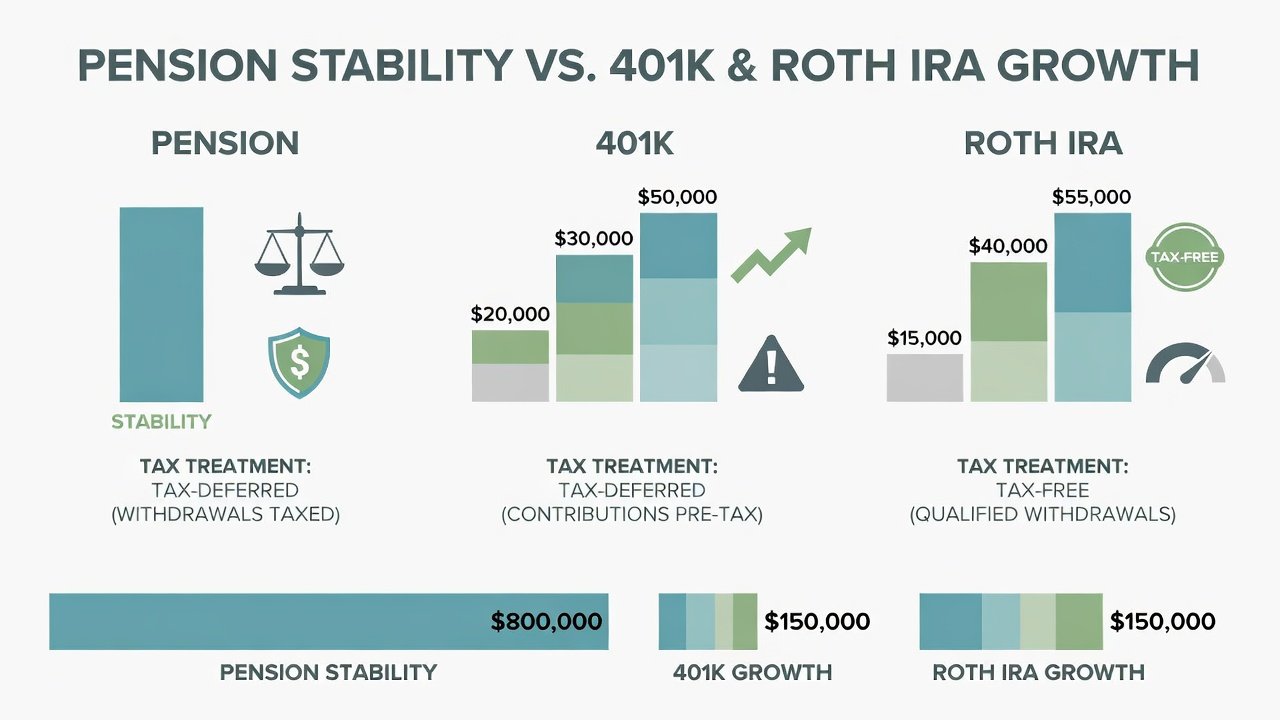
Comparison of Pension vs. 401(k)/Roth Growth
| Feature | Pension | 401(k)/Roth IRA |
|---|---|---|
| Growth Type | Guaranteed, defined benefit | Market-dependent, defined contribution |
| Tax Treatment | Taxed as ordinary income | Traditional: taxed on withdrawal; Roth: tax-free |
| Risk Level | Low (employer-funded) | Higher (investment risk) |
| Flexibility | Fixed payments | Withdraw anytime (with rules) |
Practical Steps for Calculating Combined Income Needs
- List all guaranteed income sources including pensions and any cost-of-living adjustments.
- Estimate essential and discretionary expenses with inflation adjustments applied annually.
- Model tax scenarios using current IRS brackets and projected future rates.
- Stress-test for inflation, market downturns, and longevity beyond age 95.
- Adjust Roth conversion timing annually based on actual income received.
- Consult updated IRS publications each year for any regulatory changes.
Mistakes to Avoid When Coordinating These Accounts
One frequent error is ignoring the interaction between pension income and Medicare IRMAA surcharges. Another is failing to account for state taxes on pension distributions in states that do not conform to federal rules. Retirees also sometimes overlook the opportunity to use Roth accounts for tax diversification during high-tax years. Always maintain records of basis in nondeductible IRA contributions to support backdoor Roth strategies.
Common Pitfalls and IRS Rules in the FAQ
What happens if I convert too much from my 401(k) while receiving pension income?
Excess conversions can trigger higher Medicare premiums and taxes. Always model net income after conversions and consider provisional income limits.
Can I contribute to a Roth IRA if I have pension income?
Yes, as long as you meet earned income requirements or use backdoor strategies. Pension income itself does not count as earned income for contribution purposes.
Are there IRS rules limiting pension and 401(k) coordination?
Review IRS retirement plan publications for required minimum distribution rules and contribution limits that apply across accounts. The Department of Labor also provides oversight on pension plans.
How do early retirement withdrawals affect coordination?
Withdrawals before age 59½ may incur penalties unless exceptions apply. Plan conversions and distributions carefully around pension start dates.
Conclusion
Coordinating pensions with Roth IRAs and 401(k)s in 2026 creates a balanced retirement portfolio focused on tax efficiency and risk management. By timing conversions, managing brackets, handling RMDs, and using practical calculation steps, retirees can optimize multiple income streams for long-term security. Real-world examples demonstrate the value of proactive planning. Consult a tax professional or financial advisor to tailor these strategies to your specific situation and stay updated on any 2026 regulatory adjustments.


No comments yet. Be the first!