 Bullish Portfolio

Introduction to QCD Strategies in 2026
Qualified Charitable Distributions (QCDs) offer retirees aged 70½ and older a powerful way to support causes they care about while reducing their tax burden. In 2026, these rules remain a key part of advanced retirement planning, especially when paired with Roth IRA and 401k accounts. Unlike standard donations, QCDs allow direct transfers from retirement accounts to qualified charities without counting as taxable income.
This approach is particularly valuable for those who take required minimum distributions (RMDs) but do not need the full amount for living expenses. By directing funds straight to charity, retirees can lower their adjusted gross income and potentially reduce Medicare premiums or other tax-related costs.
Understanding QCD Eligibility Rules
To qualify for a QCD, you must be at least 70½ years old on the date of the distribution. The charity must be a 501(c)(3) organization recognized by the IRS, and the transfer must go directly from the retirement account custodian to the charity. Personal contributions made after age 70½ cannot be used for QCDs, though pre-age 70½ contributions remain eligible.
Both traditional IRAs and Roth IRAs can support QCDs, but Roth accounts often provide additional tax advantages because qualified withdrawals are already tax-free. For 401k plans, direct QCDs are not always available, so many retirees first roll over funds into an IRA.
Step-by-Step Setup for Roth IRA QCDs
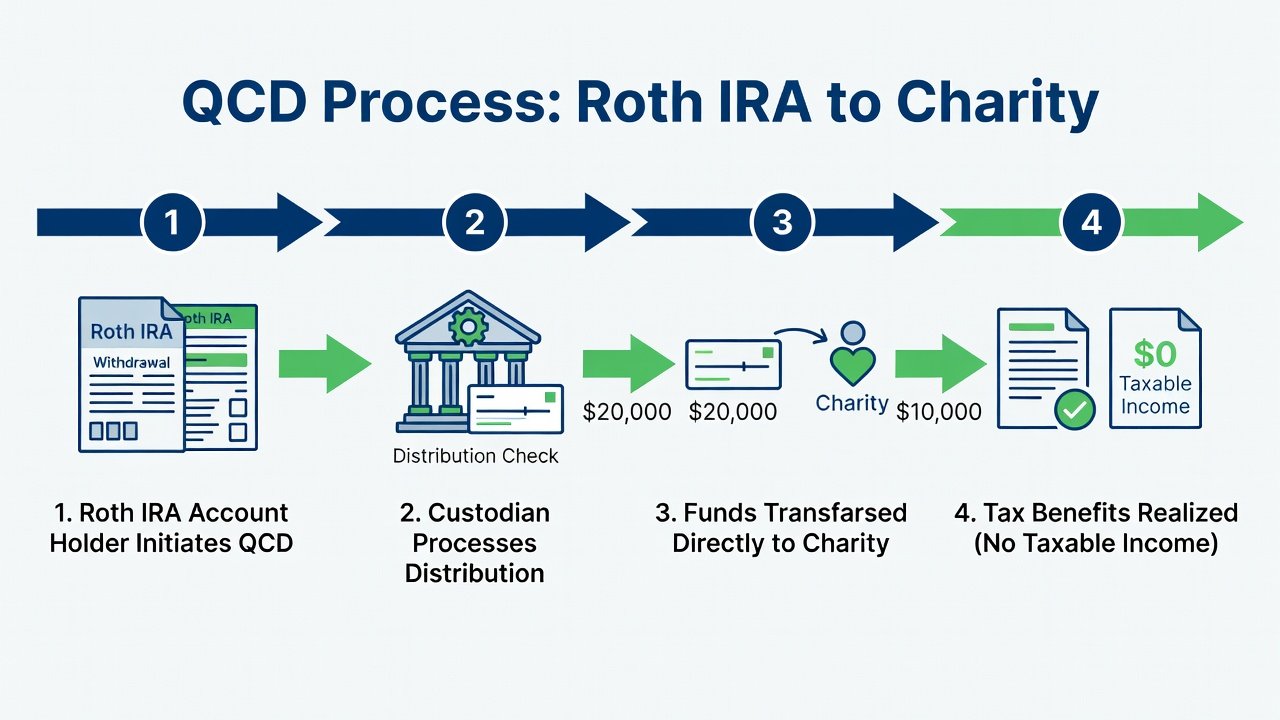
Setting up a QCD from a Roth IRA involves several clear steps. First, confirm your age and contact your IRA custodian to request a QCD form. Provide the charity’s name, address, and tax ID. Specify the exact dollar amount and ensure the check is made payable directly to the charity.
Next, verify the distribution is coded correctly as a QCD on your 1099-R form. Keep records including the custodian’s confirmation and the charity’s acknowledgment letter. This documentation is essential for your tax return even though the amount is excluded from income.
Handling QCDs from 401k Accounts
Most 401k plans do not permit direct QCDs. The practical solution is to complete a rollover from the 401k to a traditional or Roth IRA first. Once the funds are in the IRA, follow the standard QCD process. Timing matters—complete the rollover at least 30 days before the desired QCD date to avoid processing delays.
After the rollover, treat the new IRA balance according to the same eligibility rules that apply to any other IRA. This two-step method expands options for 401k holders while maintaining full tax benefits.
Real-World Dollar Examples of Tax Savings
Consider a retiree with a $20,000 RMD who donates $10,000 via QCD. The full RMD is satisfied, but only $10,000 appears as taxable income. This strategy can keep the individual in a lower tax bracket and reduce the taxable portion of Social Security benefits. Another example involves a couple filing jointly who uses QCDs to cover their entire charitable giving budget, potentially saving thousands in federal income tax compared with writing checks from a taxable brokerage account.
Comparing QCDs to Standard Donations
Standard cash donations require itemizing deductions on Schedule A, which many retirees no longer do because of the higher standard deduction. QCDs bypass this requirement entirely because the distribution is excluded from income rather than claimed as a deduction. This difference makes QCDs more effective for taxpayers who take the standard deduction.
Additionally, QCDs do not trigger capital gains tax if the retirement account holds appreciated assets, unlike donations of stock from a taxable account. For retirees with large RMDs, QCDs provide a cleaner, more predictable tax outcome.
Integrating QCDs with Overall Withdrawal Plans
Successful retirement income planning treats QCDs as one component of a broader withdrawal strategy. Retirees should coordinate QCD timing with RMD deadlines, Social Security claiming ages, and Roth conversions. A common approach is to satisfy charitable giving goals first with QCDs, then withdraw additional amounts only as needed for living expenses.
Reviewing your full financial picture each year helps ensure QCDs align with changing tax brackets and Medicare IRMAA thresholds. Many financial planners recommend running multiple scenarios before finalizing the annual distribution schedule.
Practical Checklist for QCD Execution
- Confirm you are at least 70½ on the distribution date.
- Verify the recipient is an IRS-qualified charity.
- Request a direct transfer from your account custodian.
- Obtain written confirmation from the charity.
- Review your 1099-R for correct QCD coding.
- Keep all records for at least three years.
- Coordinate with your tax professional before year-end.
Common Pitfalls to Avoid
One frequent mistake is having the check made payable to the donor instead of the charity. Another error is using post-70½ contributions for the QCD, which disqualifies that portion. Failing to notify the custodian in advance can also delay processing and push the distribution into the next tax year. Always double-check the charity’s status and maintain clear communication with both the custodian and your tax advisor.
Short FAQ Section
Can I make a QCD from a Roth 401k directly?
Most Roth 401k plans do not allow direct QCDs. Rolling the balance into a Roth IRA first is the standard workaround.
Does a QCD count toward my RMD?
Yes. A QCD satisfies all or part of your required minimum distribution for the year.
Are there income limits for QCDs?
No income limits apply. Anyone 70½ or older may make QCDs regardless of total income.
Conclusion
Qualified Charitable Distributions remain one of the most tax-efficient ways for retirees to support charitable causes in 2026. By understanding eligibility, mastering the setup process for both Roth IRA and 401k accounts, and integrating QCDs into a comprehensive withdrawal plan, you can maximize tax savings while advancing philanthropic goals. Consult your financial advisor and tax professional to tailor these strategies to your specific situation.

No comments yet. Be the first!