 Bullish Portfolio

Introduction to Mid-Career Retirement Optimization in 2026
Mid-career professionals in their 40s and early 50s stand at a pivotal crossroads for retirement planning. With roughly 15 to 20 years remaining before typical retirement age, this phase offers the strongest opportunity to accelerate savings through strategic use of Roth IRA and 401k accounts. Peak earning years often coincide with higher tax brackets, family expenses, and mortgage obligations, yet they also provide the cash flow needed for aggressive contributions. This comprehensive guide examines contribution optimization, tax bracket management, employer match maximization, and asset allocation shifts tailored to 2026 rules and beyond.
By balancing traditional pre-tax contributions with Roth after-tax options, savers can create tax diversification that protects against future legislative changes. Integrating side income further expands possibilities, while early planning for catch-up contributions ensures seamless acceleration once eligible.
Contribution Optimization Techniques for 2026
Effective optimization begins with a clear hierarchy of priorities. First, secure the full employer match in your 401k plan because it delivers an immediate return with zero market risk. Second, fund a Roth IRA to establish a foundation of tax-free growth and withdrawals. Professionals exceeding direct Roth IRA income limits can implement backdoor Roth strategies by contributing to a traditional IRA and converting to Roth, though pro-rata rules require careful tracking of all IRA balances.
Additional optimization arises when side income streams such as consulting, freelance projects, or small business revenue are present. These allow funding of SEP IRAs or solo 401k plans that supplement primary employer-sponsored accounts. Track all earned income meticulously and coordinate contribution timing across multiple vehicles to avoid exceeding annual limits while maximizing tax advantages.
Practical Steps for Contribution Optimization
- Review your current 401k plan documents and confirm employer match percentage and vesting schedule.
- Calculate your available cash flow after essential expenses to determine sustainable contribution rates.
- Establish automatic payroll deductions for 401k and set up monthly Roth IRA transfers.
- Monitor quarterly statements and adjust contribution percentages annually or after major life events.
- Evaluate backdoor Roth eligibility each tax year and document all conversion steps for IRS compliance.
Tax Bracket Management Strategies
Tax bracket management requires forward-looking projections of both current and future marginal rates. In high-income years, directing more dollars into traditional 401k accounts reduces taxable income immediately. During lower-income periods, such as planned sabbaticals or phased retirement transitions, Roth conversions become advantageous because they lock in today's potentially lower rates for future tax-free growth.
Spreading conversions across several years prevents bracket creep and allows strategic use of the standard deduction. Mid-career savers should also consider the impact of state taxes and potential changes in federal tax law when timing these moves. Working with a tax professional ensures conversions align with overall financial goals without triggering unexpected Medicare premium surcharges later.
Employer Match Maximization
Employer matching funds represent the highest-priority retirement dollars available. Always contribute at least enough to receive 100 percent of the match, and review plan documents each year for formula changes or true-up provisions. Some plans calculate matches on a per-pay-period basis while others true up at year-end, meaning front-loaded contributions still receive full credit.
Understand vesting schedules thoroughly, especially if job changes are anticipated. Leaving before full vesting can forfeit valuable match dollars. Mid-career professionals should also explore whether their plan offers after-tax mega backdoor Roth contributions, which can dramatically increase tax-free retirement savings when available.
Asset Allocation Shifts for Mid-Career Investors
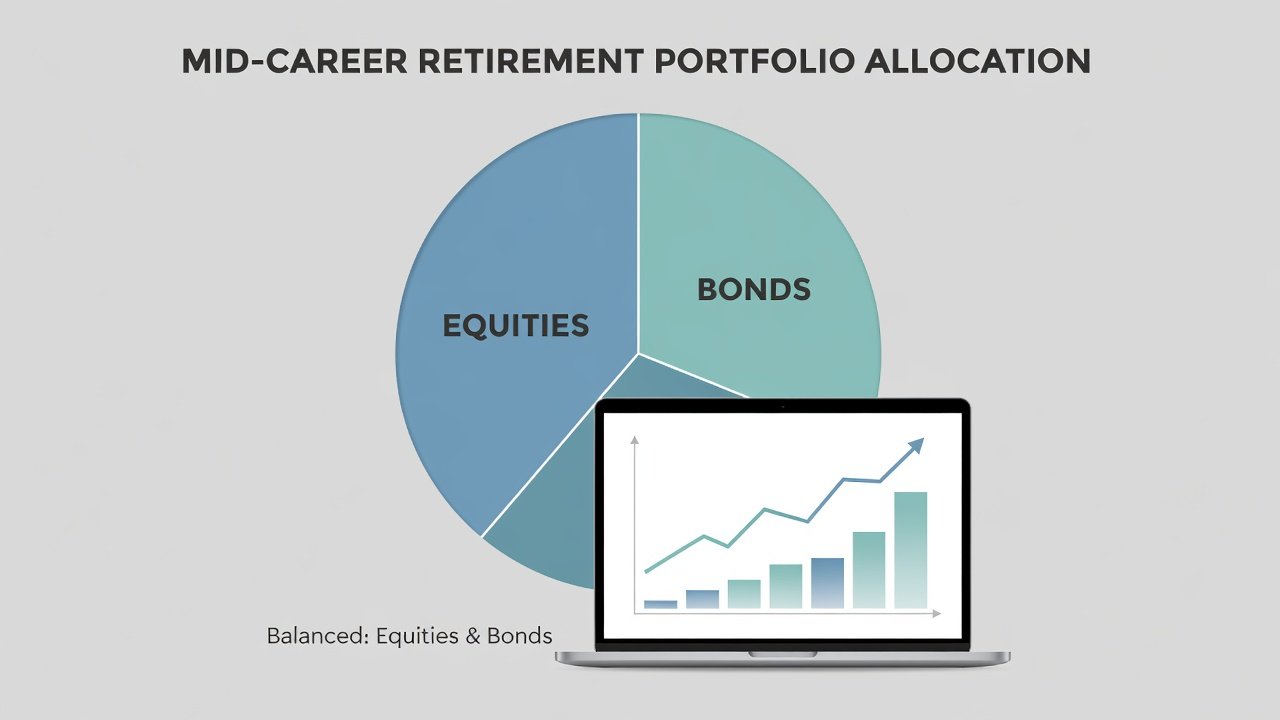
Asset allocation must evolve from aggressive growth in early career to balanced growth and preservation in mid-career. A typical glide path maintains 70 to 80 percent equities with the balance in bonds and alternative assets. Rebalance portfolios at least quarterly or when allocations drift more than five percentage points from targets. Consider both target-date funds for simplicity and custom portfolios for greater control.
Diversification across domestic, international, large-cap, small-cap, and growth versus value equities reduces single-market risk. Incorporating inflation-protected securities and modest alternative allocations can further stabilize returns during volatile periods.
Catch-Up Contribution Planning
Although catch-up contributions activate at age 50, mid-career professionals benefit from preparing years in advance. Maximize base contribution limits now, build liquid emergency reserves, and reduce outstanding high-interest debt. This preparation allows seamless transition into accelerated savings once catch-up eligibility begins, preserving lifestyle while rapidly closing retirement gaps.
Step-by-Step Contribution Calculators and Real-World Examples
Consider a hypothetical 45-year-old earning a stable salary with access to both 401k matching and Roth IRA options. Begin by securing the full employer match, then direct remaining available savings into a Roth IRA. Allocate the overall portfolio across broad index funds with quarterly rebalancing. Over a 20-year horizon, consistent application of this approach combined with moderate assumed market returns can generate substantial balances in both tax-deferred and tax-free accounts. Run multiple scenarios by varying contribution rates, expected returns, and inflation assumptions using reputable online retirement calculators.
Another example involves a professional with fluctuating side income. In high-revenue years, increase traditional 401k contributions to manage taxes, then convert portions during quieter years. Document every conversion and maintain separate Roth conversion ladders to manage future five-year distribution rules.
Mid-Career vs Early-Career Approaches
Early-career savers focus primarily on establishing consistent contribution habits and harnessing compound growth through aggressive equity allocations. Mid-career approaches shift emphasis toward optimization, tax efficiency, and preparation for catch-up provisions. The later stage rewards fine-tuning of contribution sources, careful Roth conversion timing, and gradual portfolio de-risking rather than pure accumulation speed.
Integrating Side Income Streams
Side businesses create powerful additional retirement funding channels. Self-employment income permits contributions to SEP IRAs or solo 401k plans beyond W-2 limits. Maintain accurate expense records, separate business banking, and consult tax advisors to maximize legitimate deductions while funding retirement accounts. These streams also provide flexibility during career transitions or economic downturns.
FAQ
- How does market volatility affect Roth IRA and 401k balances? Short-term market swings matter less than long-term participation and disciplined rebalancing. Dollar-cost averaging through automatic contributions reduces timing risk and allows accumulation of more shares during downturns.
- What are required minimum distributions (RMDs) and how do they impact Roth accounts? Traditional 401k and IRA accounts require RMDs beginning at age 73. Roth IRAs have no lifetime RMDs for the original owner, enabling continued tax-free growth and more flexible estate planning for beneficiaries.
- Can I contribute to both a 401k and Roth IRA simultaneously? Yes, provided total contributions respect annual limits and Roth IRA eligibility rules based on modified adjusted gross income.
- How should I adjust my plan during economic uncertainty? Maintain core contribution rates, avoid panic selling, and use volatility as an opportunity to rebalance toward target allocations. Review emergency fund adequacy before increasing investment risk.
Proactive mid-career planning positions individuals for greater financial freedom. Review official guidance from IRS.gov and SSA.gov regularly, and consult a fiduciary financial advisor for personalized implementation. Consistent execution of these strategies today builds lasting retirement security.

No comments yet. Be the first!