 Bullish Portfolio
Introduction to Global Diversification in Tax-Advantaged Accounts
Retirement planning in 2026 requires moving beyond U.S.-centric strategies. Incorporating international equities and bonds into Roth IRA and 401k accounts helps investors achieve genuine global diversification. This approach reduces reliance on domestic markets while capturing growth from developed and emerging economies worldwide. Many intermediate investors find that limiting exposure to U.S. assets leaves portfolios vulnerable to domestic recessions, policy changes, or sector-specific downturns. By spreading investments across continents, individuals can better weather volatility and position themselves for compounded growth over decades.
International diversification is not merely an add-on but a core principle for long-term retirement success. Tax-advantaged accounts like Roth IRAs and traditional 401ks provide an ideal environment because they shield investors from annual capital gains taxes and dividend distributions that would otherwise erode returns in taxable brokerage accounts.
Why Add International Assets to Roth IRAs and 401ks?
Global diversification spreads risk across currencies, economies, and regulatory environments. Historical data shows that portfolios with 20-40% international allocation often outperform domestic-only strategies during certain market cycles. In tax-advantaged accounts like Roth IRAs and 401ks, growth compounds without annual tax drag, making them ideal vehicles for foreign investments. For example, European markets may thrive during periods when U.S. valuations appear stretched, while Asian economies can deliver rapid expansion tied to manufacturing and technology booms.
Key benefits include access to sectors underrepresented in the U.S., such as European luxury goods or Asian technology manufacturing. Currency fluctuations can also provide additional return opportunities when hedged properly. However, investors must weigh these advantages against potential challenges like political instability or differing accounting standards. A well-constructed international sleeve can lower overall portfolio volatility while enhancing expected returns through exposure to uncorrelated assets.
Currency Hedging Options for International Holdings
Currency risk arises when foreign assets fluctuate due to exchange rate changes. Many investors use currency-hedged ETFs to mitigate this volatility. These products employ forward contracts to lock in exchange rates, stabilizing returns in U.S. dollar terms. Hedged funds appeal to conservative retirees who prioritize predictability over potential currency-driven gains.
Unhedged options may appeal to those comfortable with additional volatility for potential upside from favorable currency movements. The choice depends on individual risk tolerance and time horizon. For instance, a weakening U.S. dollar can boost unhedged international returns, while a strengthening dollar may erode them. Practical steps include reviewing the hedging ratio in each ETF prospectus and considering a mix of hedged and unhedged holdings to balance cost and protection.
Top Low-Cost International ETFs for Tax-Advantaged Accounts
Several low-cost ETFs provide broad international exposure suitable for Roth IRAs and 401ks. These funds typically carry expense ratios below 0.10% and focus on developed or emerging markets. Popular choices include funds tracking MSCI EAFE or FTSE All-World ex-US indexes. Investors should evaluate liquidity, dividend yield, and sector breakdown before committing capital.
Examples include broad developed-market ETFs that cover Europe, Japan, and Australia, as well as emerging-market funds targeting China, India, and Brazil. Always prioritize funds with tight bid-ask spreads and strong assets under management to minimize trading costs inside retirement accounts. Reviewing the latest holdings on provider websites ensures alignment with personal investment objectives.
Impact of Foreign Tax Withholding on Roth vs Traditional 401k Growth
Foreign governments often withhold taxes on dividends from international stocks. In Roth IRAs, these withheld taxes permanently reduce the account balance since contributions are after-tax. Traditional 401ks may allow some recovery through foreign tax credits on U.S. returns, though this benefit does not apply inside the account itself. The difference becomes pronounced with high-dividend international holdings, where cumulative withholding can meaningfully affect long-term compounding.
Consult official guidance from the IRS for current withholding rates and credit rules. Emerging market holdings often face higher withholding than developed markets. Investors holding bonds from foreign issuers may encounter additional tax complexities, making it wise to favor equity-focused international ETFs in Roth accounts where possible.
Allocation Models by Age
Younger investors might target 30-40% international exposure to maximize growth potential. Those nearing retirement could reduce this to 20-25% to prioritize stability. A common glide path gradually decreases international weighting as investors age. For a 35-year-old, an aggressive model might allocate 35% to international equities split between developed and emerging markets. By age 55, the same investor may shift toward 25% international with greater emphasis on hedged developed-market bonds.
These models should align with overall risk tolerance and other holdings outside retirement accounts. Regular reviews every three to five years help adjust for life changes such as inheritance or career shifts. Comparing sample allocations across age groups reveals how international exposure supports both growth and preservation phases of retirement planning.
Performance Comparisons Versus Domestic-Only Portfolios
Over rolling 10-year periods, diversified global portfolios have shown competitive returns with lower maximum drawdowns during U.S. market corrections. Domestic-only strategies performed strongly in recent years but may face headwinds from valuation concerns. For example, during periods of U.S. market leadership, international allocations may lag, yet they often recover strongly when global economic cycles shift in favor of non-U.S. economies.
Long-term comparisons highlight the value of rebalancing to maintain target allocations during market shifts. Investors can examine historical performance using tools from the Federal Reserve to understand how currency and market cycles influence outcomes. Such analysis underscores why global diversification remains a prudent strategy even when U.S. markets dominate headlines.
Sample $500k Portfolio with 30% International Exposure
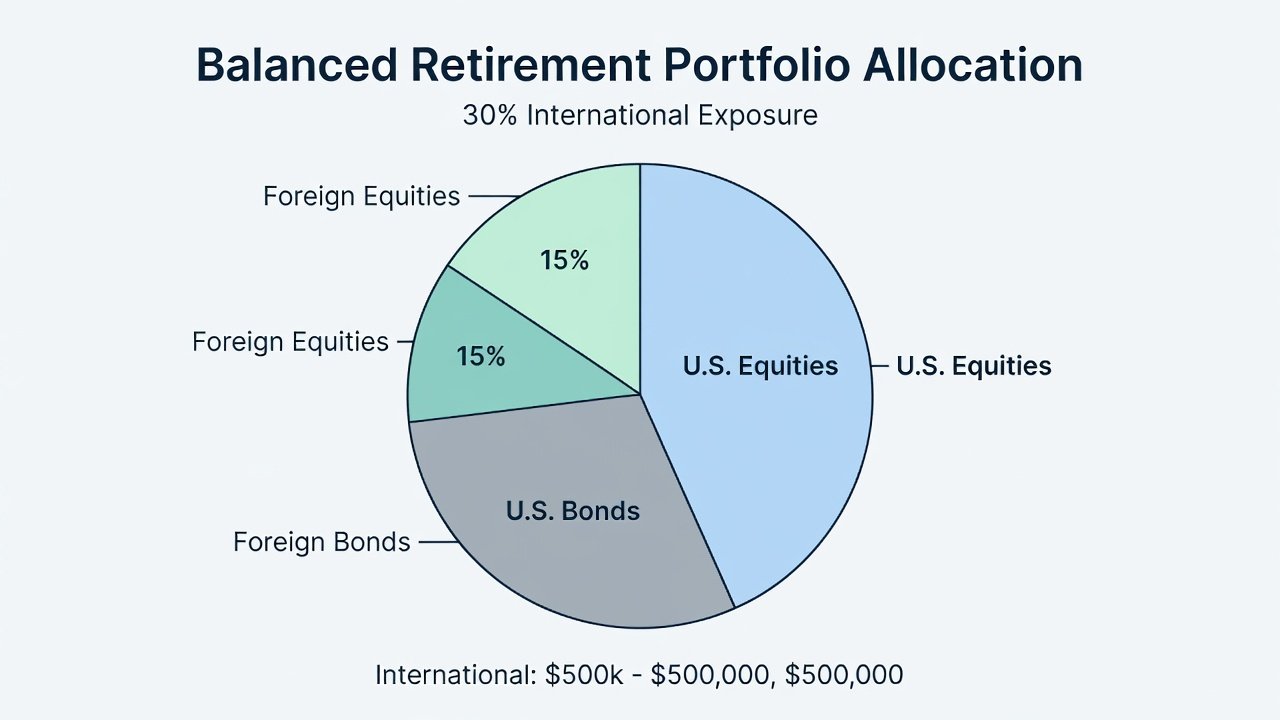
Consider a hypothetical $500,000 retirement portfolio allocated as follows: 50% U.S. large-cap, 20% U.S. small-cap, 20% developed international, and 10% emerging markets. This structure provides meaningful global diversification while remaining tax-efficient in Roth or 401k accounts. Breaking it down further, the international portion could include 15% in developed-market equities, 5% in international bonds, and 10% in emerging-market equities for balanced risk.
Rebalance annually or when allocations drift more than 5% from targets. This disciplined approach captures gains from outperforming regions and maintains desired risk levels. In practice, an investor might sell a portion of U.S. large-cap holdings after strong domestic performance and redirect proceeds into underweighted international ETFs, all within the tax-advantaged wrapper.
Rebalancing Steps During Market Shifts
- Review current allocations quarterly using account statements or portfolio tracking software.
- Identify drifts caused by strong U.S. performance or international underperformance, noting specific percentage deviations.
- Sell portions of overweight assets and buy underweight international holdings to restore targets.
- Execute trades within the tax-advantaged account to avoid capital gains taxes while documenting each transaction for future reference.
- Monitor currency impacts on international positions and adjust hedging if volatility spikes unexpectedly.
Addressing Geopolitical Risks and Emerging-Market Opportunities
Geopolitical events can impact international investments. Diversifying across multiple countries and regions helps mitigate single-country risks. Emerging markets offer higher growth potential but come with elevated volatility and regulatory uncertainty. Opportunities in markets such as India or Southeast Asia may deliver outsized returns tied to demographic trends and infrastructure development.
Investors should limit emerging market exposure to 5-15% of the international sleeve and monitor developments through reputable sources such as the SEC. A practical FAQ addresses common concerns: How should geopolitical tensions influence allocation decisions? Limit exposure to high-risk regions and favor broad diversified ETFs. What about emerging-market opportunities in 2026? Focus on countries with improving governance and strong economic fundamentals while maintaining strict position sizing.
Conclusion
Integrating international equities and bonds into Roth IRA and 401k accounts positions investors for more resilient retirement outcomes in 2026 and beyond. By focusing on low-cost ETFs, appropriate hedging, and disciplined rebalancing, intermediate investors can achieve true global diversification while navigating tax considerations effectively. Consistent application of these principles supports sustainable wealth accumulation across market cycles.


No comments yet. Be the first!