 Bullish Portfolio

Introduction to Side Hustle Retirement Planning in 2026
Freelancers and side-gig workers often juggle multiple income streams, making retirement planning both essential and complex. Integrating extra earnings into Roth IRA and 401k accounts allows for tax-advantaged growth while building a diversified portfolio. This guide explores actionable workflows for 2026, focusing on eligibility based on earned income, tax implications, and error avoidance. With evolving IRS rules, understanding how side income qualifies for contributions is key. Earned income from gigs must be properly tracked to support contributions without triggering audits or penalties. Many workers overlook the opportunities available when combining traditional employment with freelance projects, yet doing so correctly can accelerate retirement readiness significantly.
Side income provides flexibility but also demands careful coordination between accounts. Readers will find step-by-step examples, comparisons of plan types, and checklists designed for real-world application throughout this resource.
Understanding Earned Income Requirements for Retirement Contributions
Before contributing to any retirement account, freelancers must confirm that all reported income qualifies as earned income. This includes wages from a primary job plus net profits from self-employment activities documented on Schedule C. Income from investments, rentals, or passive sources does not count toward contribution eligibility. Workers should maintain detailed records of client payments, business expenses, and quarterly estimated tax filings to substantiate their figures at tax time.
Tracking tools such as spreadsheets or dedicated accounting platforms help categorize revenue streams accurately. For instance, a graphic designer with a full-time role and weekend freelance projects needs to separate W-2 earnings from 1099 income when calculating allowable Roth IRA deposits. Failure to verify earned income can result in disallowed contributions and potential IRS penalties.
Contribution Rules and Tax Implications for Multiple Income Sources
Side-gig workers must ensure all income is reported as earned income on tax returns. Roth IRA contributions are made with after-tax dollars, offering tax-free withdrawals in retirement, while traditional 401k contributions reduce taxable income now. When combining sources, total compensation determines eligibility limits. Tax implications include potential phase-outs for Roth contributions based on modified adjusted gross income. Workers with multiple W-2s and 1099s should calculate net self-employment income carefully to avoid over-contribution issues. Visit the IRS website for official guidance on reporting requirements for the 2026 tax year.
Additional considerations involve self-employment tax calculations, which affect net earnings available for retirement funding. Deducting half of self-employment taxes can increase the amount available for contributions. Those with fluctuating gig income benefit from reviewing projections quarterly to adjust savings rates dynamically.
Maximizing Employer Matches While Avoiding Errors
Many side hustlers participate in employer-sponsored 401k plans at their day job. To maximize matches, contribute enough to capture the full employer contribution, typically up to a percentage of salary. Side income can then flow into a solo 401k for additional tax-deferred savings. Common errors include failing to coordinate contributions across plans, leading to excess deferrals. Use payroll tracking tools and maintain separate records for each income stream to stay compliant.
Real-world scenarios illustrate the value of coordination. Consider a marketing professional earning a base salary plus freelance consulting fees. By maximizing the corporate match first, then directing side profits into a solo 401k, the individual captures free money while expanding overall retirement savings capacity without overlap.
Step-by-Step Example: Tracking Side Income for Eligibility
- Log all 1099-NEC forms and self-employment income monthly using a dedicated folder system.
- Calculate net profit after deductions using accounting software, subtracting legitimate business expenses such as home office costs and equipment.
- Verify total earned income exceeds desired contribution amounts by cross-checking against IRS worksheets.
- Submit estimated taxes quarterly to align with retirement funding goals and prevent cash flow surprises.
- Reconcile year-end totals before filing to confirm eligibility and make any necessary adjustments to contribution levels.
- Consult prior-year tax returns to identify patterns in income variability and refine future projections.
This workflow prevents mismatches that could disqualify contributions and builds a reliable audit trail.
Comparing Solo 401k Options Versus Spousal IRA Strategies
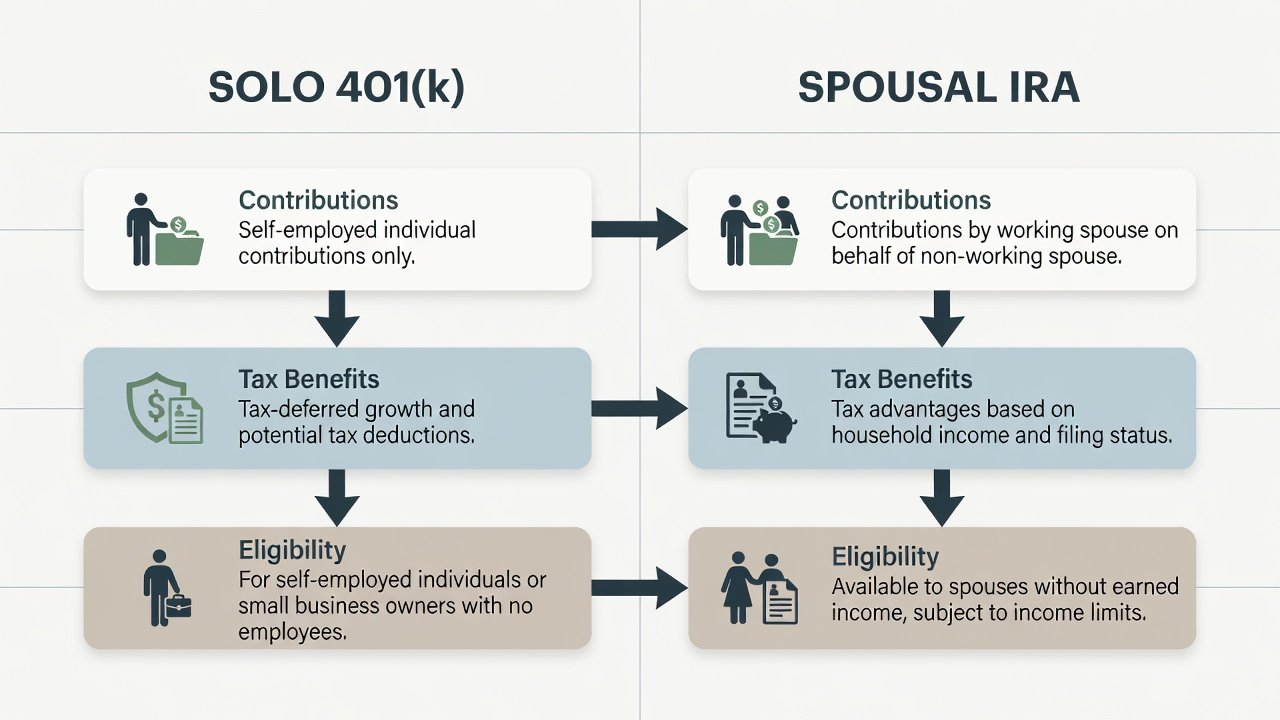
Solo 401k plans offer higher contribution potential for self-employed individuals, including employee and employer portions, plus loan features. In contrast, spousal IRA strategies allow a working spouse to contribute to a non-working partner's IRA based on joint income. For freelancers, a solo 401k often provides more flexibility with profit-sharing. Spousal IRAs suit couples where one partner has limited earned income. Evaluate based on your household's total compensation and long-term goals. Check Social Security Administration resources for related benefit calculations.
Further analysis reveals that solo 401ks permit higher overall limits when business profits are substantial, whereas spousal IRAs simplify contributions for households with uneven earnings. Decision factors include filing status, age, and whether one spouse lacks sufficient earned income of their own.
Practical Checklist for 2026 Integration
- Confirm all income sources are reported accurately on appropriate tax forms.
- Set up automated transfers to retirement accounts timed with client payments.
- Review plan documents for match formulas and vesting schedules.
- Consult a tax advisor for multi-plan coordination and state-specific rules.
- Monitor contribution deadlines, including April extensions for prior-year IRA deposits.
- Rebalance investment allocations within accounts annually to maintain diversification.
- Document all business expenses that reduce net self-employment income for accurate eligibility math.
Common Pitfalls Like Over-Contributing and How to Avoid Them
Over-contributing occurs when total deferrals exceed annual caps across all plans. Track contributions in real time with spreadsheets or apps. Another pitfall is misclassifying hobby income as earned income, which the IRS scrutinizes. Always maintain documentation and adjust mid-year if projections change. This proactive approach safeguards your retirement savings. Additional pitfalls include ignoring required minimum distributions timing or overlooking the impact of side income on Social Security taxation later in retirement.
FAQs on IRS Reporting for the 2026 Tax Year
How do I report side-gig income for retirement contributions?
Report on Schedule C of Form 1040, ensuring net earnings support your chosen contribution levels and that all deductions are properly substantiated.
Can I contribute to both a Roth IRA and solo 401k?
Yes, provided your total earned income qualifies and you stay within combined limits set by the IRS for the tax year.
What happens if I over-contribute?
Excess amounts may incur a 6% excise tax annually until corrected via timely withdrawal or recharacterization.
Are there special rules for married couples with separate side gigs?
Each spouse calculates eligibility based on individual earned income, though spousal IRA rules may provide additional options when one income is lower.
Conclusion: Building Your Diversified Retirement Portfolio
Strategic integration of side income into Roth IRA and 401k vehicles positions freelancers for secure retirement. By following the workflows, comparisons, and checklists outlined, readers can maximize opportunities while minimizing risks. Start implementing these steps today for stronger financial outcomes in 2026 and beyond. Consistent application of these principles supports long-term wealth accumulation across multiple income sources.

No comments yet. Be the first!