 Bullish Portfolio
Introduction to Triple Tax-Advantaged Retirement Planning
Retirement planning in 2026 demands sophisticated strategies that maximize tax efficiency across multiple account types. Pairing a Roth IRA and traditional 401k with a Health Savings Account (HSA) creates powerful triple tax benefits: tax-deductible contributions, tax-free growth, and tax-free qualified withdrawals. This approach goes beyond basic retirement vehicles by leveraging the unique features of each account for comprehensive tax optimization. Investors who understand how these accounts interact can significantly reduce their lifetime tax burden while building substantial wealth for later years.
High-income earners and families seeking advanced strategies will find this guide particularly valuable. It covers eligibility, optimal contribution sequencing, investment allocation across accounts, sample scenarios, and common pitfalls to avoid. By integrating these tools thoughtfully, individuals can create a retirement income stream that minimizes taxes at every stage, from contribution through withdrawal.
Understanding Eligibility Rules for Each Account
Eligibility varies significantly across the three accounts. Traditional 401k plans are available through employers with no income limits for participation, though annual contribution caps still apply based on IRS guidelines. Roth IRA contributions face income phaseouts, which may require backdoor conversion strategies for higher earners. HSA eligibility strictly requires enrollment in a qualified high-deductible health plan, making it accessible to many working-age adults and families who choose this coverage option.
Family coverage under an HDHP expands HSA utility by allowing larger annual contributions while providing tax-free reimbursements for a wide range of medical expenses. This flexibility makes the HSA especially powerful for households with children or ongoing healthcare needs. Always verify plan details with your employer or insurer to confirm ongoing eligibility each year.
Contribution Sequencing for Maximum Tax Efficiency
Optimal sequencing begins with capturing any available employer 401k match, as this represents immediate free money. Next, prioritize HSA contributions to lock in the triple tax advantage as early as possible. Then fund a Roth IRA up to its annual limit before returning to the 401k for additional pre-tax contributions. This order prioritizes immediate tax deductions alongside long-term tax-free growth opportunities.
Step-by-step workflow: First, secure the full employer match in your 401k. Second, contribute the maximum allowable amount to your HSA. Third, max out Roth IRA contributions. Fourth, complete remaining 401k contributions if room remains. Reassess this sequence annually based on income fluctuations, changes in health plan enrollment, or shifts in tax brackets. Documenting each step helps maintain consistency and avoids missed opportunities.
Investment Allocation Strategies Across Accounts
Asset location matters as much as overall allocation. Place tax-inefficient investments such as bonds and REITs inside the tax-deferred 401k to shield interest and dividends from annual taxation. Growth-oriented equities and index funds belong in the Roth IRA, where all future appreciation and qualified withdrawals remain completely tax-free. HSA funds can hold a balanced portfolio since qualified medical withdrawals stay tax-free at any age, and non-medical withdrawals become penalty-free after age 65.
Consider your personal risk tolerance and time horizon when deciding allocations. Younger investors might favor aggressive equity exposure inside Roth accounts for maximum compounding. Those closer to retirement may shift HSA holdings toward more stable investments to cover predictable healthcare expenses. Regular rebalancing across all three accounts ensures alignment with changing life circumstances and market conditions.
Tax-Free Growth Examples with Sample Scenarios
Consider a mid-career investor who consistently maximizes contributions across all three accounts. The combined effect of deductible contributions in the 401k and HSA, paired with tax-free Roth growth, produces dramatically different outcomes compared to using only taxable brokerage accounts. Over decades, the compounding effect inside tax-advantaged vehicles accelerates wealth accumulation while reducing the tax drag that erodes returns elsewhere.
Scenario one involves a moderate earner who follows the optimal sequencing and maintains consistent contributions. Scenario two features a high earner utilizing backdoor Roth strategies alongside family HSA coverage. Both cases illustrate how thoughtful coordination across accounts creates multiple layers of tax protection. Reviewing these examples helps readers visualize the long-term impact of disciplined implementation and highlights why starting early matters.
Comparison Table of Tax Treatments
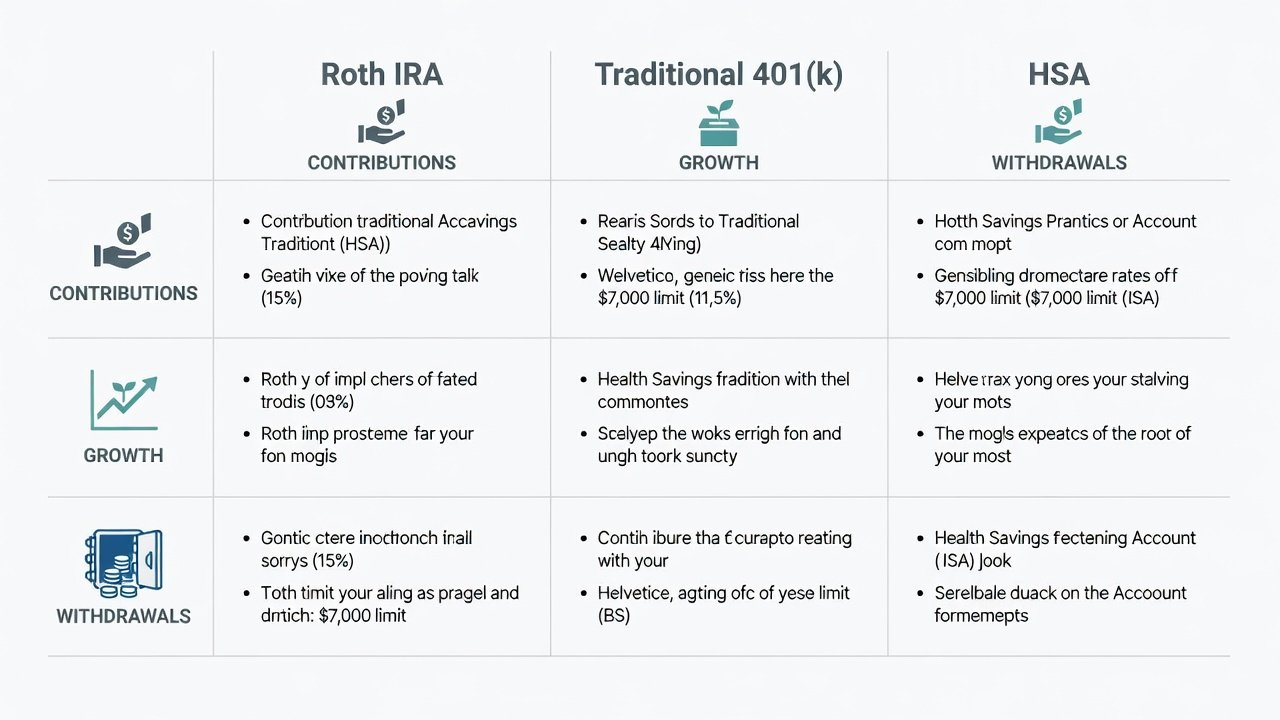
| Account | Contribution | Growth | Qualified Withdrawals |
|---|---|---|---|
| Traditional 401k | Pre-tax deduction | Tax-deferred | Taxed as ordinary income |
| Roth IRA | After-tax dollars | Tax-free | Tax-free if rules met |
| HSA | Pre-tax deduction | Tax-free | Tax-free for medical expenses (or any purpose after 65) |
Common Pitfalls to Avoid
- Ignoring HSA investment options and leaving funds in low-yield cash equivalents that fail to keep pace with inflation.
- Over-contributing to a Roth IRA without first confirming income eligibility or using proper backdoor procedures.
- Failing to maintain high-deductible health plan status, which immediately disqualifies further HSA contributions.
- Withdrawing HSA funds for non-qualified expenses before age 65, resulting in penalties and lost tax advantages.
- Neglecting to coordinate contribution limits across spousal accounts or forgetting to adjust for annual inflation adjustments.
- Overlooking required minimum distributions from traditional 401k accounts that can push retirees into higher tax brackets.
Advanced Strategies for High Earners
High earners often face restricted direct Roth IRA access yet can still benefit through backdoor conversions executed annually. Pairing this with maximized HSA family contributions creates additional tax-free medical savings. Timing conversions during lower-income years further reduces tax costs on the conversion itself.
Family Coverage Considerations
Family HDHP enrollment increases HSA contribution room and allows tax-free payments for dependent medical expenses. Parents can also reimburse themselves for prior qualified expenses years later, offering unique flexibility not available in other accounts. Coordinating HSA usage with 401k and Roth withdrawals helps manage taxable income during retirement years.
FAQ: High Earners and Family Coverage
How do high earners access Roth IRA benefits? Backdoor Roth conversions allow indirect contributions regardless of income limits by contributing to a traditional IRA then converting.
Can family HSA coverage provide extra advantages? Yes, it increases allowable contribution limits and covers dependent medical expenses on a tax-free basis.
What happens to HSA funds in retirement? After age 65, withdrawals for any purpose become penalty-free though non-medical distributions remain taxable as ordinary income.
How do these accounts interact with Social Security? Strategic withdrawals from tax-advantaged accounts can help manage provisional income and reduce taxation of Social Security benefits. Consult IRS resources for detailed rules and Medicare.gov for HSA coordination with Medicare enrollment.
Conclusion
Combining Roth IRA, 401k, and HSA accounts delivers unmatched tax efficiency for 2026 retirement planning. By following eligibility rules, strategic sequencing, and thoughtful allocation, investors can build substantial tax-advantaged wealth. Start implementing these steps today to secure a more secure financial future. For additional guidance, review official materials at SSA.gov and Healthcare.gov.


No comments yet. Be the first!