 Bullish Portfolio

Introduction: Navigating Competing Financial Priorities in 2026
Parents today face the dual challenge of building robust retirement savings while funding their children's higher education. Roth IRAs and 401(k)s offer powerful tax advantages for long-term growth, yet 529 plans provide dedicated education funding with their own benefits. This 2026 guide examines how to strategically allocate resources across these vehicles to minimize taxes, avoid penalties, and meet both goals effectively. Families often struggle with limited cash flow, making prioritization essential to prevent derailing either objective. Understanding contribution limits, tax rules, and withdrawal flexibility allows parents to create a cohesive plan that adapts to changing income, family size, and economic conditions.
Understanding the Key Accounts in Depth
A Roth IRA allows after-tax contributions with tax-free qualified withdrawals in retirement, including earnings after age 59½ and a five-year holding period. A traditional 401(k) provides pre-tax contributions and tax-deferred growth, often with employer matching that boosts effective returns immediately. Meanwhile, 529 plans enable tax-free growth and withdrawals for qualified education expenses such as tuition, books, and room and board. Each serves distinct purposes but can overlap in family planning when parents coordinate contribution timing and investment choices. For example, high-growth stock allocations may suit younger retirement accounts, while more conservative bonds fit 529 plans nearing distribution years.
Prioritizing Contribution Order for Maximum Impact
Begin by securing any employer 401(k) match, as it represents immediate return on investment with no downside risk. Next, maximize contributions to a Roth IRA if income eligibility permits, then consider additional 401(k) deferrals for further tax deferral. Only after these retirement priorities should parents allocate to a 529 plan, unless specific state tax deductions make 529 contributions more compelling upfront. This order preserves liquidity and tax advantages while addressing the longest time horizon first. Parents should review their marginal tax bracket annually to decide between traditional and Roth options within the 401(k).
Integrating 529 Plans with Retirement Accounts
Parents can coordinate 529 contributions alongside retirement accounts by using tax diversification. For instance, funding a 529 reduces current taxable income in some states while preserving retirement account space for higher-growth investments. Timing matters: front-load 529 contributions during high-income years and shift focus to Roth conversions during lower-income periods tied to education withdrawals. This integration helps avoid opportunity costs where over-saving in one vehicle leaves another underfunded. Coordination also involves beneficiary designations that allow flexibility if college plans change.
Real-World Allocation Examples and Case Studies
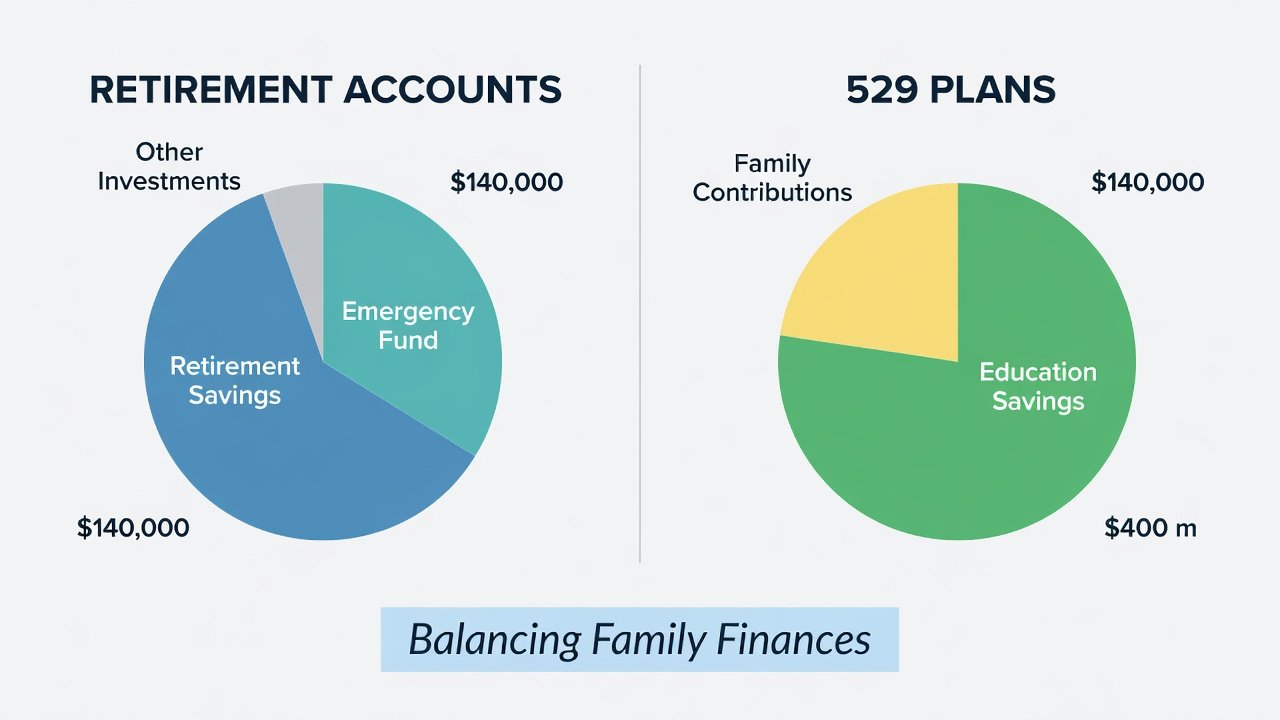
Consider a mid-income family earning $140,000 annually with two children. They might direct 6% of salary to a 401(k) to capture the full match, contribute the annual maximum to a Roth IRA for each spouse, and allocate $400 monthly split between two 529 accounts. Another case involves a family adjusting timelines by delaying some college savings to accelerate retirement catch-up contributions after age 50, then reversing the flow once catch-up room is maximized. A third example features a single-income household using part-time work income exclusively for 529 contributions while directing primary salary to retirement vehicles. These examples illustrate flexible rebalancing based on age, income, number of children, and projected college costs.
Advanced Techniques: Roth Conversions and Education Withdrawals
Roth conversions can be strategically timed during years when children are in college and parental income dips due to education expenses. This lowers the tax bracket for conversions while using 529 funds for tuition, creating a dual benefit of tax-efficient retirement buildup and education funding. Parents may also explore mega backdoor Roth strategies if their 401(k) permits after-tax contributions, then roll those into a Roth IRA. Such techniques require careful modeling of future tax rates and required minimum distributions.
Avoiding Common Penalties and Opportunity Costs
Early 401(k) withdrawals trigger taxes and penalties; similarly, non-qualified 529 distributions incur taxes plus a 10% penalty. Parents should avoid overfunding 529s beyond projected needs to prevent these costs and maintain liquidity in retirement accounts. Another frequent mistake is ignoring state-specific 529 tax deductions or failing to rebalance investment allocations as children approach college age. Regular reviews with a financial advisor help identify and correct these issues before they compound.
Practical Checklist for Parents
- Secure employer 401(k) match first each pay period
- Maximize Roth IRA eligibility based on modified adjusted gross income limits
- Review state 529 tax benefits and contribution limits annually
- Model multiple scenarios with projected college costs using online calculators
- Rebalance allocations every 12-18 months or after major life events
- Consult a tax advisor before large Roth conversions or 529 rollovers
- Track contribution deadlines and tax filing requirements
- Evaluate beneficiary changes if education plans evolve
Timeline Adjustments and Long-Term Planning
Starting 529 contributions at birth maximizes compounding, yet parents can still catch up with larger annual gifts during peak earning years. As retirement nears, shifting emphasis toward 401(k) catch-up contributions after age 50 becomes valuable. Families with multiple children benefit from staggering contribution peaks so education funding aligns with each child's college timeline without interrupting retirement momentum.
FAQ
Can I use 529 funds for retirement if not needed for college?
Non-qualified withdrawals face taxes and penalties, so alternatives like beneficiary changes to another family member or penalty-free education expenses are preferable. Explore all options before accessing funds outside qualified uses.
How do loans affect these strategies?
Student loans or 401(k) loans can bridge gaps but increase overall costs through interest; prioritize tax-advantaged accounts to reduce reliance on borrowing. IRS guidelines provide current rules on loan taxation.
What timeline adjustments work best?
Start 529 contributions early for compounding, then accelerate retirement savings once children near college age. Adjust based on actual college costs and scholarship outcomes each year.
Are there tax implications when changing 529 beneficiaries?
Changing beneficiaries within the same family generally avoids taxes or penalties, offering flexibility if one child receives scholarships or chooses a different path.
Conclusion
Balancing Roth IRA, 401(k), and college savings requires deliberate prioritization and ongoing adjustments. By focusing on tax efficiency, leveraging employer matches, and avoiding penalties, parents can successfully fund both retirement and education goals in 2026 and beyond. Regular reviews ensure the plan remains aligned with family circumstances and evolving tax laws.
No comments yet. Be the first!