 Bullish Portfolio

Introduction to Dividend Growth Investing in Tax-Advantaged Accounts
Dividend growth investing focuses on companies that consistently increase their payouts over time, providing a reliable stream of retirement income. In 2026, Roth IRAs and 401(k)s remain powerful vehicles for this strategy because they shield dividends and capital gains from immediate taxation. This guide walks through concrete steps to construct a resilient portfolio that respects contribution rules while targeting sustainable income at retirement age. Many investors search for methods to generate steady retirement income but overlook how account type influences placement decisions. Roth accounts offer tax-free withdrawals, making them ideal for high-growth dividend payers, while traditional 401(k)s provide upfront tax deductions that can complement overall planning. Understanding these nuances helps maximize long-term results without unnecessary tax drag.
Building such a portfolio requires patience and a focus on quality over quick gains. By selecting companies with proven track records of raising dividends, investors can create a compounding effect that grows income year after year. This approach suits those nearing retirement who value predictability alongside growth potential.
Screening Criteria for High-Quality Dividend Payers
Selecting the right holdings starts with rigorous criteria. Focus on companies with at least 10 years of consecutive dividend increases, payout ratios below 60 percent, and strong free cash flow. Dividend aristocrats and kings from the S&P 500 often meet these standards. Additional filters include sector diversification, consistent earnings growth, and reasonable valuations measured by forward price-to-earnings ratios. Investors should also examine return on equity and debt levels to ensure financial health. For example, a company like Johnson & Johnson has raised dividends for decades while maintaining a conservative balance sheet, illustrating the type of stability sought.
Use financial screening tools to narrow candidates. Prioritize firms with moats such as brand strength or regulatory advantages. Avoid high-yield traps that signal distress; instead, target yields between 2 and 4 percent that can grow reliably. Review quarterly earnings reports and management commentary to confirm ongoing commitment to shareholder returns. This thorough process reduces the chance of selecting companies that may cut dividends during economic stress.
Allocation Rules and Contribution Limits
Respect annual contribution caps when building positions. Spread investments across both account types to optimize tax treatment. In a Roth IRA, allocate toward companies expected to deliver strong total returns over decades. In a 401(k), emphasize holdings that generate steady current income. Revisit allocations annually to stay aligned with personal risk tolerance and time horizon. A practical example involves dividing contributions evenly at first, then tilting toward growth names in the Roth as the portfolio matures.
Target an overall equity allocation of 60-80 percent for most pre-retirees, adjusting downward as you near age 65. Maintain a cash buffer equivalent to one year of projected withdrawals inside more conservative holdings. Track contribution room monthly using plan statements to avoid overfunding penalties. This disciplined allocation supports both income generation and capital preservation.
Tax-Efficient Placement Between Roth IRA and 401(k)
Place faster-growing dividend stocks inside Roth accounts to maximize tax-free compounding. Slower-growing but higher-yielding names fit better in traditional 401(k)s where tax deferral provides immediate benefit. This placement reduces future tax drag and improves after-tax income during retirement. For instance, a technology dividend payer with rapid growth belongs in the Roth, while a mature utility stock suits the 401(k).
Review employer match rules first. Contribute enough to capture the full match before directing additional funds to an IRA. Consider backdoor Roth strategies if income limits apply, consulting current IRS guidance at IRS.gov. Proper placement also involves monitoring required minimum distributions in traditional accounts to avoid forced taxable events later.
Sample 2026 Dividend Growth Portfolio
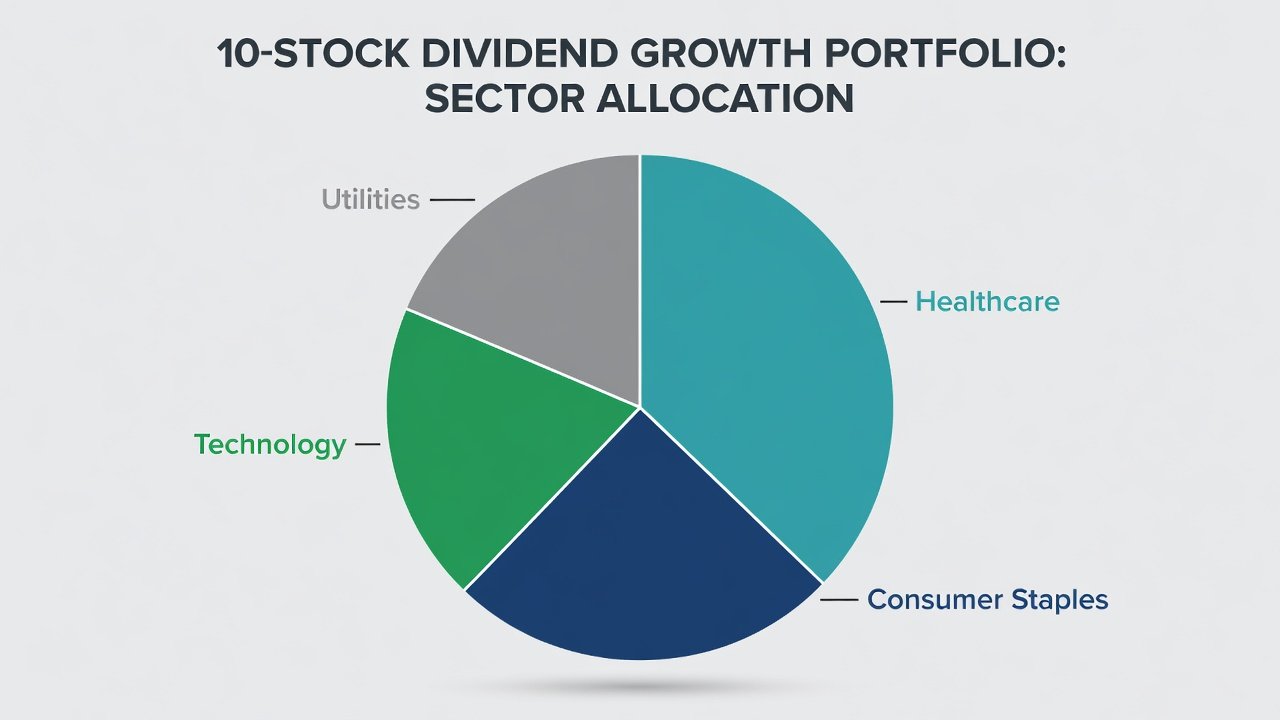
Here is a balanced example featuring 10 holdings across defensive and growth-oriented sectors. The portfolio emphasizes quality and diversification: Johnson & Johnson (healthcare) for stable medical demand, Procter & Gamble (consumer staples) for essential household products, Coca-Cola (beverages) for global brand strength, PepsiCo (consumer staples) for diversified snacks and drinks, AbbVie (pharmaceuticals) for innovative drug pipelines, Microsoft (technology) for software recurring revenue, Visa (financial services) for transaction volume growth, McDonald’s (restaurants) for franchise model resilience, Automatic Data Processing (business services) for payroll outsourcing stability, and NextEra Energy (utilities) for renewable energy expansion. Weights range from 8 to 12 percent per holding, with quarterly reviews to maintain balance. This mix projects growing income through dividend increases while limiting sector overlap.
Quarterly Rebalancing Checklist
Follow this checklist each quarter to keep the portfolio on track. First, review dividend announcements and payout ratios for all holdings to confirm sustainability. Second, rebalance any position that drifts more than 3 percentage points from target weight by trimming or adding shares. Third, assess sector exposure and add or trim as needed to prevent overconcentration. Fourth, confirm contribution room remains available in both accounts. Fifth, update projected retirement income based on latest dividend growth rates. Document all changes in a simple log for future reference.
Common Pitfalls to Avoid
Chasing yield often leads to poor outcomes when companies cut dividends during downturns. Another frequent mistake is over-concentrating in one sector, such as energy or financials, which amplifies volatility. Neglecting fees can also erode returns over decades. Finally, failing to automate contributions reduces the power of dollar-cost averaging. Real-world examples show investors who ignored payout ratio warnings suffered unexpected cuts, while those who maintained diversification weathered market swings better.
Real-World Income Projections at Age 65
Consider an investor who begins contributing steadily in 2026 and maintains the sample portfolio. With consistent dividend growth averaging 6-8 percent annually, the holdings can generate meaningful income by retirement. Hypothetical scenarios illustrate how early automation of reinvestment accelerates the outcome. Actual results depend on contribution consistency, market conditions, and personal circumstances. Track progress using a simple spreadsheet template available at the end of this guide to adjust projections yearly.
Frequently Asked Questions
How do I automate DRIP inside retirement accounts?
Most brokerage platforms and plan administrators offer automatic dividend reinvestment. Enable the feature at the account level to compound growth without manual intervention. This automation ensures every dividend buys additional shares, enhancing long-term compounding.
What are the risks of sector concentration?
Heavy exposure to one industry increases volatility. The sample portfolio above spreads across healthcare, staples, technology, and utilities to mitigate this risk. Monitor allocations quarterly and adjust when any sector exceeds 25 percent.
Can I hold international dividend stocks?
Yes, but limit foreign holdings to 10-15 percent to manage currency and regulatory risks. Focus first on high-quality U.S. dividend growers for core stability.
How often should I review dividend growth rates?
Conduct a full review at least annually, with quarterly checks for major changes in company fundamentals. This keeps the portfolio aligned with evolving economic conditions.
Conclusion and Next Steps
Building a dividend growth portfolio inside Roth IRAs and 401(k)s requires discipline and ongoing oversight. By applying the screening criteria, allocation rules, and rebalancing checklist outlined here, investors can position themselves for reliable retirement income. Download the free tracking template to monitor your holdings and dividend growth over time. For official contribution rules, visit IRS.gov and review plan documents regularly. Additional investor education resources are available at SEC.gov.

No comments yet. Be the first!