 Bullish Portfolio

Introduction: Why Behavioral Biases Undermine Retirement Success in 2026
Retirement planning through Roth IRA and 401k accounts remains one of the most powerful wealth-building tools available, yet behavioral biases frequently sabotage even the best intentions. In 2026, market volatility driven by economic shifts, interest rate changes, and geopolitical events continues to test investors. This guide explores three primary biases—recency bias, loss aversion, and overconfidence—while providing actionable strategies to maintain discipline. Investors who recognize these patterns early can protect their long-term growth trajectories and avoid costly emotional decisions that compound over decades.
Understanding these psychological pitfalls helps investors make consistent contributions and rebalance effectively, regardless of short-term market noise. The consequences of unchecked bias include lower account balances at retirement, missed tax advantages, and increased stress during market downturns. By building systems that counteract human tendencies, individuals can transform retirement accounts into reliable engines of compounding growth even amid uncertainty.
Recency Bias: Letting Recent Market Events Dictate Long-Term Decisions
Recency bias causes investors to overweight recent performance when making contribution or allocation choices. For example, after a strong 2025 equity rally, many 401k participants increased stock allocations beyond their risk tolerance, only to panic during early 2026 corrections. This bias distorts perspective because people naturally remember vivid recent events more clearly than longer historical patterns, leading to allocation drift that exposes portfolios to unnecessary risk or missed opportunities.
Triggers often appear during contribution decisions when individuals chase past winners or reduce 401k deferrals after seeing negative quarterly statements. Rebalancing becomes emotional rather than rules-based. In practice, recency bias might cause an investor to move heavily into technology funds after a sector rally, only to suffer amplified losses when that sector rotates out of favor. Over time, this pattern erodes the benefits of diversification that Roth IRA and 401k structures are designed to provide through steady, tax-advantaged growth.
Real-World Example Tied to Volatility
Consider an investor who witnessed the 2022 bear market and then shifted heavily into bonds in 2023–2025. When equities surged again, recency bias led them to stay overly conservative, missing significant Roth IRA growth opportunities. Similar patterns repeated in 2026 when brief volatility spikes prompted many mid-career professionals to pause new contributions, illustrating how recency bias can interrupt the dollar-cost averaging process that smooths out market fluctuations.
Loss Aversion: The Pain of Losses Outweighs Equivalent Gains
Loss aversion makes investors twice as sensitive to losses as to gains of the same magnitude. This bias frequently surfaces when markets dip and individuals halt Roth IRA contributions or move 401k assets into cash equivalents. The emotional weight of seeing account values decline often overrides logical assessment of long-term recovery potential, causing premature exits from equity positions that historically rebound over multi-year periods.
During 2026 volatility spikes, loss-averse behavior might prompt selling low in taxable accounts while ignoring the tax-advantaged nature of retirement vehicles that reward long holding periods. For high earners managing larger balances, this aversion can manifest as excessive caution around rebalancing, leaving portfolios overweight in underperforming assets simply to avoid realizing losses on paper. Recognizing this tendency allows investors to pre-commit to rules that prioritize portfolio integrity over short-term emotional comfort.
Overconfidence: Overestimating Personal Market Timing Ability
Overconfidence leads investors to believe they can predict market turns better than professionals. High earners often fall into this trap by attempting frequent 401k reallocations or timing Roth conversions based on short-term forecasts. The illusion of control grows stronger after periods of positive returns, encouraging more aggressive trading that increases costs and tax drag inside retirement accounts.
Mid-career professionals with larger account balances may feel especially prone to this bias after a few successful trades outside their retirement accounts. Overconfidence also appears when individuals ignore diversification principles, concentrating contributions into a handful of familiar stocks or sectors. This behavior contradicts the broad-market approach that has historically delivered the most consistent results within tax-advantaged vehicles like Roth IRAs and 401ks.
Recognizing Triggers During Contributions and Rebalancing
Contribution triggers include reacting to monthly statements or news headlines. Rebalancing triggers often coincide with major life events or market milestones. Keeping a decision journal helps identify patterns before they derail strategy. Common warning signs include increasing contribution percentages only after strong market months or delaying rebalancing until a specific index reaches a new high. Awareness of these triggers creates space for deliberate responses instead of reflexive reactions.
IRS retirement resources provide clear rules on contribution limits and tax treatment that remove emotion from the process. Additional guidance from SEC investor education materials helps investors distinguish between market noise and actionable information. Department of Labor retirement plan resources further support fiduciary standards that encourage disciplined plan management.
Step-by-Step Tactics to Automate Disciplined Investing
- Set automatic payroll deductions for 401k contributions at a fixed percentage of income and increase that percentage automatically with each raise to maintain momentum without annual renegotiation.
- Schedule quarterly rebalancing alerts through your plan administrator rather than discretionary reviews, ensuring allocations stay aligned with your original risk tolerance regardless of market direction.
- Use target-date funds or robo-advisors within Roth IRA accounts to enforce glide paths that gradually shift toward conservative assets as retirement approaches, removing the need for manual intervention.
- Establish a 48-hour cooling-off period before making any manual allocation changes, giving emotional reactions time to subside before executing trades.
- Review your investment policy statement annually on a set date, independent of market conditions, and document any deviations to build accountability over time.
- Enable contribution splitting between traditional and Roth 401k options where available to balance tax diversification without timing decisions based on current tax rates.
These automation techniques reduce the opportunity for bias to influence decisions and create repeatable processes that compound effectively across market cycles.
Comparing Biased vs. Bias-Aware Strategies
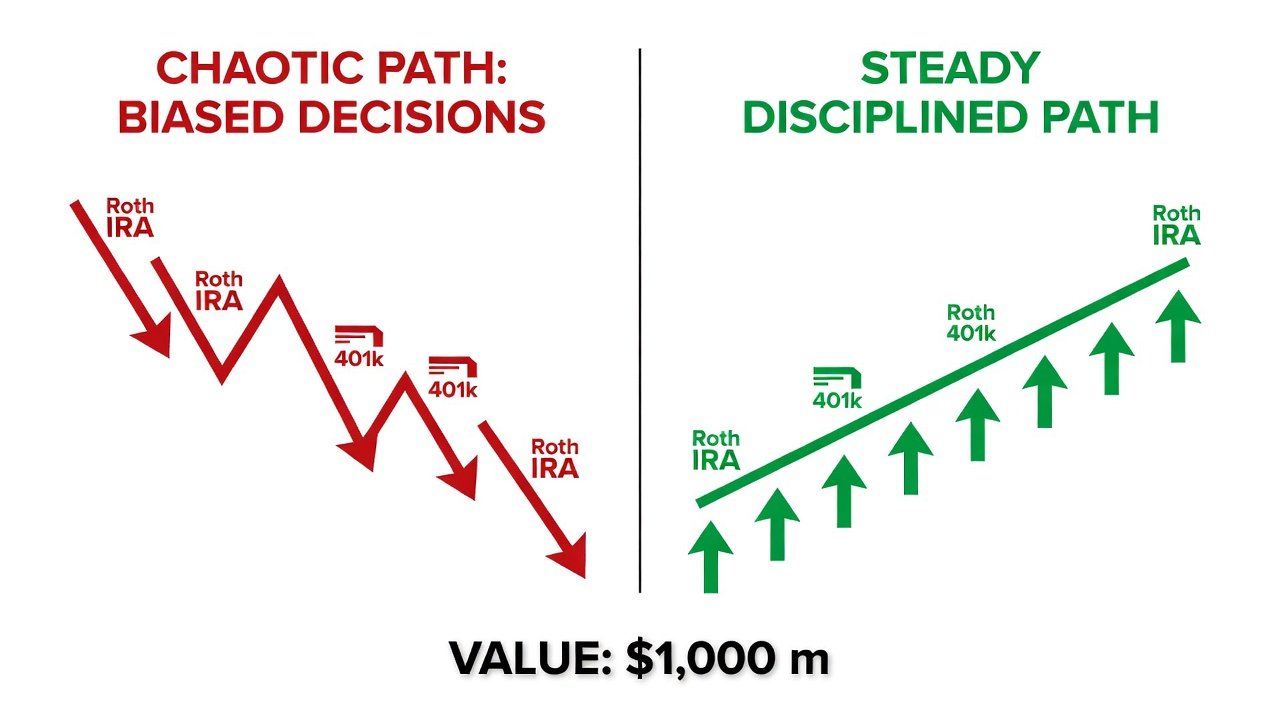
Hypothetical scenario: Two investors each contribute $1,000 monthly to a Roth IRA starting in 2026. Investor A reacts to volatility by pausing contributions during downturns and chasing rallies when markets recover. Investor B maintains steady contributions and rebalances annually using predetermined rules. Over multiple market cycles, Investor A experiences gaps in compounding during paused periods and higher internal costs from frequent shifts, while Investor B benefits from uninterrupted accumulation and disciplined risk management.
Over 20 years, the bias-aware approach typically compounds to substantially higher balances because of consistent dollar-cost averaging and reduced transaction costs. The difference becomes especially pronounced during periods of elevated market swings, where emotional decisions amplify losses and delay recovery. Tracking both approaches side-by-side in a spreadsheet can illustrate the long-term impact and reinforce commitment to bias-resistant habits.
Self-Assessment Checklist for Bias Awareness
- Do I review statements more frequently during volatile periods than during stable markets?
- Have I changed contribution rates based on recent market performance rather than income changes?
- Do I believe I can time the market better than broad index strategies over the long term?
- Am I holding excessive cash in retirement accounts after recent losses instead of maintaining target allocations?
- Have I skipped rebalancing for more than 12 months due to discomfort with current market levels?
- Do I attribute recent account gains primarily to my own skill rather than market conditions?
- Have I avoided increasing contributions during downturns because of fear of further declines?
- Do I compare my portfolio performance only to recent winners instead of a balanced benchmark?
FAQ: Applying Techniques for High Earners and Mid-Career Professionals
How should high earners handle Roth contribution limits in 2026?
High earners can use backdoor Roth strategies while maintaining automated monthly conversions to avoid emotional timing decisions. Focus on consistent execution rather than waiting for market dips, and coordinate with tax professionals to stay within annual limits without reactive adjustments.
What rebalancing frequency works best for mid-career professionals?
Annual rebalancing combined with automatic contribution increases at each raise provides an effective, bias-resistant approach. This method works well whether managing a 401k or multiple Roth IRA accounts and prevents drift without requiring constant monitoring.
Can these tactics help during major life transitions?
Yes. Pre-committing to automated rules protects against overconfidence spikes that often accompany promotions, inheritances, or career changes. Establishing these systems before transitions occur creates stability when other financial decisions demand attention.
How do these strategies interact with employer matching contributions?
Maximizing employer matches should remain a priority regardless of market conditions because the match represents immediate guaranteed return. Automation ensures contributions continue at levels that capture the full match even when bias tempts investors to reduce deferrals.
Conclusion
Beating behavioral biases in Roth IRA and 401k investing requires deliberate systems rather than willpower alone. By recognizing recency bias, loss aversion, and overconfidence—and implementing automation—investors position themselves for more reliable retirement outcomes in 2026 and beyond. Start with one automated tactic this month and build from there to create lasting discipline that supports long-term financial security.


No comments yet. Be the first!