 Bullish Portfolio

Introduction to 2026 Annuity Strategies in Retirement Accounts
Retirees in 2026 are increasingly turning to annuities within Roth IRA and 401k accounts to create reliable income streams that last throughout retirement. This approach combines the tax advantages of these accounts with the guaranteed payouts annuities provide, helping address longevity risk and market volatility. By strategically funding annuities, individuals can replace a portion of their working income with predictable payments while minimizing tax burdens. The search for tax-efficient guaranteed income has grown as traditional pension plans decline and market uncertainty persists. This guide covers practical methods to blend these tools effectively, offering depth on comparisons, rollover processes, real examples, tax rules, allocation models, and risk management techniques.
Understanding these strategies requires examining how different annuity structures interact with tax-advantaged accounts. Retirees must weigh growth potential against guarantees and consider how inflation and fees affect long-term outcomes.
Comparing Fixed, Variable, and Indexed Annuities
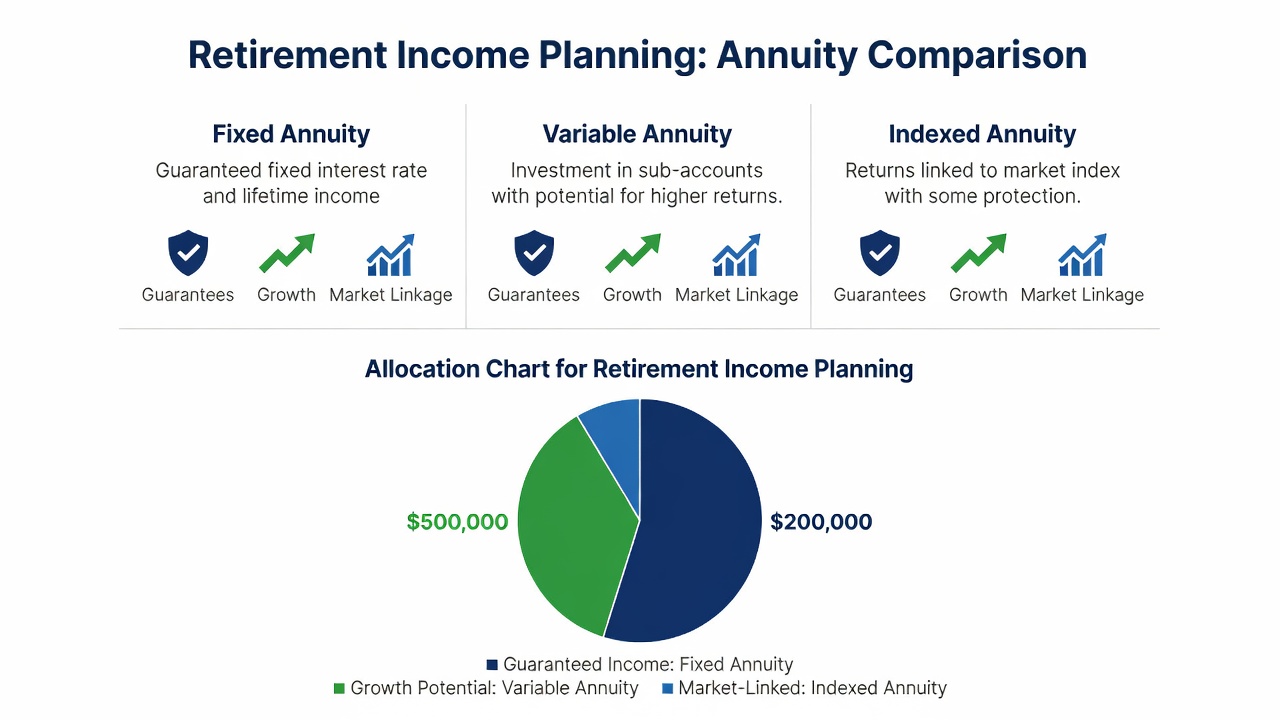
Choosing the right annuity type is critical for meeting income goals. Fixed annuities offer steady interest rates and predictable payments, making them suitable for conservative investors seeking stability without market exposure. Variable annuities tie returns to underlying investments such as mutual funds, offering growth potential but with market risk that can affect payout amounts. Indexed annuities link performance to market indices like the S&P 500 while providing downside protection through floors, blending elements of both fixed and variable options.
Each type carries different fee structures and payout options. Fixed annuities typically appeal for simplicity and lower costs, while indexed versions balance growth and security through participation rates and caps. Variable annuities suit those comfortable with equity exposure inside tax-advantaged accounts, though they often include complex riders for death benefits or income guarantees. Consider your risk tolerance and time horizon when deciding. For instance, a retiree prioritizing certainty may favor fixed contracts, whereas someone with a longer retirement phase might allocate to indexed products for modest upside.
Pros and Cons of Each Annuity Type
- Fixed: High predictability, lower fees, but limited growth and vulnerability to inflation over time.
- Variable: Potential for higher returns, flexible investment choices, but subject to market losses and higher fees.
- Indexed: Downside protection with some market participation, yet caps on gains and complex crediting methods.
Steps for Partial 401k Rollovers into Roth IRAs to Fund Annuities
Many retirees use partial rollovers to move funds from a 401k into a Roth IRA, then purchase an annuity. Begin by confirming eligibility and reviewing plan rules with your plan administrator. Next, execute a direct trustee-to-trustee transfer to avoid withholding taxes and potential penalties. Once funds arrive in the Roth IRA, allocate a portion to an annuity contract that matches your income needs and risk profile.
Always consult tax professionals, as Roth conversions trigger taxable events on pre-tax amounts. Spreading conversions over multiple years can manage tax brackets effectively. Document every step, including cost basis calculations and required minimum distribution impacts. Avoid indirect rollovers that could lead to 60-day deadlines and complications. Consider timing the rollover during lower-income years to reduce the tax hit from the conversion.
Real-World Examples of Income Replacement Rates
Consider a retiree with $500,000 in a 401k who rolls $200,000 into a Roth IRA and funds a fixed annuity. This might generate consistent annual income replacement depending on age and rates at purchase. Another example involves splitting allocations across annuity types to balance guarantees with growth potential, such as placing half in an indexed annuity for inflation hedging and the rest in fixed for base stability.
A third scenario could feature a couple combining their accounts: one spouse funds a variable annuity for potential appreciation while the other secures a fixed contract for immediate income. These models demonstrate how combining accounts can replace 30-50% of pre-retirement income when paired with Social Security benefits. Review outcomes annually and adjust for changes in health or market conditions.
Tax Implications of Annuity Integration
Roth IRAs provide tax-free qualified distributions, enhancing annuity efficiency by shielding both growth and payouts from future taxes. However, non-qualified annuities outside these accounts face different taxation on gains, often with ordinary income rates applied to earnings portions. Proper placement inside Roth accounts avoids required minimum distributions during the owner's lifetime, preserving flexibility.
Review IRS guidelines on required minimum distributions and annuity taxation at IRS.gov. State tax rules may also apply and should be factored into planning. Early withdrawals before age 59½ can incur penalties unless exceptions apply, underscoring the importance of long-term holding periods.
Practical Allocation Models and Inflation Adjustments
A balanced model might allocate 40% to fixed annuities for base income, 30% to indexed for moderate growth, and 30% to variable for upside potential. Include inflation riders where possible to protect purchasing power over decades, though these features typically reduce initial payout percentages. Another model uses laddered purchases, buying annuities at different times to average interest rate environments.
Warnings about inflation adjustments are essential: without them, fixed payments lose real value over time as living costs rise. Evaluate riders carefully, as they reduce starting payments. Longevity insurance through deferred annuities can further hedge extended lifespans by providing payments that begin later in life.
Mistakes to Avoid in Annuity Funding Strategies
Common pitfalls include over-allocating to annuities and reducing liquidity, ignoring surrender periods that lock funds for years, and failing to compare multiple carrier quotes. Another error is neglecting to coordinate annuity income with Social Security claiming strategies, which can lead to higher overall taxes. Always maintain an emergency fund outside annuities to cover unexpected expenses without penalties.
FAQ on Fees and Longevity Risks
- What fees apply? Annuities often include surrender charges, mortality fees, and administrative costs—compare contracts thoroughly before committing.
- How do annuities address longevity? Deferred income annuities provide payments starting later in life, ensuring income continues if you outlive average expectations.
- Are there inflation protections? Many contracts offer COLA riders, though they lower starting payments and require careful cost-benefit analysis.
- What happens to unused funds? Many modern contracts include death benefit riders that pass remaining value to heirs, though these add to overall costs.
- How do fees impact returns? High fees can erode 1-2% annually, so prioritize low-cost providers and understand all expense ratios upfront.
Conclusion
Integrating annuities with Roth IRA and 401k accounts offers retirees powerful tools for steady 2026 income. By understanding annuity types, executing careful rollovers, and modeling allocations with inflation in mind, individuals can build resilient retirement plans. Always work with qualified advisors to tailor strategies to personal circumstances and review resources from SSA.gov for broader retirement context and benefit coordination.


No comments yet. Be the first!