 Bullish Portfolio
Introduction to 2026 Portfolio Rebalancing
Market shifts in 2026 can cause your Roth IRA and 401k allocations to drift from targets, exposing you to unintended risks. Rebalancing restores balance while preserving the tax-free growth advantages of Roth accounts and the tax-deferred status of traditional 401ks. This guide provides actionable steps for investors focused on long-term retirement security. Investors often overlook how small drifts compound over time, leading to higher volatility than intended. By establishing a clear rebalancing process now, you protect gains and reduce emotional decision-making during market swings. The strategies outlined here address common search queries around timing, tax implications, and practical execution for both Roth IRAs and employer-sponsored 401ks.
Why Rebalance Roth IRAs and 401ks in 2026
Asset drift occurs when strong equity performance pushes stock allocations above targets. In volatile 2026 markets, failing to rebalance can amplify losses during downturns. Rebalancing enforces discipline, locks in gains, and aligns portfolios with risk tolerance. Tax advantages remain intact because transfers within the same account type avoid immediate taxation. Without regular adjustments, a portfolio that started at 60 percent equities might climb to 75 percent after a bull run, increasing downside exposure. Historical patterns show that disciplined rebalancing improves risk-adjusted returns by systematically buying low and selling high. Roth IRAs benefit especially because all future growth stays tax-free, making any rebalancing inside the account highly efficient. In 401ks, the same principle applies but you must work within the plan's investment menu, which may limit options compared to a brokerage IRA.
Understanding Asset Allocation Drift
Drift happens gradually through market movements rather than deliberate choices. A target allocation of 70 percent stocks and 30 percent bonds can shift to 78 percent stocks after just one strong quarter. Monitoring drift requires comparing current percentages against your original targets at least twice yearly. Factors accelerating drift in 2026 include sector rotations, interest rate changes, and geopolitical events. Recognizing these patterns early allows you to act before imbalances become severe.
Annual Rebalancing Triggers
Set calendar-based reviews each January and July. Monitor for threshold breaches where any asset class deviates more than 5% from target. Economic events such as Federal Reserve policy changes also warrant checks. Combine time and threshold rules for proactive management. Additional triggers include receiving a large bonus contribution, changing jobs, or experiencing a major life event like marriage or inheritance. These moments often coincide with contribution inflows that provide natural opportunities to rebalance without extra trades.
Tax-Efficient Transfer Methods
Within a single Roth IRA, sell overweight assets and buy underweight ones directly. For 401ks, use plan menus to redirect future contributions or execute exchanges. Cross-account transfers between Roth IRA and 401k require care to avoid taxable events; consult plan administrators before moving funds. IRS guidelines outline qualified distribution rules that protect tax status. When moving between accounts, consider Roth conversions only if your current tax bracket supports it, but avoid using rebalancing as the primary reason for conversions. Inside 401ks, many plans allow automatic rebalancing features that execute without participant intervention, preserving tax deferral. Always confirm that exchanges stay within the same tax-advantaged wrapper to prevent unintended tax consequences.
Threshold-Based Rebalancing Rules
- 5% deviation triggers review
- 10% deviation requires immediate action
- Rebalance only when transaction costs remain below 0.5% of portfolio value
- Document every adjustment for future tax reporting and performance tracking
Step-by-Step Rebalancing Checklist
- Review current allocations against targets
- Calculate drift percentages
- Identify tax-advantaged accounts first
- Execute trades in order of lowest cost
- Document changes for tax records
- Schedule next review date
- Verify contribution directions align with new targets
- Assess impact on overall retirement income projections
Sample Portfolios: Before and After Allocations
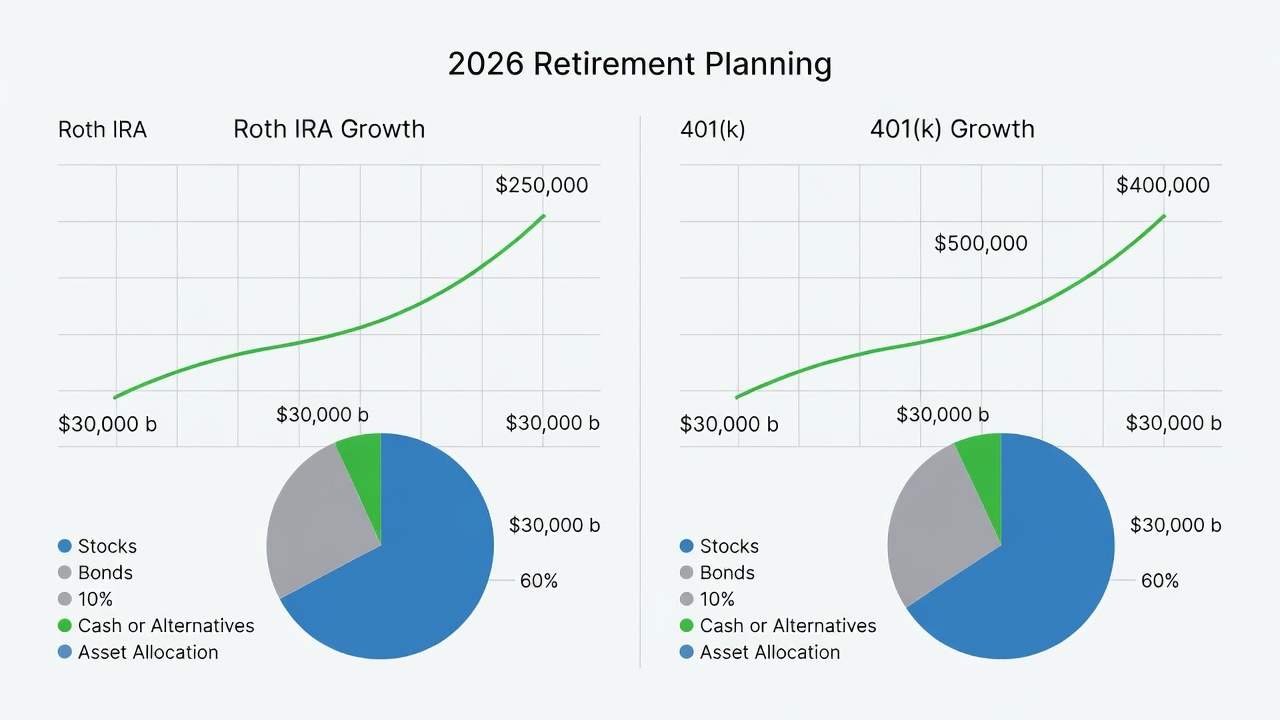
Consider a $250,000 Roth IRA targeting 60% equities and 40% bonds. Before rebalancing: 72% equities, 28% bonds. After: sell $30,000 equities and buy $30,000 bonds to restore 60/40. In a 401k with $400,000, similar adjustments maintain consistency across accounts. Another example involves a younger investor with an 80/20 target. After market gains, equities reach 88%. Rebalancing involves directing new contributions entirely to bonds until the ratio normalizes, minimizing selling and associated costs. A third case shows a near-retiree shifting from 50/50 to 40/60; rebalancing here emphasizes increasing fixed income while keeping overall equity exposure stable.
Manual vs Automated Rebalancing Comparison
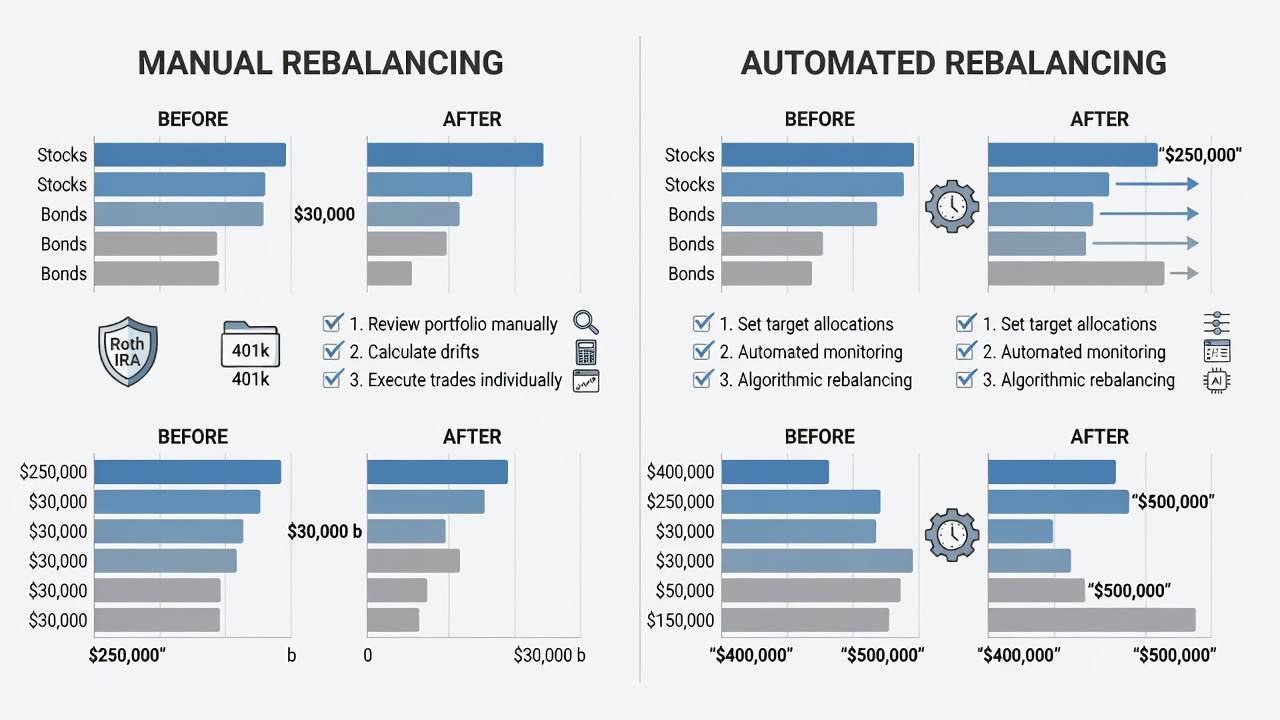
Manual rebalancing offers full control but demands time and emotional discipline. Automated tools within many 401k plans rebalance quarterly at no extra cost. Hybrid approaches use alerts from brokerage platforms to prompt manual review. Investors with complex holdings often prefer manual oversight for precision. Automated systems excel at removing behavioral biases, yet they may rebalance too frequently in low-cost plans. Manual methods allow customization around personal cash flow needs but require consistent attention. Many platforms now offer semi-automated options that suggest trades for your approval, blending the benefits of both approaches.
Real-World Growth Impact Examples
An investor who rebalanced annually from 2021-2025 achieved 1.8% higher annualized returns than a drifted portfolio due to reduced downside exposure. Another case showed a $500,000 portfolio maintaining target risk levels avoided a 12% drawdown during a 2026 correction through timely bond increases. A third example involves a couple who used threshold-based rules in their combined Roth IRAs; by rebalancing only at 7% drift, they reduced trading activity by 40% while still capturing most of the risk-reduction benefits compared to more frequent adjustments.
Common Mistakes to Avoid
Many investors rebalance too often, incurring unnecessary costs or taxes if rules are misapplied. Others ignore contribution direction changes that can naturally correct drift over time. Failing to coordinate between multiple accounts leads to overall portfolio imbalance even if individual accounts appear on target. Always review the entire retirement picture rather than isolated accounts.
Tools and Resources for Rebalancing
Spreadsheet templates help track allocations across accounts. Brokerage dashboards often include drift alerts. Government resources provide foundational education on retirement account rules. Investor.gov resources offer additional educational support for ongoing planning. SEC investor education materials further explain allocation strategies in plain language.
FAQ: Timing, Fees, and Common Concerns
When is the best time to rebalance?
Align with contribution dates or major life events rather than market timing. Annual reviews minimize unnecessary trades.
Do rebalancing fees erode returns?
Most 401k plans and Roth IRA custodians offer commission-free exchanges. Focus on low-cost index funds to keep expenses minimal.
Can I rebalance across Roth IRA and 401k?
Yes, but treat each account separately to preserve tax treatment. Direct rollovers may apply when changing employers.
How does inflation affect rebalancing targets?
Adjust targets periodically to reflect changing risk tolerance and inflation expectations, but avoid frequent shifts that undermine the discipline of the process.
What if my 401k has limited investment choices?
Use available core funds to approximate targets and supplement with IRA holdings for finer adjustments.
Conclusion
Consistent rebalancing in 2026 protects retirement portfolios from drift while safeguarding tax advantages. Use the checklists and examples here to implement a personalized strategy that supports long-term goals. Regular attention ensures your Roth IRA and 401k remain aligned with your retirement vision despite evolving market conditions.

No comments yet. Be the first!