 Bullish Portfolio

Introduction to Coordinating Retirement Income Streams in 2026
Retirement planning in 2026 demands precise coordination between Social Security benefits and withdrawals from Roth IRAs and 401(k) accounts. Aligning these income sources allows retirees to minimize lifetime taxes, reduce the impact of required minimum distributions, and avoid pushing income into higher tax brackets. This comprehensive guide walks through proven strategies for sequencing withdrawals, timing benefit claims, and managing interactions with Medicare premiums and spousal options.
Many individuals approach retirement accounts and Social Security in isolation, missing opportunities for optimization. When RMDs from traditional accounts begin at age 73 or later, they can increase the taxable portion of Social Security benefits up to 85 percent. Strategic Roth conversions executed in lower-income years before those RMDs start often produce substantial long-term savings. Understanding these interactions helps create a resilient income plan that lasts throughout retirement.
Understanding Tax-Efficient Withdrawal Sequencing
The sequence in which you tap different accounts directly affects your overall tax bill. A baseline approach draws first from taxable brokerage accounts, then traditional IRAs or 401(k)s, and finally Roth accounts. Integrating Social Security changes the optimal order because benefits are partially taxable based on combined income.
Start by projecting your income without Social Security. Next, model the effect of claiming benefits at different ages while layering in Roth conversions. In years when your taxable income sits in the 12 or 22 percent federal bracket, converting larger amounts from traditional accounts can lock in lower lifetime taxes. This approach also shrinks future RMDs that would otherwise inflate provisional income and tax Social Security benefits more heavily.
The Impact of RMDs on Social Security Taxation
Required minimum distributions count toward the provisional income calculation that determines how much of your Social Security is taxed. Once RMDs begin, many retirees discover that 50 to 85 percent of benefits become taxable. Delaying the start of Social Security while completing conversions before RMD age can keep more benefits tax-free.
For those born in 1951 through 1959, RMDs begin at age 73. Later birth years push the start to age 75. Using the years between full retirement age and RMD onset for conversions creates a powerful window. This period often features lower income, making conversions more affordable and preserving headroom under Medicare IRMAA brackets.
Timing Social Security Claims with Account Conversions
Claiming Social Security at age 62 permanently reduces benefits by roughly 30 percent relative to full retirement age. Delaying until age 70 earns delayed retirement credits of 8 percent per year. Married couples can further optimize by having the lower earner claim a spousal benefit while the higher earner continues delaying.
During the gap years before claiming, focus on Roth conversions funded by modest traditional account withdrawals or other income. This strategy manages taxable income precisely and builds tax-free assets for later years when RMDs would otherwise dominate. Review annual tax projections each fall to adjust conversion amounts based on current bracket thresholds.
Real-World Examples for Married Couples
Consider a couple where one spouse has significantly higher lifetime earnings. The higher earner delays Social Security until age 70 while the lower earner claims a spousal benefit at full retirement age. In the intervening years they systematically convert traditional IRA balances to Roth, paying taxes at the 12 or 22 percent rate. The result is lower future RMDs and a larger tax-free bucket for legacy or unexpected medical costs.
Another scenario involves two equal earners who both delay claiming. They bridge income needs with 401(k) withdrawals and spousal benefits during the delay period. By keeping combined income below key Medicare thresholds, they avoid IRMAA surcharges that can add hundreds of dollars monthly to Part B and Part D premiums. These examples illustrate how personalized modeling outperforms generic rules of thumb.
Step-by-Step Coordination Checklist
- Project RMD amounts using the IRS Uniform Lifetime Table starting at your required beginning date.
- Run multiple tax scenarios for Social Security claiming ages of 62, full retirement age, and 70.
- Identify low-income windows between ages 60 and 72 for Roth conversions.
- Monitor Medicare IRMAA brackets annually to prevent premium spikes.
- Coordinate with a tax professional or fee-only advisor to stress-test combined household outcomes.
- Review beneficiary designations on all accounts to align with Roth conversion goals.
- Track state tax treatment of Social Security and retirement distributions in your residence state.
Early vs. Delayed Claiming Scenarios Compared
Claiming benefits early supplies immediate cash flow but reduces monthly amounts permanently and increases exposure to future RMD-driven taxation. Delaying builds substantially larger benefits and creates more time for tax-efficient planning, yet requires alternative income sources during the bridge period. Longevity-focused retirees who pair delayed claiming with Roth conversions typically achieve higher after-tax lifetime income.
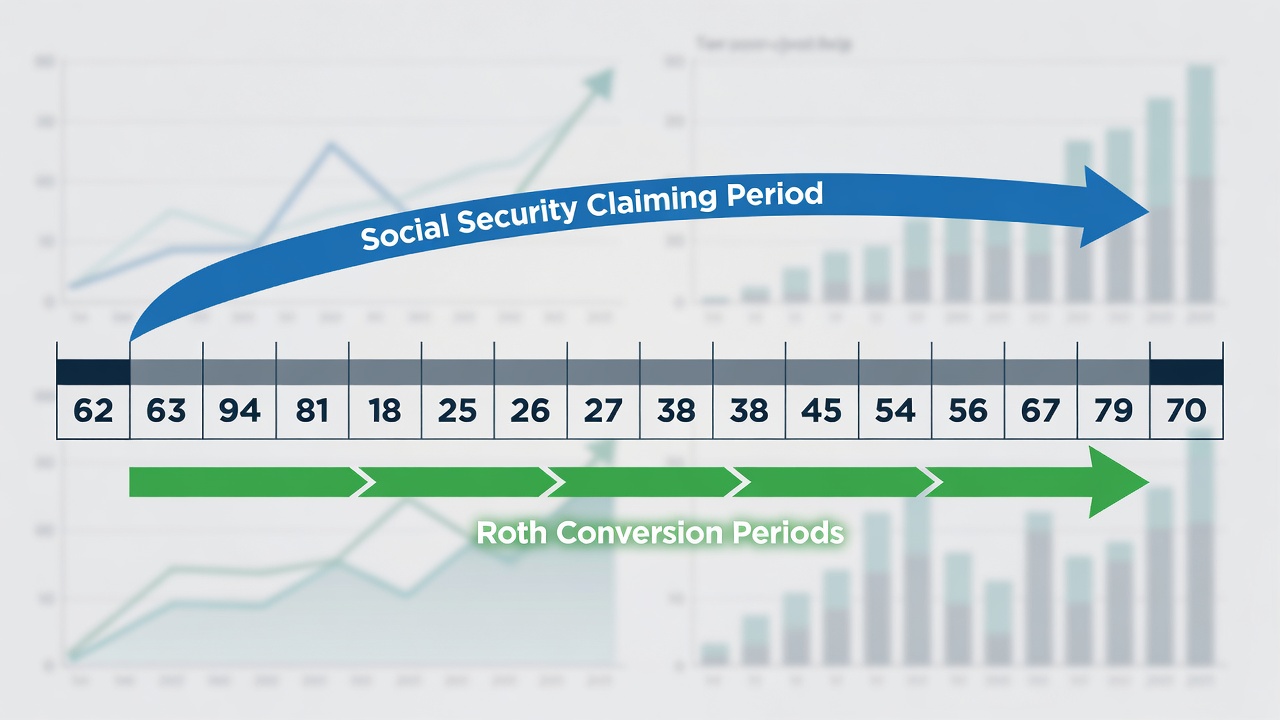
Early claiming may suit individuals with shorter life expectancy, health concerns, or immediate liquidity needs. Delayed claiming combined with conversion planning generally benefits couples with at least average longevity and moderate to high account balances. Running personalized projections with current tax tables remains essential because individual circumstances vary widely.
Addressing Spousal Benefits and Medicare Premiums
Spousal benefits allow a lower-earning spouse to receive up to 50 percent of the higher earner’s benefit while the primary earner continues delaying. This tactic maximizes household cash flow without accelerating the larger benefit. Restricted application rules have tightened, so current filers must understand eligibility before filing.
Medicare premiums rise through IRMAA when modified adjusted gross income exceeds annual thresholds. Strategic timing of Roth conversions and Social Security claims helps retirees stay below those thresholds. Monitoring income two years in advance of Medicare enrollment provides the best opportunity to manage surcharges.
Additional Considerations for 2026 Retirees
Market volatility, changes in tax law, and evolving healthcare costs all influence optimal timing. Maintaining flexibility in withdrawal sources allows quick adjustments. Some retirees incorporate qualified charitable distributions from IRAs after age 70½ to satisfy RMDs while lowering taxable income. Others explore Roth conversions paired with tax-loss harvesting in taxable accounts to offset conversion taxes.
Regular annual reviews become critical once RMDs begin. Adjust conversion amounts, rebalance portfolios, and update projections whenever tax brackets, standard deductions, or Medicare rules change. Professional guidance ensures strategies remain aligned with personal goals and current regulations.
Conclusion
Coordinating Social Security with Roth IRA and 401(k) decisions creates a more tax-efficient and durable retirement income plan. Focus on withdrawal sequencing, RMD management, and personalized claiming timing to minimize taxes and protect benefits. The strategies outlined above, when implemented with professional oversight, help retirees maximize after-tax income across multiple decades.
Frequently Asked Questions
How do spousal benefits affect Roth conversion strategies?
Spousal benefits can supply income during conversion years, allowing precise management of taxable income without claiming your own benefit early. This flexibility often permits larger conversions at lower rates.
Can delaying Social Security reduce Medicare costs?
Yes. Keeping provisional income lower during conversion periods helps avoid IRMAA surcharges on Medicare Part B and Part D premiums. Timing conversions before claiming benefits is a common tactic.
What resources provide official guidance on these topics?
The Social Security Administration offers detailed claiming calculators and benefit estimators. The Internal Revenue Service publishes RMD rules and tax-bracket information. Medicare details appear on the Medicare.gov site.

No comments yet. Be the first!