 Bullish Portfolio

Introduction to FIRE and Tax-Advantaged Accounts in 2026
Financial Independence, Retire Early (FIRE) continues to attract professionals seeking freedom before traditional retirement age. Integrating Roth IRA and 401(k) accounts effectively can optimize taxes, maximize growth, and support sustainable withdrawals. This guide details practical steps for a 45-year-old pursuing FIRE in 2026, including contribution sequencing, backdoor Roth tactics, and safe withdrawal rate modeling. Tax bracket management remains central because early retirees often face unique income patterns during semi-retirement phases. Understanding how traditional versus Roth accounts interact with these brackets helps avoid unnecessary tax hits and preserves more wealth for long-term goals.
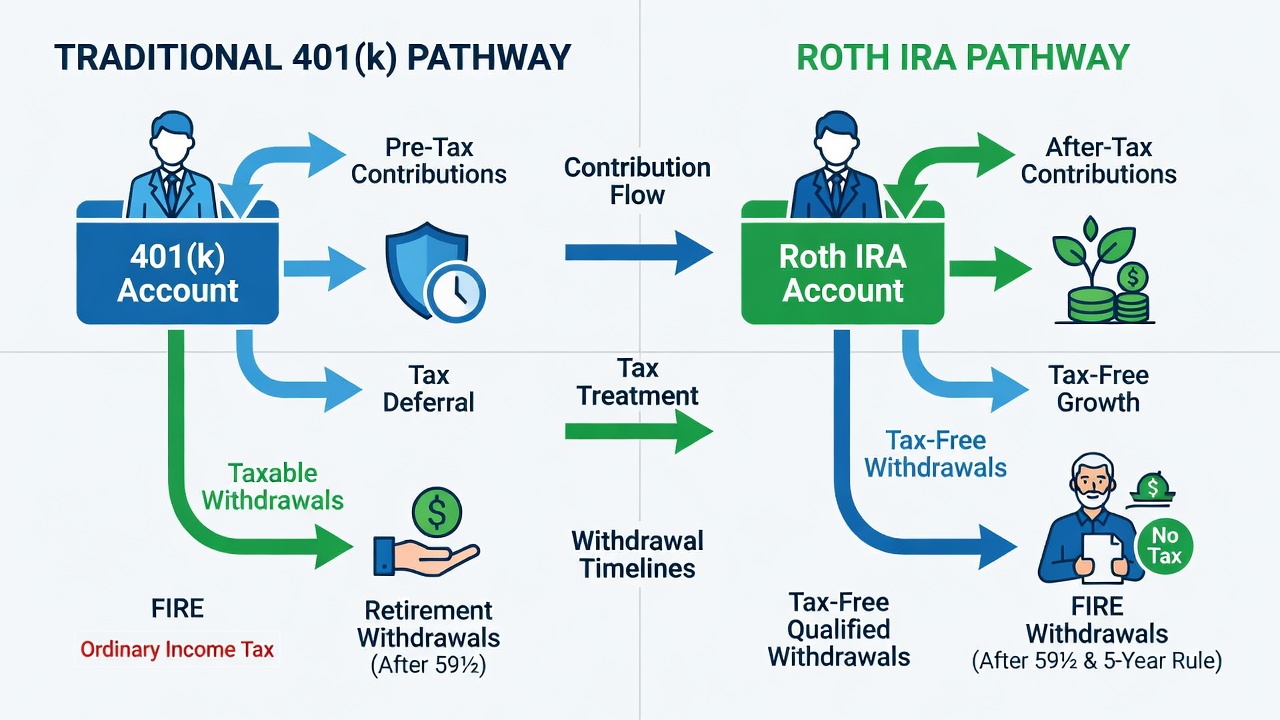
Early retirement planning requires balancing aggressive savings with flexible tax strategies. Roth accounts offer tax-free growth, while traditional accounts provide immediate tax deductions. Combining both creates diversification that proves valuable when tax laws or personal circumstances shift over decades.
Contribution Sequencing for FIRE Investors
Effective sequencing begins with maximizing employer matches in a traditional 401(k), then funding a Roth IRA or backdoor Roth if income limits apply. After that, additional pre-tax contributions to a 401(k) can reduce current taxable income while building the account for later Roth conversions. For someone at age 45 with steady employment, prioritize the match first. This guaranteed return compounds powerfully over the remaining working years. Next, direct after-tax dollars into a Roth IRA to lock in tax-free growth and withdrawals. Investors should also consider mega backdoor Roth options if their plan allows after-tax contributions beyond the standard limit, converting those amounts promptly to avoid taxable gains.
Review your plan documents annually to confirm contribution limits and any employer-specific rules. Automating transfers ensures consistency even during busy career periods.
Backdoor Roth Tactics and Tax Bracket Management
High earners often use the backdoor Roth strategy: contribute to a non-deductible traditional IRA, then convert to a Roth IRA. Proper execution requires tracking basis to avoid pro-rata taxation on the conversion. Timing conversions during lower-income years in semi-retirement can keep the investor in a favorable bracket. Monitor annual tax brackets closely. Converting just enough each year to fill the lower brackets without triggering Medicare surcharges or higher capital gains rates supports long-term tax efficiency. Keep detailed records of all contributions and conversions using spreadsheets or dedicated tax software to simplify future IRS reporting.
Consult a tax professional when first implementing backdoor tactics to ensure compliance with current IRS rules.
Calculating Safe Withdrawal Rates
The classic 4% rule serves as a starting point, yet FIRE practitioners often model 3.5% or lower rates to account for sequence-of-returns risk in early retirement. Use Monte Carlo simulations or historical data to stress-test portfolios that include both traditional and Roth balances. A 45-year-old targeting independence might project a 3.25% initial withdrawal rate, adjusting annually for inflation. Roth accounts provide flexibility because qualified withdrawals do not increase taxable income, helping manage Medicare premiums and Social Security taxation later. Factor in other income sources such as part-time consulting or rental properties when determining the sustainable rate. Revisit the calculation every few years as life expectancy assumptions and market conditions evolve.
Handling 401(k) Employer Matches During Semi-Retirement
Many FIRE candidates transition to part-time work. If the new role offers a 401(k) match, continue contributing at least enough to capture the full match. This free money accelerates portfolio growth even at reduced hours. Keep the old 401(k) or roll it into an IRA depending on fees and investment options. Rolling allows easier Roth conversions but may limit creditor protection compared with keeping assets in the plan. Evaluate the new employer's vesting schedule carefully before making large contributions. Some semi-retirees choose to delay full retirement by a year or two specifically to maximize matches from bridge employment.
Timing Roth Conversions Before RMDs
Required Minimum Distributions (RMDs) begin at age 73 for most individuals. Completing Roth conversions in the decade before RMDs can reduce future taxable distributions and lower overall lifetime taxes. Create a conversion ladder so converted amounts become penalty-free after five years. Coordinate conversions with healthcare subsidies and other income sources to stay below key thresholds. Spreading conversions over multiple years prevents pushing yourself into a higher marginal bracket in any single year. Consider the impact on state taxes as well, since some states conform to federal rules while others do not.
Step-by-Step Example for a 45-Year-Old
- Maximize 401(k) match at current employer to capture the full employer contribution immediately.
- Fund Roth IRA via backdoor if income exceeds direct contribution limits, tracking every non-deductible contribution.
- Model portfolio with 60% equities and 40% bonds; run withdrawal simulations at 3.25% using multiple economic scenarios.
- Plan annual Roth conversions of moderate size during early semi-retirement years while monitoring tax brackets.
- Build a taxable brokerage bridge account for the first five years to avoid early withdrawal penalties on traditional accounts.
- Review healthcare options and maintain an emergency fund covering at least two years of expenses.
Traditional vs Roth Comparison
| Factor | Traditional 401(k)/IRA | Roth IRA/401(k) |
|---|---|---|
| Tax Treatment | Pre-tax contributions, taxable withdrawals | After-tax contributions, tax-free qualified withdrawals |
| Growth | Tax-deferred | Tax-free |
| RMDs | Subject to RMDs | No RMDs during owner's lifetime |
| Estate Planning | Heirs pay income tax | Tax-free to heirs |
| Early Retirement Flexibility | Penalties before 59½ (with exceptions) | Contributions accessible anytime; conversions after 5 years |
| Medicare IRMAA Impact | Withdrawals can increase premiums | Qualified withdrawals do not affect premiums |
Common Mistakes to Avoid in Early Retirement
One frequent error is ignoring sequence-of-returns risk by withdrawing too aggressively in the first few years. Another is failing to maintain a taxable account for flexibility. Investors sometimes overlook state tax implications or neglect to update beneficiary designations after major life events. Regularly rebalancing the portfolio and reviewing withdrawal strategies prevents small issues from compounding over time.
Conclusion
Combining Roth IRA and 401(k) accounts within a FIRE framework delivers powerful tax diversification. Thoughtful contribution sequencing, strategic backdoor Roth moves, and proactive conversion planning position a 45-year-old for a resilient early retirement. Regular reviews with updated tax rules and market conditions keep the plan on track.
FAQ
What if markets drop sharply in the first years of retirement?
Maintain a cash or short-term bond buffer covering 2–3 years of expenses to avoid selling equities at lows. Reduce discretionary spending temporarily and consider part-time work if needed.
How do I cover healthcare before Medicare eligibility?
Budget for marketplace plans or part-time work that provides coverage; explore Healthcare.gov resources and compare subsidies carefully each year.
Can I access retirement funds penalty-free before age 59½?
Yes, via Roth contribution withdrawals, substantially equal periodic payments, or the Roth conversion ladder after five years. Always confirm current IRS guidelines before executing any strategy.
Should I keep my 401(k) or roll it to an IRA?
Compare fees, investment choices, and creditor protection; many choose rollover for simpler Roth conversion management. See guidance at IRS.gov and consult a financial advisor familiar with your full situation.
How does Social Security interact with early retirement withdrawals?
Claiming benefits early reduces monthly amounts permanently, while delaying increases them. Coordinate Roth conversions before claiming to minimize taxation of benefits. Review official details at SSA.gov.

No comments yet. Be the first!