 Bullish Portfolio

Introduction to Risk Budgeting in Modern Portfolios
As investors prepare for 2026 market uncertainties driven by geopolitical shifts, interest rate volatility, and evolving inflation dynamics, traditional asset allocation often falls short in managing tail risks and prolonged drawdowns. Risk budgeting with alternatives offers a sophisticated approach that allocates risk rather than capital across private equity, hedge funds, and real assets. This framework enhances diversification while maintaining targeted return profiles for institutional and high-net-worth investors seeking resilience. By focusing on risk contributions instead of nominal weights, portfolios can better withstand volatility spikes compared to static mixes like the classic 60/40 equity-bond allocation. The following sections detail comprehensive frameworks, granular processes, side-by-side comparisons, real-world examples, and practical monitoring tools tailored specifically for 2026 conditions.
Core Principles of Risk Budgeting Frameworks
Risk budgeting begins with defining total portfolio risk tolerance, typically measured through metrics like volatility, expected shortfall, or maximum drawdown limits. Alternatives play distinct roles: private equity delivers illiquidity and complexity premiums through buyout and venture strategies; hedge funds provide absolute return approaches via long-short equity, macro, and event-driven tactics; and real assets such as infrastructure, timber, and commodities offer inflation hedging and low equity beta. These asset classes exhibit lower correlations to public markets, enabling more efficient overall risk distribution across factors like equity beta, credit spreads, and liquidity premia. The core principle involves decomposing portfolio volatility into marginal and component contributions from each holding. This prevents over-concentration in any single risk factor, which remains a persistent issue in conventional allocations where equities can dominate 70 percent or more of total risk despite representing only 60 percent of capital.
Step-by-Step Process for Setting Risk Limits
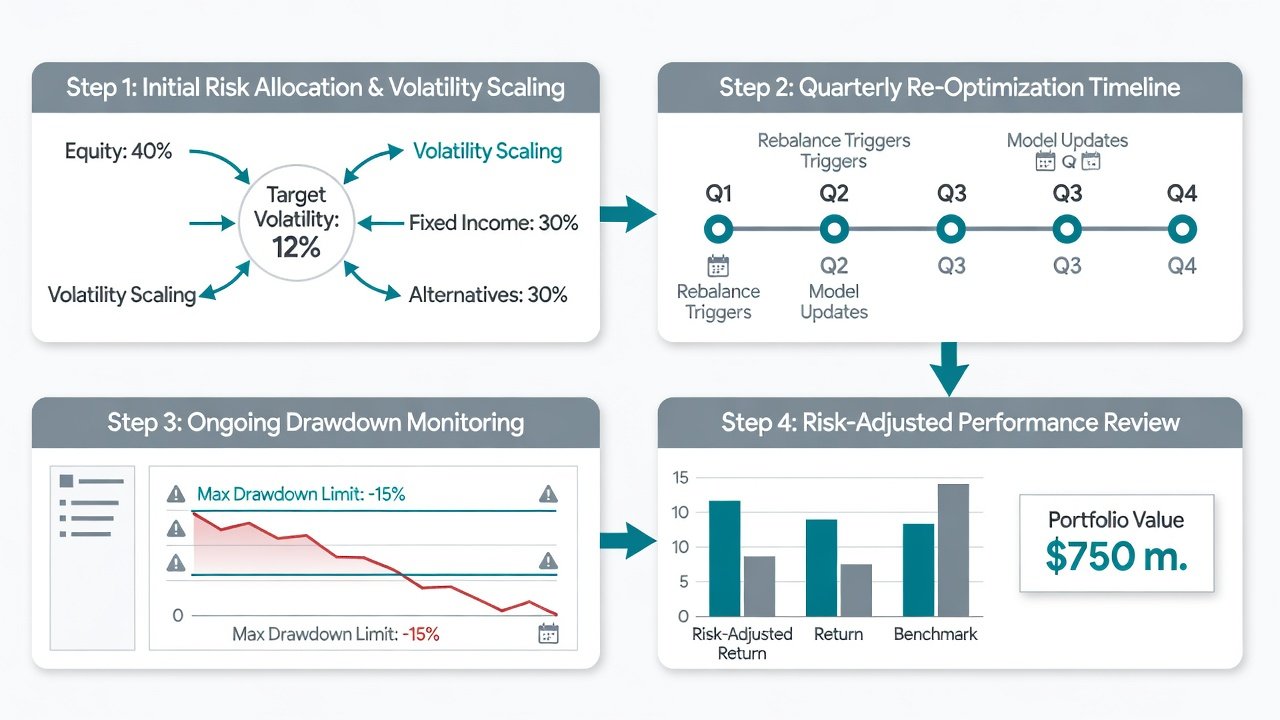
Establishing effective risk limits requires a structured sequence. First, assess overall risk appetite through a combination of historical drawdown analysis spanning multiple market cycles and forward-looking scenario modeling that incorporates 2026-specific stressors such as supply chain disruptions or policy reversals. Second, identify and quantify primary risk factors including equity market beta, interest rate duration, currency exposure, and liquidity constraints unique to private markets. Third, allocate risk budgets proportionally by assigning higher limits to assets demonstrating superior risk-adjusted metrics, such as alternatives with favorable Sharpe ratios after adjusting for smoothing biases in private valuations. Fourth, implement hard constraints, for instance capping private equity at no more than 25 percent of total portfolio risk contribution to mitigate redemption and valuation uncertainties. Fifth, validate limits via Monte Carlo simulations that stress-test the entire allocation under correlated shocks. This methodical approach ensures budgets remain both ambitious and defensible.
Using Volatility Scaling for Dynamic Adjustments
Volatility scaling introduces a dynamic layer by adjusting exposures in response to realized or implied volatility measures. For hedge fund sleeves, this may entail reducing leverage during elevated VIX regimes above 25. Real assets like infrastructure can be scaled using commodity or REIT volatility proxies to maintain consistent risk footprints. In practice, an investor might increase real asset exposure by 5-10 percent when equity volatility forecasts exceed predefined thresholds, thereby preserving the overall portfolio volatility target. Quarterly calibration of scaling parameters incorporates updated market data and prevents drift. This technique proved particularly effective during the 2022-2025 period when rapid volatility regime changes rewarded adaptive rather than static risk budgets.
Quarterly Re-Optimization of Risk Budgets
Re-optimization should occur every quarter using refreshed covariance matrices, updated return forecasts, and alternative-specific performance metrics. The process involves recalculating each asset's marginal risk contribution, comparing actual versus target budgets, and executing rebalancing trades or commitment adjustments where deviations surpass tolerance bands of 3-5 percent. Stress testing against plausible 2026 scenarios, including prolonged rate hikes or regional conflicts, forms an integral step. Inputs from authoritative macroeconomic sources help refine assumptions. Federal Reserve projections and IMF global economic assessments supply critical forward indicators for these updates, ensuring budgets evolve with the macro environment rather than remaining static.
Traditional vs Alternative Risk Contributions: Comparisons
Traditional portfolios frequently exhibit extreme risk concentration, with equities accounting for 70-85 percent of total volatility despite balanced capital allocations. Alternative-inclusive frameworks distribute risk more evenly: private equity might contribute 22-28 percent of portfolio risk while representing 12-18 percent of capital; hedge funds 18-25 percent risk for 8-15 percent allocation; and real assets absorbing 10-15 percent risk through inflation-linked cash flows with minimal equity overlap. A side-by-side comparison reveals that adding alternatives typically lowers maximum drawdown by 25-35 percent in historical simulations while preserving or enhancing expected returns. Real-world backtests using 2015-2025 data demonstrate that diversified risk budgets outperform capital-weighted mixes during both equity bear markets and inflationary spikes.
Real-World Allocation Examples
Consider a $750 million public pension portfolio: 38 percent public equities (targeting 42 percent risk budget), 22 percent private equity across buyout and growth funds (28 percent risk), 18 percent multi-strategy hedge funds (18 percent risk), and 22 percent real assets including core infrastructure and farmland (12 percent risk). This configuration targets 7.5-9.5 percent annualized returns with a volatility ceiling of 11 percent. Another high-net-worth family office example allocates 30 percent equities, 25 percent private equity, 20 percent hedge funds, and 25 percent real estate and timber, with quarterly volatility scaling applied to the liquid portions. In both cases, the risk-budgeted approach reduced tail-risk exposure measurably during simulated 2026 stress events.
Tools for Monitoring Drawdown Risks in 2026
Robust monitoring relies on integrated platforms that combine risk-parity optimization engines with alternative data feeds for real-time drawdown alerts. Essential capabilities include conditional value-at-risk modeling, liquidity-adjusted stress testing, and rolling 12-month maximum drawdown tracking with automated triggers at 10-15 percent thresholds. Investors should also deploy factor-exposure dashboards that flag unintended concentrations in equity beta or duration. Authoritative global outlooks from World Bank resources further enrich scenario analysis. Regular dashboard reviews, ideally weekly for liquid holdings and monthly for private assets, allow timely interventions before drawdowns compound.
Practical Checklists for Implementation
- Define precise risk metrics, tolerance bands, and escalation protocols before deployment.
- Map correlations across all alternative strategies using minimum five-year smoothed datasets supplemented by public proxies.
- Establish a fixed quarterly review calendar inclusive of investment committee sign-off.
- Document explicit rebalancing rules, including minimum trade sizes and tax considerations.
- Conduct independent third-party audits of risk models annually.
- Perform liquidity stress tests simulating simultaneous redemption requests across private vehicles.
- Maintain a living document of assumptions and model limitations for transparency.
- Train internal teams on interpreting alternative-specific risk reports.
Common Mistakes to Avoid
Investors frequently underestimate private equity valuation lags, leading to overstated diversification benefits. Another pitfall involves ignoring liquidity mismatches when scaling risk budgets dynamically. Over-reliance on historical correlations without regime-adjustment factors can also erode effectiveness during structural market breaks. Finally, neglecting to update risk limits after material capital inflows or outflows creates unintended concentration.
FAQ: Common Implementation Challenges
How do I handle data gaps in private equity valuations?
Apply lagged or smoothed returns with conservative haircuts and cross-reference against listed private equity proxies for interim risk estimates during reporting lags.
What if alternatives exceed risk budgets during market stress?
Trigger pre-defined de-risking protocols such as reducing hedge fund leverage, pausing new commitments, or shifting to lower-beta real asset sub-strategies until the next re-optimization cycle.
Are these strategies suitable for smaller high-net-worth portfolios?
Yes, though focus on accessible vehicles including interval funds, liquid alternatives, and co-investment platforms to navigate minimums and fee structures effectively.
How frequently should correlations be recalculated?
Monthly for all liquid holdings and quarterly for illiquid alternatives, with immediate ad-hoc reviews triggered by macroeconomic regime shifts or major policy announcements.
What governance structures best support ongoing risk budgeting?
Form a dedicated risk committee that meets quarterly and includes both internal staff and external advisors to review model outputs and approve adjustments.
Conclusion
Risk budgeting with alternatives equips portfolios for 2026 resilience by prioritizing intelligent risk allocation over simple capital weights. Through systematic limit setting, volatility scaling, quarterly re-optimization, and vigilant drawdown monitoring, investors achieve superior diversification and downside protection. Implementing these frameworks demands discipline, robust data infrastructure, and ongoing governance, yet consistently delivers measurable improvements in risk-adjusted performance across market environments.


No comments yet. Be the first!