 Bullish Portfolio
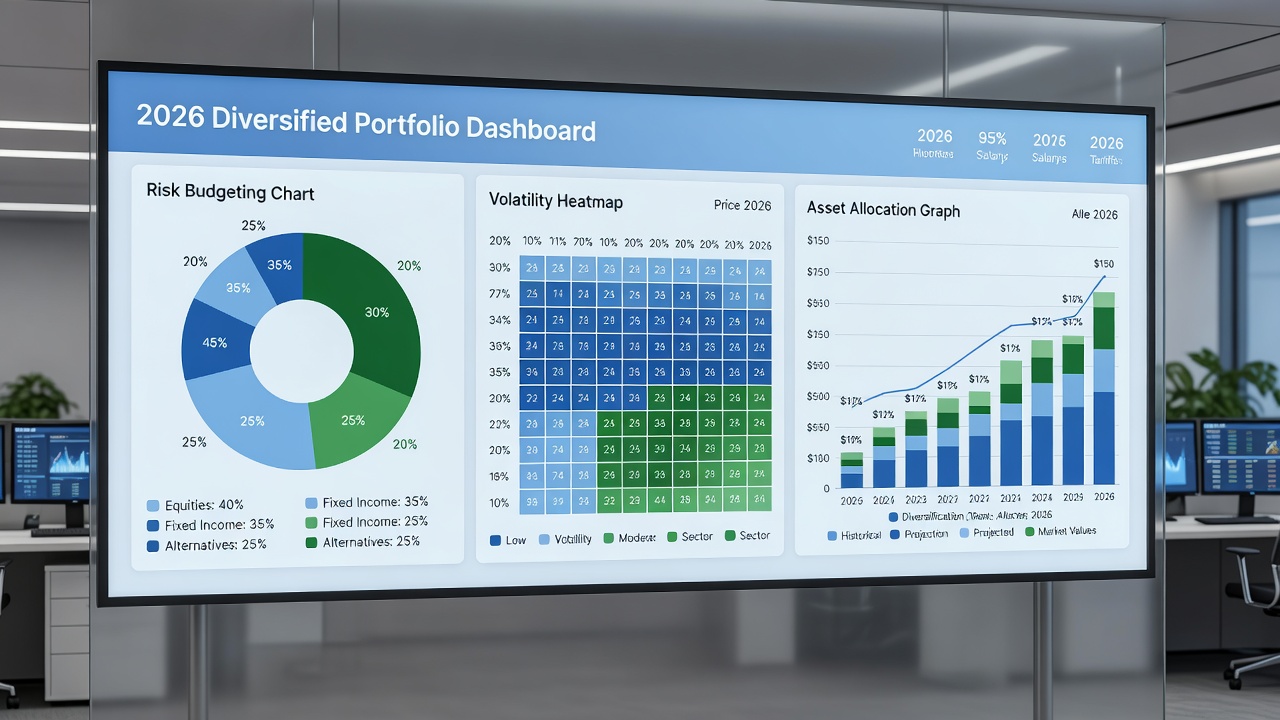
Introduction to Risk Budgeting in 2026 Markets
Experienced investors navigating 2026's volatile markets need sophisticated tools beyond traditional asset allocation. Risk budgeting shifts focus from capital weights to risk contributions, enabling more precise control over portfolio volatility and drawdowns. This approach helps achieve true diversification by ensuring no single risk factor dominates returns. In an environment marked by geopolitical tensions, fluctuating interest rates, and rapid technological shifts, relying solely on percentage-based allocations often leaves portfolios exposed to hidden concentrations of risk. Risk budgeting addresses this by quantifying and distributing volatility across holdings in a deliberate manner.
By allocating risk budgets across asset classes, portfolios can withstand geopolitical shocks, interest rate swings, and sector rotations expected this year. The method draws from institutional practices refined over decades, offering retail and professional investors alike a framework for more resilient outcomes. This article explores the underlying mechanics, provides actionable steps, and illustrates applications through real-world contexts.
Core Principles of Risk Budgeting
Risk budgeting allocates a total risk budget proportionally to each asset's contribution to overall portfolio volatility. Key concepts include marginal risk contribution, component risk contribution, and risk parity principles. Unlike capital allocation, where a 60/40 stock-bond split often concentrates risk in equities, risk budgeting equalizes exposures. Investors begin by defining an acceptable level of total portfolio risk, typically measured through standard deviation or more advanced metrics like expected shortfall. They then decompose this total risk into contributions from individual assets or factors, adjusting weights until each component aligns with the predetermined budget.
This framework integrates volatility, correlations, and tail risks. Investors define a target risk level, then optimize weights so each holding consumes an equal share of that budget. Additional layers incorporate liquidity considerations and regime-dependent correlations, recognizing that relationships between assets can change dramatically during stress periods. Advanced implementations also layer in scenario analysis to test how proposed risk budgets perform under hypothetical market crashes or inflation spikes.
Risk Budgeting vs. Traditional Asset Allocation
Traditional methods rely on market capitalization or simple percentage targets. Risk budgeting explicitly measures and caps risk exposures. For example, during periods of rising correlations, traditional diversification fails while risk budgeting dynamically rebalances to maintain target risk levels. A classic 60/40 portfolio may appear balanced by capital but can derive over 90 percent of its volatility from equities alone, leaving it vulnerable to equity-specific shocks. Risk budgeting corrects this imbalance by assigning explicit risk limits to each sleeve, often resulting in higher allocations to lower-volatility assets or derivatives overlays.
Studies from major institutions show risk-budgeted portfolios often deliver higher Sharpe ratios over full market cycles by avoiding unintended risk concentrations. The approach also supports better communication with stakeholders, as risk budgets can be expressed in intuitive percentages rather than abstract capital weights. Federal Reserve resources provide ongoing data on market volatilities that can inform these calculations.
Step-by-Step Implementation Guide
Implementing risk budgeting requires a structured process that combines data analysis with ongoing governance. Follow these detailed steps for effective deployment:
- Define your total portfolio risk tolerance using historical volatility or expected shortfall metrics. Consider personal factors such as investment horizon, liquidity needs, and tolerance for drawdowns during stress events.
- Identify asset classes and estimate their volatilities and correlations using recent data. Sources should include at least three to five years of daily or weekly returns, with adjustments for current market regimes.
- Calculate risk contributions for each asset using covariance matrices. This involves computing marginal contributions and scaling them by position sizes to derive component contributions.
- Optimize weights so risk contributions align with your chosen budget allocations. Use quadratic programming or specialized solvers to minimize deviations from target risk shares while respecting constraints like minimum diversification or liquidity thresholds.
- Monitor and rebalance quarterly or when market regimes shift. Establish triggers based on volatility spikes or correlation breakdowns to prompt reviews outside the regular schedule.
Practical tools include Python libraries like Riskfolio-Lib or commercial platforms from asset managers. Start with ETF proxies for accessibility before advancing to custom derivatives or private-market exposures. Document every assumption and revisit them annually to maintain relevance.
Integrating Risk Budgeting with Diversification Goals
Effective diversification requires spreading both capital and risk. Combine risk budgeting with factor exposures such as value, momentum, and low-volatility to further enhance resilience. Include alternatives like commodities or real assets to capture uncorrelated risks. Factor-based risk budgets can be layered on top of asset-class budgets, creating a multi-dimensional control system that addresses both systematic and idiosyncratic exposures.
Investors should map each asset to primary risk drivers, ensuring that equity beta, interest-rate duration, inflation sensitivity, and currency exposures receive separate risk allotments. This prevents over-allocation to any single macroeconomic driver and supports smoother performance across economic cycles. IMF publications offer global economic outlooks that help calibrate these factor sensitivities for 2026.

Real-World Examples from Institutional Portfolios
Leading pension funds and endowments apply risk budgeting to multi-asset mandates. A typical sovereign wealth fund might allocate 30 percent of total risk to equities, 25 percent to fixed income, 20 percent to alternatives, and the remainder to cash overlays, adjusting dynamically based on forward-looking volatility estimates. These institutions often employ risk parity extensions that incorporate leverage on low-volatility assets to equalize risk contributions without sacrificing expected returns.
Another example comes from large university endowments that have adopted risk-budgeted approaches to alternatives, capping private-equity risk contributions at 15 percent of total portfolio volatility despite large capital commitments. Such discipline helped these portfolios weather the 2022–2025 rate-hike cycle with smaller drawdowns than traditional peers. Retail investors can replicate simplified versions using liquid ETFs and public risk models, scaling complexity as assets grow.
Actionable Frameworks and Decision Tools
Beyond basic implementation, investors benefit from visual dashboards that track risk consumption in real time. Heat maps of marginal risk contributions highlight which assets are drifting outside their budgets. Stress-testing frameworks apply historical and hypothetical scenarios to verify that the overall risk budget remains intact under extreme conditions. Governance checklists ensure that rebalancing decisions follow predefined rules rather than discretionary judgment.
Compare multiple optimization runs—one with equal risk budgets, another tilted toward defensive factors—to understand trade-offs between return potential and stability. Maintain an audit trail of model inputs and outputs for regulatory or fiduciary review.
Common Pitfalls and FAQ
What data frequency should I use for risk estimates?
Use daily or weekly returns over at least three to five years, with exponential weighting for recency. Shorter windows can overreact to temporary spikes, while longer windows may miss structural breaks.
How often should risk budgets be reviewed?
Reassess at least quarterly and after major market events to avoid drift. Annual comprehensive reviews should also incorporate updated forward-looking assumptions.
Can retail investors implement this without institutional tools?
Yes, by starting with ETF-based proxies and publicly available risk calculators before scaling to custom optimization. Many brokerage platforms now offer basic risk-contribution analytics.
What are the most frequent implementation mistakes?
Common errors include ignoring correlation changes, over-fitting historical data, and failing to account for liquidity constraints during rebalancing. Another pitfall is treating risk budgets as static rather than dynamic targets that evolve with market conditions.
Conclusion
Risk budgeting offers a powerful evolution for 2026 portfolio construction. By focusing on risk rather than capital, investors achieve superior diversification and resilience. Begin with clear objectives, robust data, and disciplined monitoring to realize these benefits. Continued education through authoritative sources such as SEC investor resources supports ongoing refinement of these advanced techniques.


No comments yet. Be the first!