 Bullish Portfolio
Navigating 2026 Markets: The Hidden Traps of Behavioral Biases
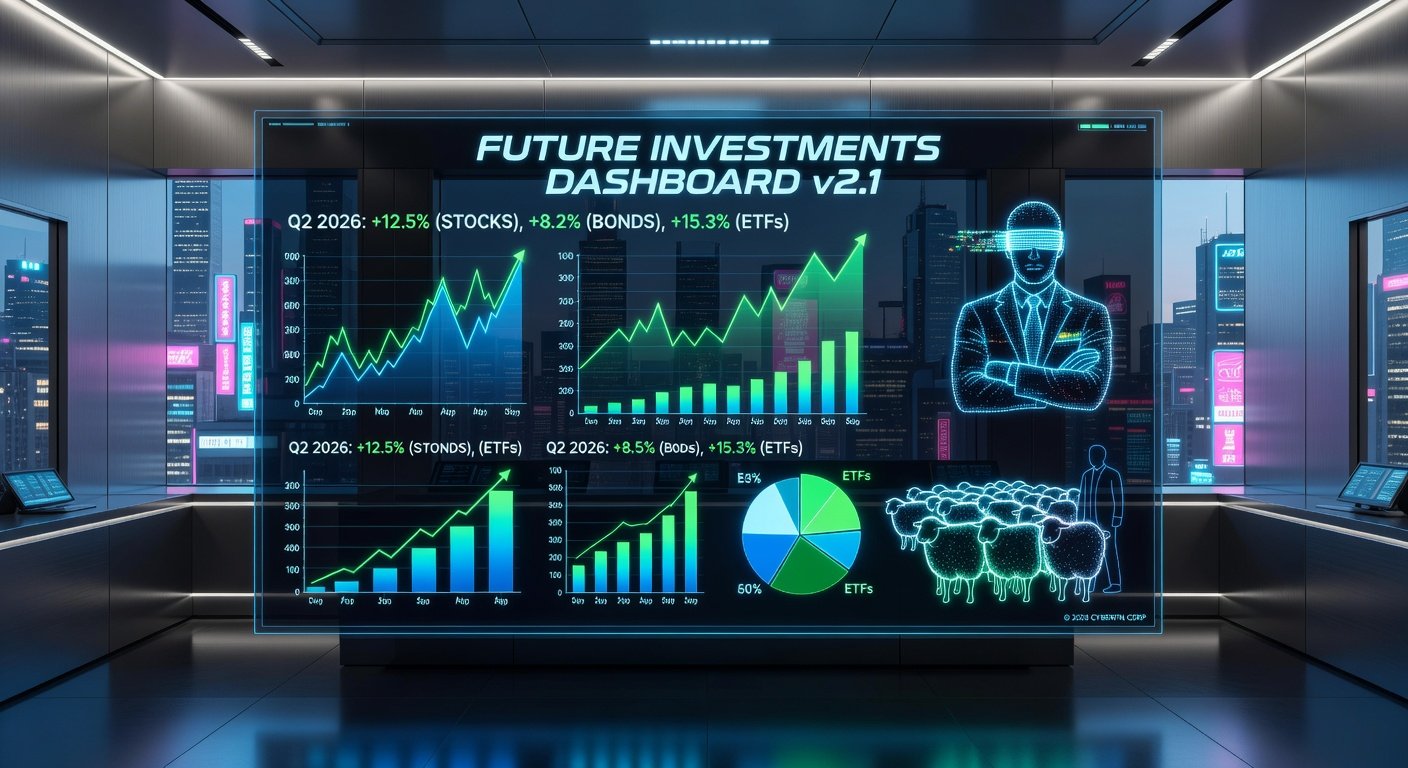
In the fast-evolving financial landscape of 2026, powered by AI-driven trading, quantum computing forecasts, and global economic shifts, investors face unprecedented opportunities—and pitfalls. Yet, amid sophisticated tools and data analytics, human psychology remains the weakest link. Behavioral biases like overconfidence and herd mentality continue to undermine portfolio management and diversification strategies. This article explores these common traps, their impact on modern portfolios, and practical techniques to enforce disciplined asset allocation and rebalancing for long-term success.
Understanding these biases isn't just academic; it's essential for preserving wealth in volatile markets. Studies from leading financial bodies show that emotional decision-making leads to underperformance by up to 2-4% annually. By implementing structured approaches, investors can counteract these instincts and build resilient portfolios.
Common Behavioral Biases Undermining Investors
Behavioral finance, a field blending psychology and economics, highlights how cognitive errors distort rational investing. Two prevalent biases—overconfidence and herd mentality—pose significant risks to diversification, the cornerstone of risk management.
Overconfidence: The Illusion of Control
Overconfidence bias occurs when investors overestimate their knowledge, predictive abilities, or control over outcomes. In 2026, with real-time sentiment analysis from social media and AI advisors, this bias amplifies. Traders might double down on tech stocks after a short winning streak, ignoring broader market signals.
This leads to concentrated positions, eroding diversification. For instance, an investor confident in AI hype might allocate 70% to semiconductor ETFs, vulnerable to sector downturns like the 2025 chip shortage ripple effects.
Herd Mentality: Following the Crowd
Herd mentality, or herd behavior, drives investors to mimic the masses, often at market peaks or troughs. Social media echo chambers and viral investment trends on platforms like X (formerly Twitter) exacerbate this in 2026. Remember the 2021 meme stock frenzy? Similar patterns emerged in 2025 with crypto-NFT hybrids, where late entrants suffered massive losses.
Herding undermines diversification by prompting panic selling during downturns or FOMO buying in bubbles, resulting in poorly timed entries and exits. Portfolios become undiversified as everyone piles into the same assets.
For deeper insights into these biases, check resources from the CFA Institute, a leader in investment education.
How Biases Erode Portfolio Management and Diversification
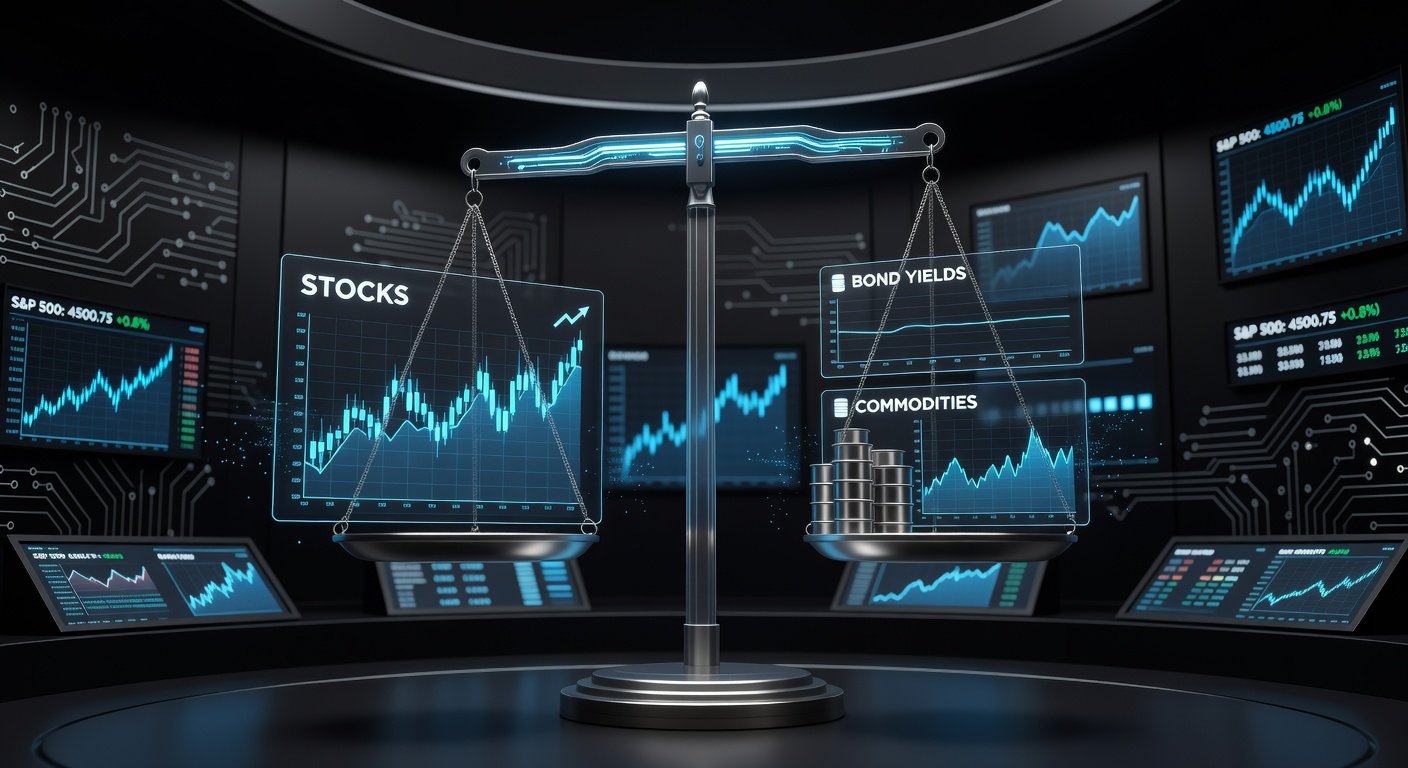
Diversification spreads risk across asset classes—stocks, bonds, real estate, commodities, and alternatives like crypto or ESG funds. Yet biases lead to "home bias" (favoring familiar assets) or over-reliance on recent winners.
In 2026 markets, characterized by geopolitical tensions and climate-driven volatility, undiversified portfolios amplify losses. Overconfident investors skip bonds during equity booms, only to face drawdowns when rates spike. Herding into megacap tech ignores value stocks or emerging markets, missing rebalancing opportunities.
The result? Higher volatility, lower Sharpe ratios, and suboptimal returns. Data from Morningstar indicates that bias-affected portfolios underperform diversified benchmarks by 1.5% annually over a decade.
Disciplined Asset Allocation: Building a Bias-Proof Foundation
Asset allocation—the strategic mix of assets based on risk tolerance, goals, and time horizon—is your first defense. Start with a target allocation: e.g., 60% equities, 30% fixed income, 10% alternatives for a moderate-risk portfolio.
- Assess Risk Profile: Use questionnaires or robo-advisors to quantify tolerance.
- Set Rules-Based Limits: Cap any asset class at 20-30% to enforce diversification.
- Incorporate 2026 Trends: Allocate to AI infrastructure, green energy, and defensive sectors like healthcare.
Avoid tinkering; review allocation quarterly, not daily, to curb overconfidence.
Rebalancing Techniques to Counteract Traps
Rebalancing restores your target allocation by selling outperformers and buying underperformers. It's a mechanical antidote to biases, forcing discipline.
Calendar-Based Rebalancing
Rebalance on fixed dates (e.g., end of quarter or year). Simple and effective, it prevents emotional drift.
Threshold-Based Rebalancing
Act when allocations deviate by 5-10%. This captures momentum while maintaining discipline. For example, if equities rise to 70% from 60%, sell 10% and buy bonds.
Tools and Automation
Leverage low-cost ETFs for broad exposure. Platforms like Vanguard or Betterment automate rebalancing. For more on diversification best practices, visit the U.S. Securities and Exchange Commission Investor.gov.
- Calculate drift: (Current % - Target %) / Target %.
- Execute trades tax-efficiently (e.g., in tax-advantaged accounts).
- Monitor transaction costs; aim for under 0.5% impact.
Real-World Examples from Recent Markets
Consider the 2025 "Quantum Bubble," where herd mentality drove quantum computing stocks up 300%, only to crash 60% on regulatory hurdles. Overconfident investors who ignored rebalancing saw portfolios halved, while disciplined ones—rebalanced quarterly—limited losses to 15%.
Another case: A retiree in 2024 over-allocated to bonds amid rate fears (herd behavior), missing the equity rebound. Implementing 5% threshold rebalancing would have preserved gains.
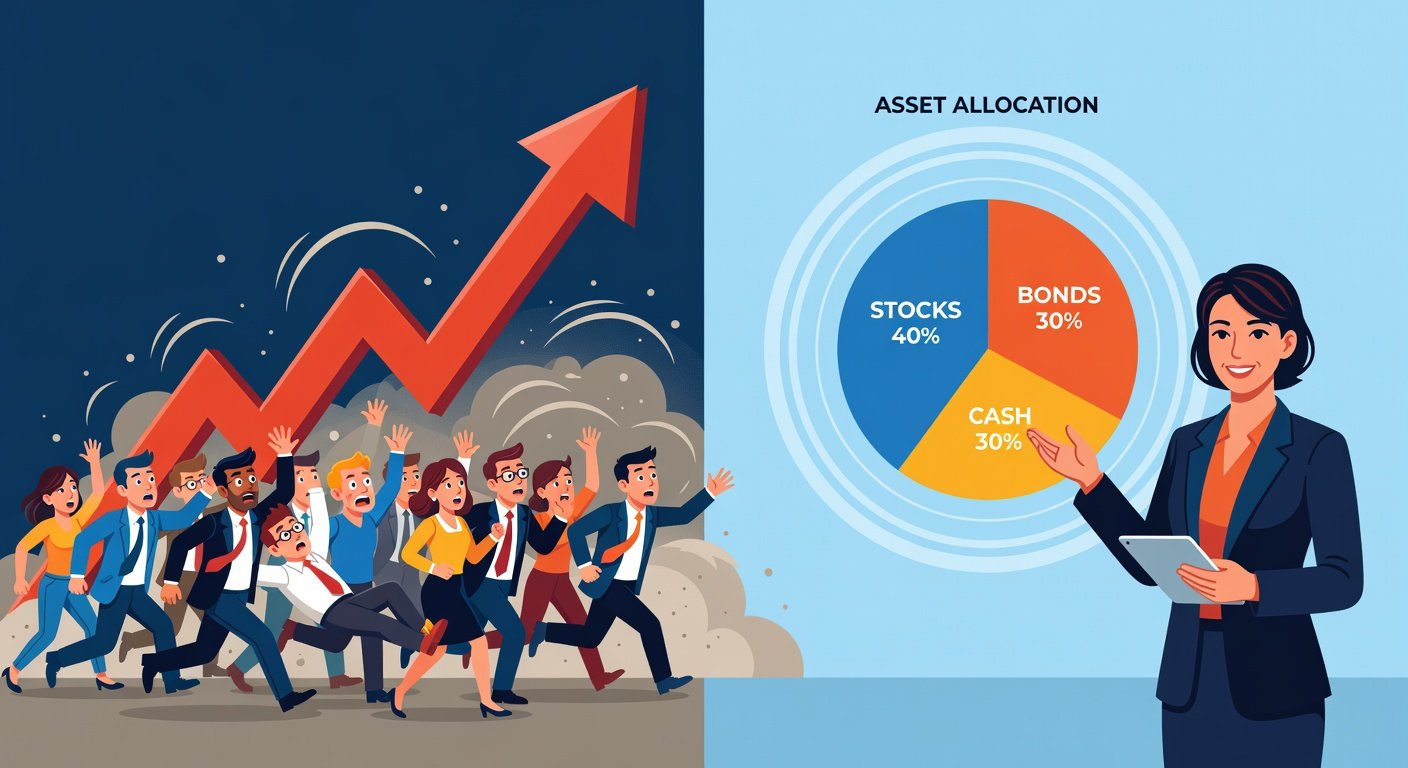
These examples underscore the power of rules over reactions. Backtests on platforms like Portfolio Visualizer show rebalanced portfolios outperforming buy-and-hold by 1-2% annually.
Essential Tools for Bias-Resistant Decision-Making
Empower your process with technology tailored for 2026:
- Portfolio Trackers: Morningstar or Personal Capital for real-time allocation views and alerts.
- Behavioral Nudges: Apps like StickK commit to rebalancing with penalties for inaction.
- AI Analytics: Tools from BlackRock's Aladdin or free alternatives like Yahoo Finance scanners to simulate scenarios.
- Journaling: Log decisions to spot bias patterns over time.
For comprehensive behavioral finance explanations, explore Investopedia.
Conclusion: Discipline Over Emotion in 2026 and Beyond
As markets grow more complex, mastering behavioral biases through disciplined asset allocation and rebalancing is non-negotiable. Start small: define your targets today, automate where possible, and review methodically. The investors who thrive in 2026 won't be the smartest or luckiest—they'll be the most disciplined. Commit to these strategies, and watch your portfolio weather any storm.
No comments yet. Be the first!