 Bullish Portfolio
Introduction to Goal-Based Portfolio Management
In 2026, investors are increasingly moving beyond traditional one-size-fits-all portfolio models toward personalized approaches that tie every investment decision directly to specific life goals. Goal-based portfolio management emphasizes defining clear financial objectives, assessing risk tolerance for each goal individually, and constructing tailored asset allocations that evolve with market conditions and personal timelines. This methodology allows investors to optimize diversification across equities, bonds, and alternative assets while maintaining flexibility for dynamic reallocation as circumstances change.
This framework helps households manage multiple competing priorities such as retirement, children's education, and home purchases simultaneously. By segmenting goals, investors can create more resilient portfolios that reduce the emotional stress of market volatility and improve long-term adherence to investment plans. The 2026 markets present unique opportunities and challenges, including evolving interest rate environments and sector-specific growth areas, making goal alignment more critical than ever.
Defining Financial Objectives Clearly
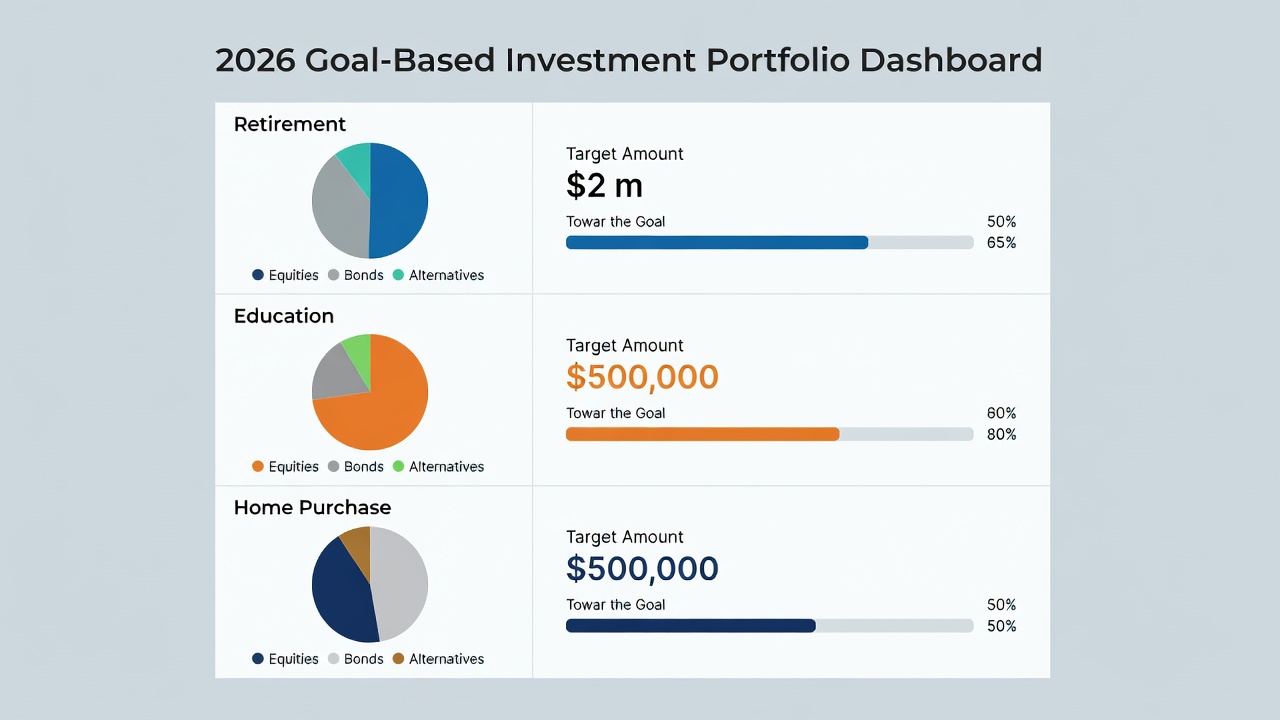
Effective goal-based management starts with precise objective setting. Investors should quantify each goal with a target amount, time horizon, and priority level. For example, a family might aim for $500,000 in education funding within 15 years or $2 million for retirement in 25 years. These details inform subsequent risk profiling and allocation decisions. It is also important to distinguish between essential goals, such as funding basic retirement living expenses, and aspirational goals like extensive travel or legacy planning.
Break down larger objectives into milestones. A retirement goal can be segmented into phases: early retirement covering the first decade, mid-retirement adjustments for healthcare needs, and late retirement focused on legacy transfer. This granular approach ensures that asset mixes remain appropriate at every stage rather than applying a static allocation across decades.
Risk Profiling Per Goal
Unlike traditional models that apply a single risk score to an entire portfolio, goal-based approaches create separate risk profiles. Short-term goals like a home down payment in three years warrant conservative allocations heavy in bonds, while long-term retirement goals can tolerate higher equity exposure. This segmentation reduces the chance of forced liquidations during market downturns and allows investors to accept calculated risks where time horizons permit recovery.
Risk profiling should incorporate both quantitative factors, such as volatility tolerance and liquidity needs, and qualitative elements like emotional comfort with drawdowns. Regular reassessment is recommended, especially after life events such as job changes or inheritance, to keep profiles aligned with current realities.
Step-by-Step Goal Segmentation
- List all major financial goals and assign timelines.
- Rank goals by importance and urgency, separating needs from wants.
- Calculate required annual contributions using conservative return assumptions and inflation adjustments.
- Group goals into buckets such as near-term (under 5 years), medium-term (5-15 years), and long-term (over 15 years).
- Assign initial contribution percentages from income or existing savings to each bucket.
- Document contingency plans for each goal in case of unexpected shortfalls.
Mapping Goals to Tailored Asset Mixes
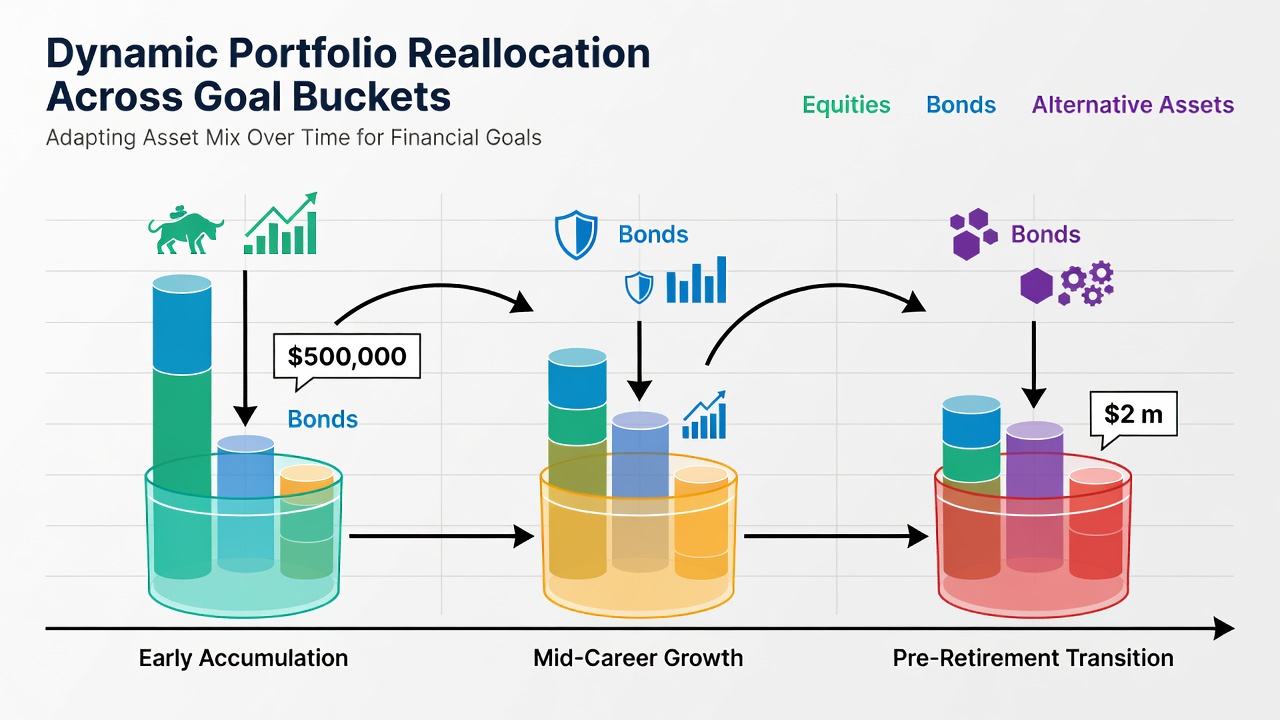
Once segmented, each goal bucket receives a customized mix. Near-term goals might allocate 70% bonds and 30% equities. Medium-term goals could use 50% equities, 30% bonds, and 20% alternatives like real estate investment trusts. Long-term goals often favor 70% equities with exposure to growth-oriented sectors and selective alternatives. Dynamic reallocation examples include shifting 10% from equities to bonds as a goal nears its target date or increasing alternative exposure during periods of equity volatility to maintain diversification.
Investors should also consider correlations between asset classes within each bucket. For instance, pairing international equities with domestic holdings can enhance diversification benefits in medium-term buckets while alternatives such as commodities may hedge inflation risks in longer-term allocations.
Performance Tracking Tools
Investors can leverage platforms that offer goal-specific dashboards, allowing real-time monitoring of progress against each objective. These tools often integrate Monte Carlo simulations to stress-test allocations under various 2026 market scenarios. Many platforms also provide automated alerts when allocations drift beyond predefined thresholds, prompting timely rebalancing without emotional decision-making.
SEC investor resources provide regulatory guidance on portfolio monitoring best practices. Additionally, IRS guidelines offer insights into tax-efficient tracking of investment accounts across multiple goals.
Case Studies of Multi-Goal Households
Consider a household with three goals: retirement in 20 years, college funding in 10 years, and a vacation home in 7 years. The retirement bucket holds 65% equities and 35% bonds. The college bucket uses 40% equities, 50% bonds, and 10% alternatives. The vacation home bucket maintains 20% equities and 80% bonds. Annual reviews allow rebalancing based on market movements and life changes. In one scenario, strong equity performance in year five prompted a partial shift from the retirement bucket into the college bucket to accelerate progress without increasing overall household risk.
Another case involves a single professional balancing debt repayment, emergency fund building, and long-term wealth accumulation. The emergency fund receives ultra-conservative treatment with short-term Treasuries, while wealth accumulation incorporates broader equity and alternative exposure. This separation prevents premature withdrawals from growth assets during short-term needs.
Comparisons to Traditional Approaches
Traditional mean-variance optimization often produces a single efficient frontier for the entire portfolio. Goal-based management creates multiple frontiers, one per objective, resulting in more resilient outcomes when goals have differing time horizons. This method also improves behavioral adherence because investors see direct connections between allocations and personal milestones. Studies from major financial institutions show that goal-aligned investors tend to maintain contributions during downturns at higher rates than those using blanket strategies.
Benefits of the Goal-Based Framework in 2026 Markets
The 2026 environment, characterized by shifting monetary policies and sector rotations, rewards investors who can adapt allocations without disrupting unrelated objectives. Goal-based management provides clear metrics for success beyond simple benchmark comparisons, focusing instead on probability of goal achievement. It also facilitates better communication with financial advisors by centering discussions on life outcomes rather than abstract performance numbers.
Common Mistakes to Avoid
- Over-allocating alternatives to short-term goals, which can create liquidity issues.
- Failing to update risk profiles after major life events.
- Ignoring tax implications when moving assets between goal buckets.
- Setting overly optimistic return assumptions that lead to under-saving.
FAQ: Common Implementation Challenges
How often should allocations be reviewed?
Conduct formal reviews at least annually or after major life events. Quarterly checks can identify drift but avoid over-trading.
What if goals conflict in priority?
Assign weights based on emotional and financial impact, then adjust contribution rates accordingly.
Are alternatives suitable for all goal buckets?
Alternatives add diversification but introduce liquidity considerations; reserve them primarily for medium- and long-term goals.
How do tax-advantaged accounts fit into goal segmentation?
Match account types to goal timelines, placing long-term objectives in tax-deferred vehicles where possible while keeping near-term needs in more accessible taxable or Roth accounts.
Conclusion
Goal-based portfolio management offers a structured path to align 2026 diversification strategies with real-life aspirations. By focusing on individualized risk profiles, dynamic reallocation, and dedicated tracking, investors achieve greater clarity and resilience across market cycles. Implementing this framework requires initial effort but delivers ongoing benefits through improved decision-making and measurable progress toward personal milestones.

No comments yet. Be the first!