 Bullish Portfolio

Introduction: Central Bank Policies and Portfolio Decisions in 2026
Central bank actions continue to drive asset allocation choices as economies adapt to evolving monetary frameworks. In 2026, investors face a landscape shaped by potential rate adjustments and balance sheet policies from institutions like the Federal Reserve and European Central Bank. This analysis examines these dynamics, emphasizing diversification across equities, bonds, and alternatives while providing forward-looking insights for advanced portfolio managers. Policy shifts influence risk premiums and capital flows, requiring proactive strategies beyond basic diversification. Understanding these impacts helps investors position portfolios for resilience amid uncertainty. Advanced investors must integrate macroeconomic signals with quantitative models to anticipate how decisions on interest rates and asset purchases ripple through global markets, affecting everything from corporate earnings to real estate valuations.
Key Central Bank Tools Affecting 2026 Markets
Interest rate decisions remain central, with quantitative easing or tightening altering liquidity conditions. Forward guidance from policymakers provides signals on future paths, affecting market volatility. For instance, sustained higher rates can pressure growth-sensitive assets while supporting income-generating ones. Balance sheet normalization further influences bond yields and equity valuations. Investors monitoring these tools gain an edge in anticipating sector rotations and geographic reallocations. Additional tools include reserve requirements and macroprudential regulations that indirectly shape lending and investment flows across borders.
Impacts on Equities
Equity markets respond to policy through cost of capital changes. Rate hikes typically compress multiples in high-growth sectors, while easing supports broader rallies. In 2026 scenarios, diversified equity exposure across value and defensive stocks may mitigate volatility from policy surprises. Global equities face added layers from differing regional policies, such as divergent paths between the US and emerging markets. Scenario analysis shows that coordinated easing could boost international allocations. Sector-specific effects often emerge, with technology and consumer discretionary stocks showing heightened sensitivity to rate expectations compared to utilities or healthcare names.
Impacts on Bonds
Bond portfolios experience direct effects from rate movements and quantitative measures. Rising rates reduce existing bond prices, favoring shorter-duration holdings. Quantitative tightening reduces demand for government securities, potentially steepening yield curves. Investors often shift toward inflation-protected bonds or corporate debt in tightening environments. This section highlights how duration management integrates with overall asset allocation. Credit spreads may widen during periods of aggressive policy normalization, prompting active managers to favor investment-grade over high-yield segments.
Impacts on Alternatives
Alternatives like real estate, commodities, and private equity offer hedges against policy-driven inflation or liquidity shifts. Commodities may benefit from certain easing cycles, while real assets provide income stability when rates remain elevated. Private markets adjust more slowly to policy signals, requiring careful timing in allocation decisions. Diversification into these areas enhances portfolio robustness in 2026 projections. Infrastructure investments, for example, frequently deliver predictable cash flows that buffer against sudden rate volatility.
Forward-Looking Projections for 2026
Projections indicate that persistent policy divergence between major central banks could lead to currency fluctuations and cross-border capital movements. Baseline forecasts suggest moderate easing in the second half of the year, potentially lifting equity multiples while capping bond yields. Stress scenarios involving renewed inflation pressures might prompt extended tightening, favoring cash-equivalent instruments and short-term fixed income. These projections underscore the value of maintaining dynamic allocation frameworks that allow rapid rebalancing.
Scenario Comparisons for Policy Environments
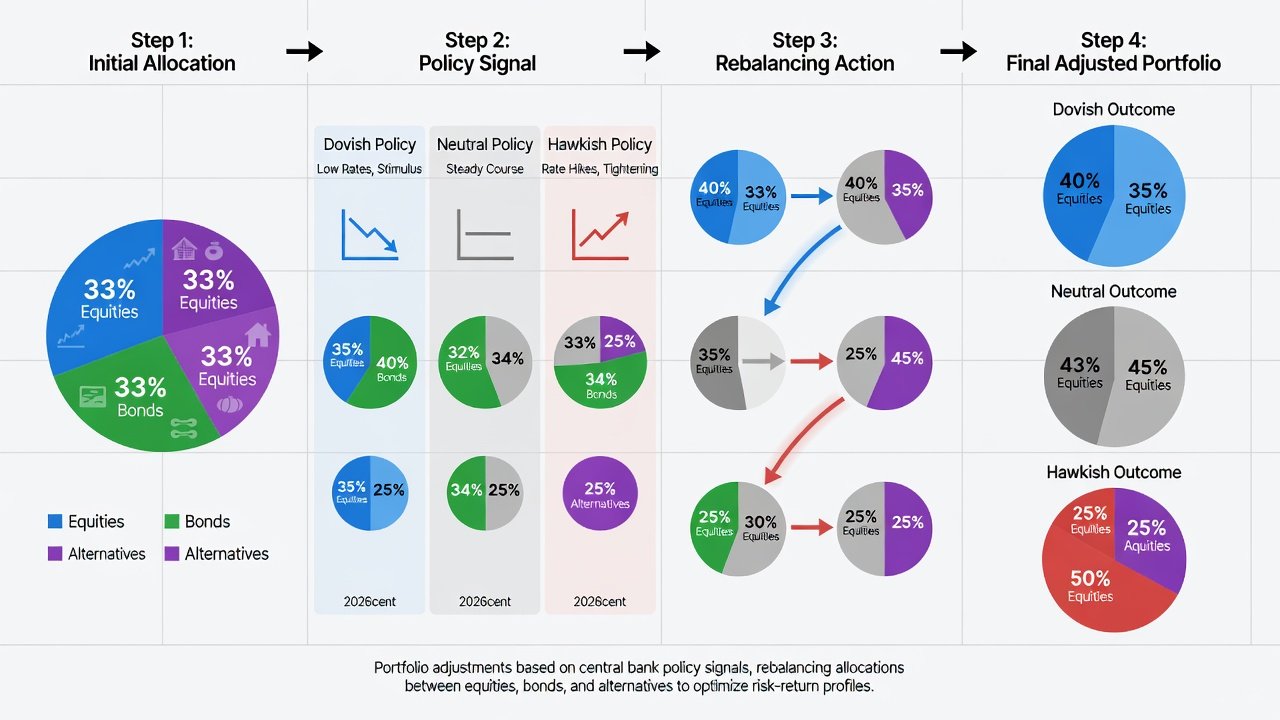
Baseline scenario: Gradual rate cuts support balanced growth across asset classes. Aggressive tightening could favor defensive equities and short-term bonds. Coordinated global easing might elevate risk assets and emerging market exposure. High-rate persistence: Prioritize quality bonds and dividend equities. Easing cycle: Increase equity weightings with focus on cyclical sectors. Mixed regional policies: Emphasize geographic diversification via ETFs. Each scenario requires tailored risk budgeting, with volatility targeting helping to maintain consistent exposure levels regardless of policy direction.
Step-by-Step Portfolio Adjustment Process
- Assess current policy outlooks from major central banks using official statements and meeting minutes.
- Stress-test allocations against rate and liquidity scenarios using historical analogs and Monte Carlo simulations.
- Rebalance toward underweighted asset classes like alternatives for added resilience against inflation surprises.
- Implement hedges such as options on bond positions or currency overlays to protect against timing mismatches.
- Monitor quarterly and adjust based on new forward guidance, incorporating feedback loops from performance attribution.
- Document decisions and review with fiduciary oversight to ensure alignment with long-term objectives.
Real-World Investor Examples
Consider a pension fund that reduced long-duration bonds ahead of 2026 tightening signals, reallocating to infrastructure assets for stable returns. Another example involves a family office increasing commodity exposure during anticipated easing phases to capture inflation protection. A third case features a sovereign wealth fund that layered currency-hedged international equities after observing divergent policy stances between the Fed and ECB, resulting in improved Sharpe ratios over the subsequent quarters. These cases illustrate practical application of policy-aware strategies, blending quantitative analysis with qualitative policy tracking.
Practical Checklist for Policy-Responsive Allocation
- Review central bank calendars monthly for upcoming decisions and prepare contingency plans.
- Maintain 20-30% allocation to alternatives for diversification across economic regimes.
- Use duration ladders in fixed income to manage rate risk while preserving liquidity.
- Incorporate scenario planning tools for equity and bond mixes with clear rebalancing triggers.
- Consult global sources for cross-border policy impacts and currency implications.
- Conduct annual reviews of manager mandates to confirm alignment with evolving policy realities.
Frequently Asked Questions on Policy Timing Risks
How do sudden policy shifts affect timing?
Unexpected announcements can trigger immediate repricing, underscoring the need for flexible mandates and liquidity buffers in portfolios. Maintaining dry powder allows opportunistic entry points without forced sales.
What role does diversification play against timing errors?
Broad diversification across uncorrelated assets reduces the impact of mistimed adjustments, smoothing returns over policy cycles and lowering overall portfolio drawdowns.
Are there tools to better forecast central bank moves?
Market-implied probabilities from futures and surveys from institutions like the Bank for International Settlements aid in probabilistic planning and help quantify tail risks.
How should retail investors without direct central bank access approach this?
They can leverage publicly available data from sources like the Federal Reserve and European Central Bank while using low-cost index products that automatically adjust to market signals.
Conclusion
Central bank policies in 2026 demand nuanced asset allocation that integrates rate outlooks, quantitative tools, and cross-asset diversification. By following structured processes and learning from real examples, advanced investors can navigate shifts effectively. Ongoing monitoring through authoritative channels supports informed decisions for sustained portfolio performance in an increasingly interconnected financial environment.

No comments yet. Be the first!