 Bullish Portfolio

Why Asset Allocation Matters for 2026 Portfolios
In the face of escalating market volatility driven by geopolitical tensions, AI disruptions, and interest rate fluctuations, savvy investors are turning to refined asset allocation strategies for 2026. Asset allocation—the practice of dividing investments across stocks, bonds, real estate, commodities, and alternatives—remains the cornerstone of portfolio management. According to the U.S. Securities and Exchange Commission (SEC), proper allocation can significantly reduce risk while enhancing long-term returns.
This article details eight proven strategies, ranging from tactical to dynamic methods. Each boosts diversification by spreading risk and improves returns through adaptive positioning in uncertain markets. We'll also compare their suitability for conservative retirees, moderate professionals, aggressive young investors, and high-net-worth individuals.
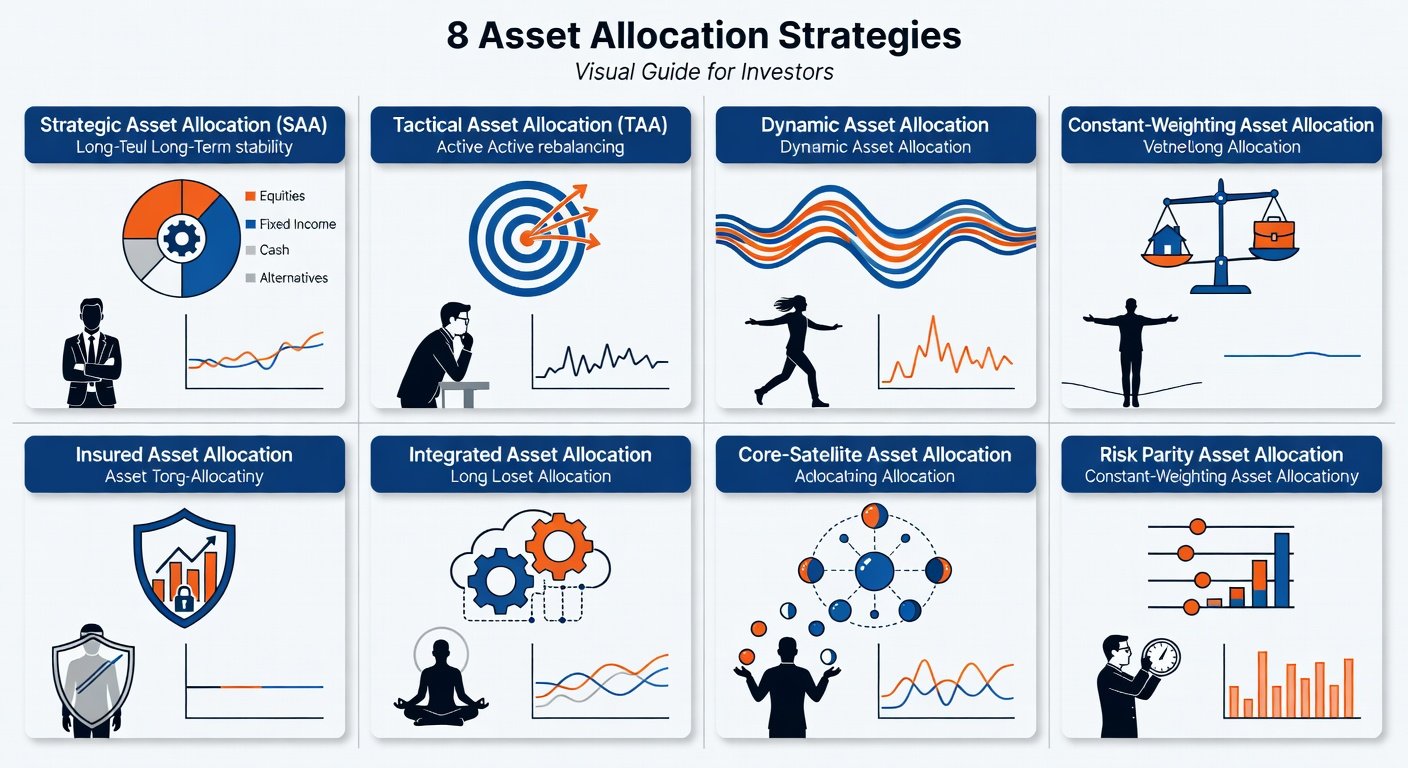
The 8 Proven Asset Allocation Strategies
1. Strategic Asset Allocation (SAA)
SAA sets a fixed long-term mix, like 60% equities and 40% fixed income, rebalanced periodically. It emphasizes buy-and-hold discipline, leveraging historical mean reversion for steady growth.
Diversification Boost: Broad exposure across asset classes mitigates sector-specific downturns.
Long-Term Returns in Volatility: Rebalancing sells high and buys low, capturing gains over decades.
Suitability: Ideal for passive, hands-off investors like retirees seeking stability.
2. Tactical Asset Allocation (TAA)
TAA makes short-term deviations from SAA based on economic forecasts, overweighting undervalued assets temporarily.
Diversification Boost: Dynamic shifts prevent overconcentration during bubbles.
Long-Term Returns: Enhances alpha by timing cycles, outperforming SAA in choppy markets.
Suitability: Moderate-risk professionals comfortable with quarterly adjustments.
3. Dynamic Asset Allocation
This strategy ramps up equities in bull markets and pivots to bonds during downturns, using momentum indicators.
Diversification Boost: Fluid weighting across risk assets adapts to volatility spikes.
Long-Term Returns: Protects capital in crashes while riding uptrends for compounded growth.
Suitability: Aggressive investors tolerant of frequent changes.
4. Constant Mix Asset Allocation
Maintains fixed proportions regardless of market moves, aggressively rebalancing against trends.
Diversification Boost: Forces contrarian moves, balancing growth and defensive assets.
Long-Term Returns: Excels in oscillating markets by selling winners and buying losers.
Suitability: Patient investors with moderate risk appetite.
5. Insured Asset Allocation
Sets a floor (e.g., 90% of initial capital) and shifts to safe assets if breached, allowing upside participation otherwise.
Diversification Boost: Combines growth assets with a safety net.
Long-Term Returns: Preserves principal in volatility, enabling recovery-focused rebounds.
Suitability: Conservative retirees prioritizing capital protection.
6. Integrated Asset Allocation
Incorporates economic expectations, risk tolerance changes, and life stage into ongoing adjustments.
Diversification Boost: Holistic view includes human capital and liabilities.
Long-Term Returns: Personalizes for sustained compounding amid life events.
Suitability: High-net-worth individuals with evolving needs.
7. Risk Parity
Allocates based on equal risk contribution from each asset, often leveraging low-vol bonds and commodities.
Diversification Boost: Balances volatility, not dollar amounts, for true risk spreading.
Long-Term Returns: Performs well in non-correlated environments like 2026's inflation scares.
Suitability: Sophisticated moderate-aggressive investors; see Vanguard's resources for implementation.
8. 60/40 Portfolio with Alternatives
Classic 60% stocks/40% bonds, augmented with 10-20% real estate, gold, or crypto for 2026 relevance.
Diversification Boost: Alternatives hedge inflation and equity drawdowns.
Long-Term Returns: Smooths returns historically, adapting to low-yield bonds.
Suitability: Broad appeal for balanced, long-horizon investors.
Comparing Strategies by Investor Profile
To choose the right fit, consider these profiles:
- Conservative Retirees: Insured or SAA—prioritize floors and stability (low volatility tolerance).
- Moderate Professionals (35-55): TAA or Constant Mix—moderate tweaks for growth without extremes.
- Aggressive Young Investors: Dynamic or Risk Parity—maximize upside with volatility embrace.
- High-Net-Worth: Integrated—customizes for taxes, estate, and philanthropy.
| Strategy | Risk Level | Management Effort | Best For |
|---|---|---|---|
| SAA | Low | Low | Retirees |
| TAA | Medium | Medium | Professionals |
| Dynamic | High | High | Young Aggressives |
| Constant Mix | Medium | Medium | Balanced |
| Insured | Low | Low-Medium | Conservatives |
| Integrated | Varies | High | HNW |
| Risk Parity | Medium-High | Medium-High | Sophisticated |
| 60/40+Alts | Medium | Low | All |
For deeper insights, explore Investopedia's asset allocation guide.
Implementing for 2026 Success
2026 forecasts point to persistent volatility from elections, tech shifts, and climate policies. Start with your risk tolerance assessment, use low-cost ETFs for execution, and rebalance annually or on 5-10% drifts. Backtests show these strategies outperforming buy-and-hold by 1-3% annually with lower drawdowns.
Combine approaches—e.g., SAA core with TAA satellites—for hybrid resilience. Consult a fiduciary advisor for personalization. Diversified allocation isn't just theory; it's your edge in turbulent times.


No comments yet. Be the first!