 Bullish Portfolio

Introduction: Why Industrial REITs Stand Out in 2026
The ongoing evolution of global supply chains, fueled by e-commerce expansion and nearshoring initiatives, positions industrial real estate investment trusts (REITs) as compelling vehicles for passive income. Investors seeking reliable dividend streams in 2026 can benefit from sector-specific dynamics that traditional assets often lack. This article examines the underlying trends, practical selection methods, and portfolio integration strategies tailored to current market conditions. Industrial REITs have emerged as a resilient choice because they own and operate warehouses, distribution centers, and logistics facilities that directly support the movement of goods in an increasingly digital economy.
E-commerce and Supply Chain Trends Driving Industrial Demand
E-commerce continues to reshape logistics needs, requiring more warehouse space near population centers and transportation hubs. Supply chain disruptions from recent years have accelerated reshoring and friend-shoring, increasing occupancy in key industrial markets. These shifts create sustained demand for modern facilities, supporting lease growth and dividend sustainability across the sector. The rise of same-day and next-day delivery expectations means companies require strategically located properties that minimize transportation times, further boosting the value of well-positioned industrial assets. Industrial properties benefit from longer lease terms compared to retail or office assets, providing predictable cash flows essential for consistent payouts to shareholders. As consumer behavior shifts permanently toward online purchasing, the need for fulfillment centers grows steadily, creating a structural tailwind for the sector that is expected to persist well into the decade.
Key Selection Criteria for Industrial REITs
Occupancy Rates
High occupancy levels signal strong tenant demand and operational efficiency. Focus on REITs maintaining rates above 95 percent in primary logistics corridors, as this stability directly supports dividend coverage. Investors should review quarterly occupancy reports and compare them against peer averages to identify leaders in the space. Properties with high occupancy also tend to attract creditworthy tenants such as major retailers and third-party logistics providers, reducing the risk of vacancies during economic slowdowns.
Lease Growth Potential
Examine embedded rent escalators and mark-to-market opportunities in existing portfolios. REITs with significant exposure to e-commerce tenants often demonstrate superior renewal spreads due to limited supply of suitable space. Look for portfolios where a large percentage of leases are set to expire in the coming years, allowing for upward adjustments in rental income that flow directly to higher distributions for investors.
Yield Sustainability
Assess payout ratios and balance sheet strength. Sustainable yields stem from diversified tenant bases and conservative leverage, reducing vulnerability to economic cycles. A payout ratio below 70 percent of funds from operations typically indicates room for future dividend increases while maintaining financial flexibility.
Real portfolio examples include established players like Prologis and EastGroup Properties, which have demonstrated resilience through targeted acquisitions in high-growth markets. These companies maintain diversified holdings across major U.S. distribution hubs and have historically delivered consistent dividend growth tied to rising rental rates.
Real-World Portfolio Examples and Performance Patterns
When evaluating industrial REITs, investors often review specific holdings such as large-scale logistics parks in Southern California or the Midwest. These examples illustrate how location near major ports and rail lines translates into lower vacancy risk and stronger rent growth. By studying annual reports and earnings calls, one can see how successful REITs recycle capital by selling mature assets and reinvesting in higher-yielding developments, a strategy that supports long-term income growth for shareholders.
Sector Comparison: Industrial REITs Versus Traditional REITs and Dividend Stocks
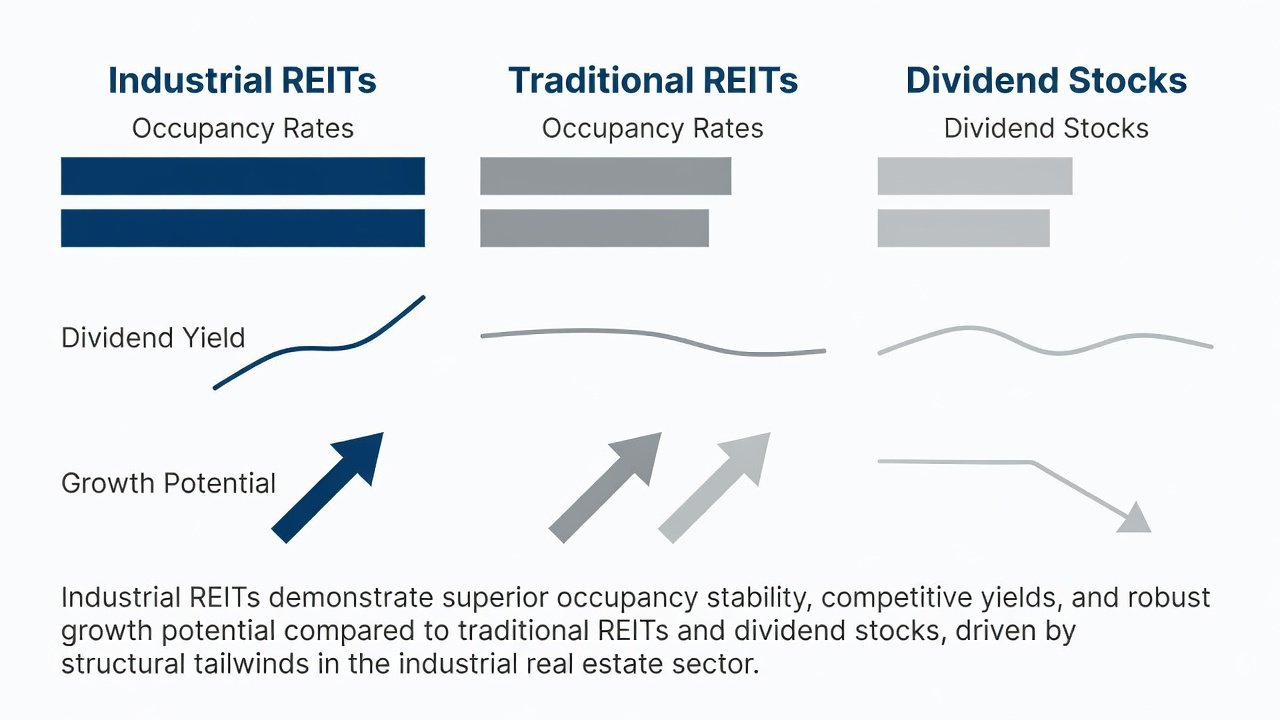
Step 1: Evaluate correlation with economic cycles. Industrial REITs show lower volatility than retail or hospitality REITs due to essential logistics functions that remain necessary regardless of consumer spending patterns.
Step 2: Compare dividend growth histories. Industrial names frequently deliver steady increases tied to contractual rent bumps, outperforming many dividend stocks reliant on corporate earnings that can fluctuate with quarterly results.
Step 3: Analyze total return potential. The combination of yield plus appreciation from property value growth often exceeds broad equity dividend strategies in supply-chain-sensitive environments, particularly when e-commerce penetration continues to rise.
Step 4: Review liquidity and accessibility. Publicly traded industrial REITs offer daily trading unlike direct real estate, while providing sector specialization absent in broad dividend ETFs.
Step 5: Consider inflation hedging characteristics. Industrial properties often include lease clauses that pass through rising operating costs to tenants, offering better protection than many fixed-income dividend stocks during periods of elevated inflation.
Step 6: Assess management quality and track record. Strong teams with proven acquisition and development capabilities tend to outperform peers over multi-year cycles, making them preferable for passive income portfolios focused on reliability.
Practical Allocation Tactics for 2026
Begin by allocating 10-20 percent of a fixed-income or dividend portfolio to industrial REITs, adjusting based on overall risk tolerance. Diversify across multiple REITs to mitigate single-asset concentration. Rebalance annually to capture new lease growth while monitoring interest rate sensitivity. Consider dollar-cost averaging during periods of market uncertainty to build positions gradually. Investors may also explore pairing industrial REITs with complementary holdings in transportation infrastructure for broader exposure to supply chain trends. Regular review of portfolio weightings ensures the allocation remains aligned with evolving economic conditions and personal income goals.
Risk Mitigation Strategies
Monitor interest rate movements, as higher borrowing costs can pressure valuations. Prioritize REITs with staggered debt maturities and strong interest coverage ratios. Geographic diversification across U.S. markets reduces exposure to regional slowdowns. Maintain a long-term horizon to weather short-term fluctuations in occupancy or rent growth. Additional tactics include reviewing tenant concentration reports to avoid over-reliance on any single industry and maintaining cash reserves for opportunistic purchases during market corrections. Investors should also stay informed about regulatory changes affecting zoning or environmental standards that could impact development pipelines.
Conclusion
Industrial REITs offer a strategic pathway to passive income amid evolving supply chains in 2026. By applying rigorous selection criteria and thoughtful allocation, investors can build resilient dividend streams while managing downside risks effectively. The sector's structural advantages position it well for continued relevance in a logistics-driven economy.
FAQ
What are typical entry points for new investors?
New investors can begin through brokerage accounts by purchasing shares of established industrial REITs during market dips or via dollar-cost averaging to smooth volatility. Starting with well-known names that have transparent reporting practices helps build confidence while learning sector dynamics.
How are industrial REIT dividends taxed?
Dividends are generally taxed as ordinary income, though qualified dividends may receive preferential rates; consult a tax advisor for individual circumstances and consider holding in tax-advantaged accounts where appropriate. Understanding the distinction between ordinary and capital gains distributions can help optimize after-tax returns over time.


No comments yet. Be the first!