 Bullish Portfolio

Introduction to Options-Enhanced REIT Strategies
Real estate investment trusts (REITs) have long served as reliable vehicles for passive income through consistent dividends. In 2026, investors facing volatile markets are turning to options overlays—specifically covered calls and protective puts—to enhance returns while controlling downside exposure. This approach layers option premiums onto standard REIT holdings, potentially lifting overall yields beyond baseline dividend distributions. The strategy appeals particularly to those seeking higher passive income without shifting entirely into higher-risk assets, as REITs continue to benefit from structural demand in logistics, housing, and medical facilities amid evolving economic conditions.
By writing covered calls against owned REIT shares, investors collect premiums that supplement dividends. Protective puts add a safety net during market dips. Together, these tactics create a more robust income stream suited to uncertain economic conditions. Many retirees and income-focused portfolios now incorporate these methods to offset inflation pressures and interest-rate fluctuations that have characterized recent years.
Selecting Suitable REITs for Options Overlay
Not every REIT works equally well with options strategies. Focus on those with high liquidity, moderate volatility, and strong underlying fundamentals. Equity REITs in sectors like residential, industrial, and healthcare often provide the necessary share volume for tight option spreads. Avoid thinly traded or highly speculative REITs, as wide bid-ask spreads can erode option premiums. Investors should examine average daily volume, open interest on the options chain, and historical price stability before committing capital.
Key criteria include average daily trading volume above institutional thresholds, consistent dividend history, and favorable sector tailwinds such as e-commerce growth for industrial properties. Investors should review options chains on major exchanges to confirm strike prices and expirations align with their income goals. Resources from NAREIT offer sector-level data that can help narrow choices. Diversifying across three to five REITs reduces concentration risk while maintaining sufficient liquidity for options trading.
Covered Calls: Generating Premium Income
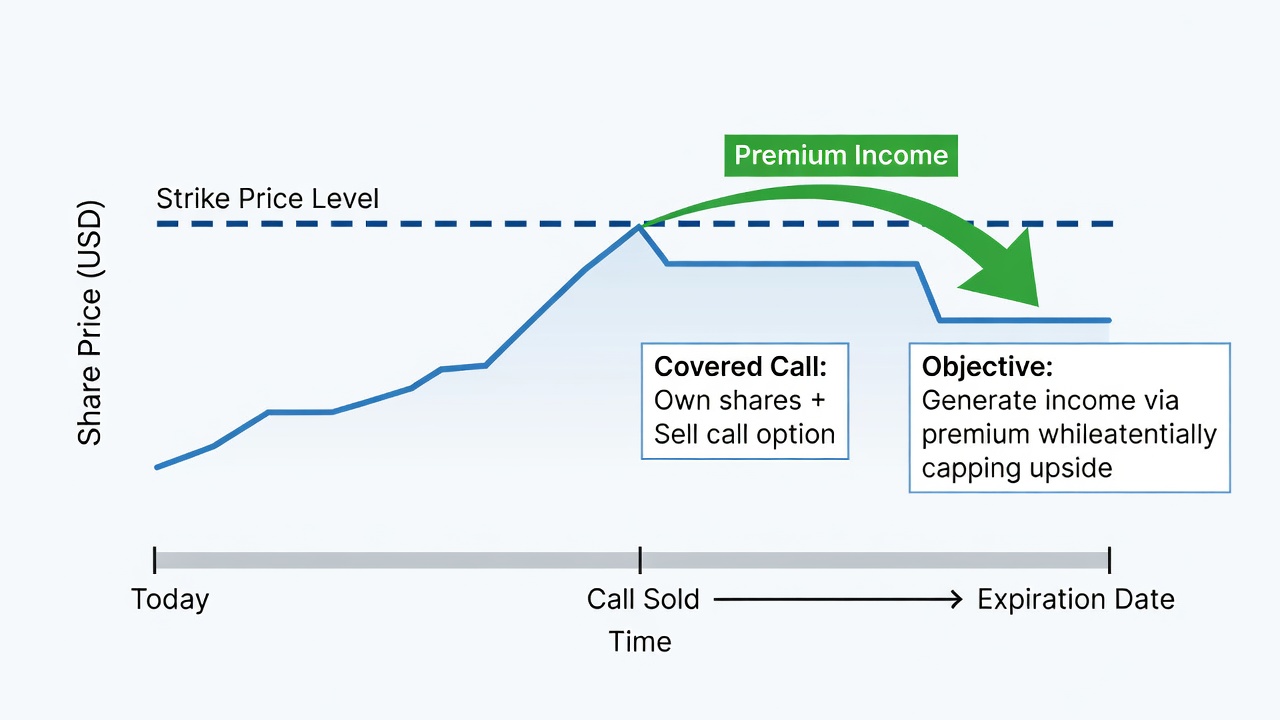
A covered call involves owning at least 100 shares of a REIT and selling call options against them. The premium received provides immediate income, which stacks on top of quarterly dividends. This strategy performs best in sideways or mildly bullish markets where the REIT price stays below the call strike. The income boost can be especially valuable when dividend growth slows due to higher borrowing costs or slower rent increases.
For example, an investor holding shares of a major industrial REIT might sell monthly out-of-the-money calls. If the calls expire worthless, the premium adds to total return. Should the price rise above the strike, shares may be called away at a profit plus the premium collected. Rolling contracts forward or choosing staggered expirations allows continuous premium collection while adapting to price movements.
Protective Puts: Managing Downside Risk
Protective puts function as insurance. Buying put options on REIT holdings caps losses if prices decline sharply. While this costs a premium, it protects capital during recessions or sector-specific shocks such as rising interest rates. Investors often implement these puts selectively during periods of elevated volatility rather than year-round to control costs.
Investors often pair protective puts with covered calls in a collar strategy, selling calls to offset put costs. This creates a defined risk-reward range that supports steady passive income collection. The net effect is a more predictable return profile that appeals to conservative income investors who still want some upside participation.
Calculating Enhanced Yields
Baseline REIT dividend yields can be augmented by net option premiums. The enhanced yield formula subtracts the cost of any protective puts from combined dividend and call-premium income, then divides by the REIT share price. Regular recalculation helps investors compare outcomes across different market regimes. Tracking performance over multiple quarters reveals whether the overlay consistently adds value after accounting for transaction costs and potential opportunity losses from capped gains.
Spreadsheet models or portfolio software can automate these calculations, allowing investors to stress-test scenarios such as a 10% REIT price drop or a sharp volatility spike. Consistent documentation of results also supports better tax planning at year-end.
Real Portfolio Examples with 2026 Projections
Consider a diversified portfolio allocating 40% to industrial REITs, 30% to residential, and 30% to healthcare. Overlaying monthly covered calls on half the position while maintaining protective puts on the remainder can produce a total return profile exceeding pure dividend income in flat markets. Projections for 2026 assume continued demand for logistics properties and stable occupancy rates, though actual results depend on interest-rate paths and economic growth. Rebalancing annually helps maintain the desired sector weights as individual REIT performances diverge.
Step-by-Step Trade Setups
- Identify eligible REITs meeting liquidity and options availability standards.
- Determine position size based on risk tolerance and overall portfolio allocation, typically limiting any single REIT to 5-10% of total holdings.
- Select expiration and strike prices aligned with income objectives and market outlook, favoring 30-45 day durations for covered calls to balance premium collection and flexibility.
- Execute the covered call or protective put trade through a brokerage platform supporting options on REITs, confirming margin availability beforehand.
- Monitor positions daily and adjust or roll contracts as needed before expiration, setting alerts for key price levels.
Risk Management Tactics
Effective risk controls include position sizing limits, regular delta monitoring, and avoiding earnings announcements when volatility spikes. Diversification across REIT sectors reduces single-asset exposure. Investors should also maintain cash reserves to handle margin requirements or early assignment scenarios. Another important tactic is using stop-loss orders on the underlying REIT shares in addition to options protection, creating multiple layers of defense against unexpected market moves.
Understanding assignment risk and the tax consequences of short-term versus long-term capital gains is essential for preserving after-tax returns. Keeping detailed trade logs supports compliance and performance review.
Baseline Dividends Versus Options-Enhanced Returns
Traditional REIT strategies rely solely on dividends, which fluctuate with property performance. Options-enhanced approaches add a second income layer but introduce trade-offs such as limited upside and added complexity. Side-by-side comparisons often favor the enhanced method in low-volatility environments while highlighting the need for active oversight during rapid market moves. Investors should periodically run both scenarios using historical data to quantify the incremental benefit net of fees and taxes.
Common Mistakes to Avoid
One frequent error is selecting REITs with insufficient options liquidity, leading to wide spreads that diminish premium income. Another is over-allocating to covered calls during strong bull markets, resulting in early assignment and missed further gains. Failing to account for tax treatment differences between premiums and dividends can also reduce net returns. Finally, neglecting to adjust protective put coverage as portfolio values change leaves positions under- or over-hedged.
FAQ on Tax Implications and Broker Requirements
What are the tax implications of options-enhanced REIT income?
Option premiums are typically taxed as short-term capital gains. Dividends from REITs may qualify for qualified dividend treatment or be classified as ordinary income. Consult IRS guidelines at IRS.gov for current rules.
Which brokers support REIT options trading?
Most major brokerages offering options approval levels 2 or higher accommodate REIT options. Verify margin requirements and platform tools before initiating trades. Regulatory details appear on the SEC website.
Are there additional costs beyond commissions?
Investors should account for bid-ask spreads, potential early assignment fees, and any platform-specific options data subscriptions. Always review the broker's fee schedule.
Conclusion
Options-enhanced REIT strategies offer a sophisticated path to higher passive income in 2026 by blending covered calls and protective puts with traditional holdings. Careful REIT selection, disciplined trade execution, and ongoing risk management enable investors to capture premium income while safeguarding principal. As markets evolve, this integrated approach provides flexibility and resilience for long-term wealth building.


No comments yet. Be the first!