 Bullish Portfolio

Introduction: Navigating REIT Dividends Amid 2026 Rate Volatility
Interest rate fluctuations remain one of the most significant drivers of real estate investment trust (REIT) performance. As central banks adjust policy in 2026, passive income investors must adapt their dividend strategies to protect yields and total returns. This guide examines how rate shifts influence REIT cash flows, highlights resilient sectors, and provides a concrete framework for portfolio adjustments. REITs serve as a popular vehicle for generating passive income through regular dividend distributions backed by rental revenues from commercial properties. Understanding the interplay between borrowing costs, property values, and tenant demand is essential for maintaining reliable income streams when rates move unpredictably.
How Interest Rates Shape REIT Performance in 2026
REITs rely heavily on debt financing for property acquisitions and development. When rates rise, borrowing costs increase and property valuations often compress. Conversely, rate cuts can lower financing expenses and support higher property prices. In 2026, investors should monitor both short-term policy rates and long-term Treasury yields, as these directly affect dividend coverage ratios and distribution growth potential. Many REITs have already begun refinancing maturing debt at prevailing rates. Those with strong balance sheets can maintain or grow dividends, while highly leveraged operators may face pressure to cut payouts. Rising rates also influence cap rates used in property appraisals, which can lead to lower net asset values and reduced borrowing capacity. Investors benefit from reviewing earnings reports that detail interest expense trends and funds from operations, a key metric for assessing dividend sustainability.
Rate environments also affect tenant behavior. Higher borrowing costs for businesses can slow lease renewals or expansions, indirectly pressuring REIT occupancy levels and rental growth. In contrast, falling rates often stimulate economic activity and support stronger demand across property types.
Sector-Specific Resilience: Healthcare and Data Centers vs. Retail
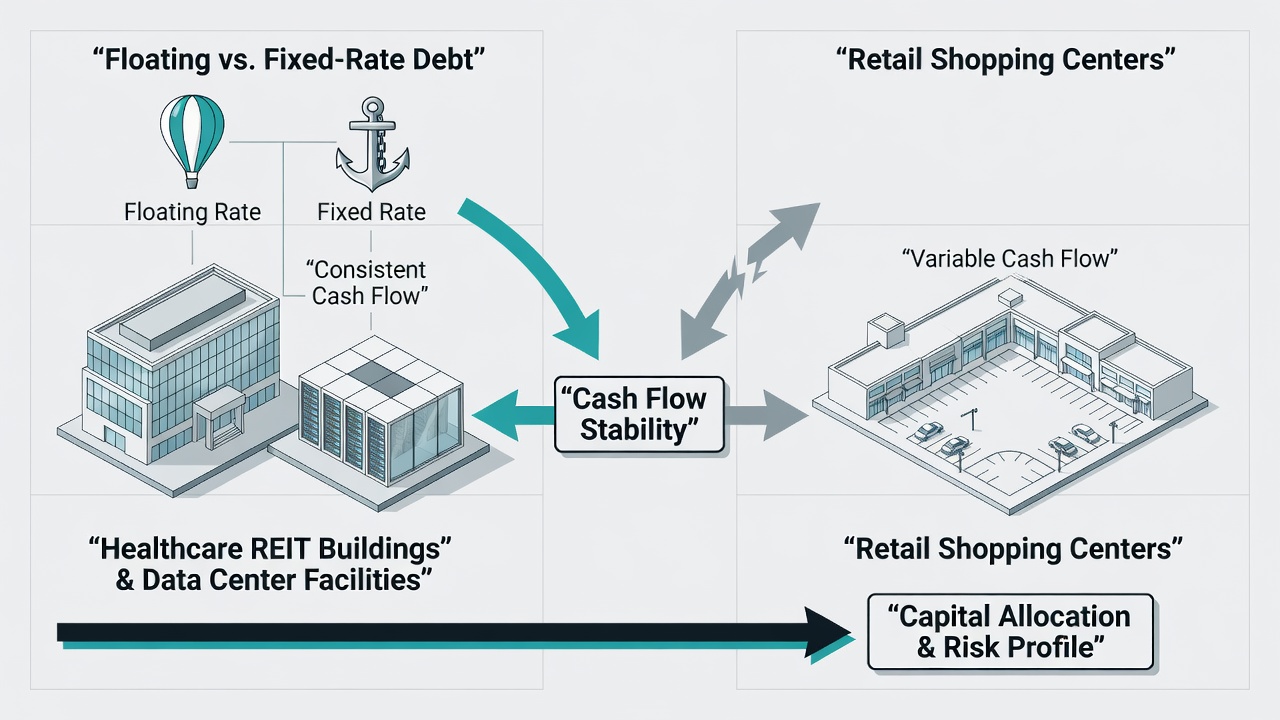
Not all REIT sectors respond equally to rate environments. Healthcare REITs benefit from long-term leases tied to essential services and demographic tailwinds, providing stable cash flows even when rates climb. Data center REITs enjoy surging demand from AI and cloud computing, often supporting premium rents that offset higher interest expenses. These facilities require specialized infrastructure that creates high barriers to entry and long-term tenant commitments. Retail REITs, particularly those focused on enclosed malls or non-essential shopping, tend to be more sensitive to economic slowdowns triggered by higher rates. Their shorter lease durations and discretionary tenant base make dividend sustainability more challenging during tightening cycles. Industrial and residential REITs occupy a middle ground, with industrial properties gaining from e-commerce logistics needs while residential assets face varying demand based on housing affordability influenced by mortgage rates.
Comparing these sectors reveals clear patterns. Healthcare and data center operators typically maintain occupancy above 95 percent through necessity-driven demand, whereas retail properties can see greater turnover when consumer spending weakens. Investors should evaluate lease expiration schedules within each sector to gauge vulnerability to rate-driven economic shifts.
Fixed-Rate vs. Floating-Rate Debt: Cash Flow Impacts
Understanding debt structure is critical for dividend forecasting. Fixed-rate debt locks in interest costs, shielding cash flows from sudden rate spikes but limiting benefits when rates fall. Floating-rate debt offers flexibility during rate cuts yet exposes REITs to higher payments when rates rise. Many resilient REITs maintain a mix, using interest-rate swaps to manage exposure. Investors should review each REIT’s debt maturity schedule and percentage of floating-rate obligations when evaluating long-term dividend reliability. A heavy concentration of floating-rate debt maturing in the near term can create refinancing risk during periods of elevated rates, potentially forcing dividend reductions to conserve cash. Conversely, a portfolio dominated by long-duration fixed-rate debt provides predictable interest expenses that support consistent distributions even if policy rates increase.
- Fixed-rate advantages: Predictable interest expense supports consistent dividend coverage and allows management to focus on operational improvements rather than constant refinancing.
- Floating-rate risks: Rapid rate increases can erode free cash flow available for distributions, requiring proactive hedging strategies.
- Hybrid approach: Sophisticated REITs combine both debt types and employ derivatives to cap interest costs while retaining some flexibility for rate declines.
Reviewing quarterly filings for weighted average interest rates and upcoming maturities helps investors anticipate cash flow pressures before they affect distributions.
Step-by-Step Portfolio Adjustment Framework
Follow this actionable process to reposition your REIT holdings for 2026 rate scenarios. Begin by cataloging every holding according to sector exposure, debt composition, and dividend coverage history. Next, model potential outcomes under different rate paths, including scenarios where rates rise 150 basis points or fall 75 basis points over the next twelve months. Use these projections to identify holdings most at risk of dividend cuts. Rebalance toward defensive sectors by increasing exposure to healthcare and data center REITs while trimming retail positions. Incorporate a portion of the portfolio in REITs with predominantly fixed-rate debt schedules extending beyond 2028. Set clear allocation guardrails such as limiting any single sector to no more than 35 percent and ensuring at least 60 percent of debt across holdings is fixed-rate. Review the portfolio quarterly and after every major central bank decision, adjusting as new data emerges on occupancy trends and refinancing activity. Example allocation for a moderate-risk passive income portfolio might emphasize 35 percent healthcare and data centers, 25 percent industrial, 20 percent residential, and 20 percent diversified retail with strong balance sheets. This structure balances yield generation with downside protection.
- Assess current allocation by sector and debt profile using latest 10-Q or 10-K filings.
- Stress-test dividends under both rising and falling rate scenarios using publicly available sensitivity disclosures.
- Rebalance toward defensive sectors with a target of 35-40 percent in healthcare and data center REITs.
- Limit retail REIT exposure to no more than 20 percent of the REIT sleeve.
- Incorporate 15 percent allocation to REITs with predominantly fixed-rate debt maturing after 2028.
- Review quarterly and rebalance if any holding’s floating-rate debt exceeds 30 percent of total capitalization.
Yield Projections and Passive Income Considerations
While exact yields vary by individual REIT and market conditions, defensive sectors such as healthcare and data centers have historically delivered more stable distributions during volatile rate periods. Investors focused on passive income should prioritize dividend coverage ratios above 80 percent and payout growth trends over headline yield alone. Diversification across property types reduces the impact of sector-specific headwinds. Monitoring macroeconomic indicators like employment data and consumer spending provides early signals of potential changes in rental demand. Tools such as REIT-specific ETFs can offer broad exposure while simplifying rebalancing, though direct ownership allows greater control over individual debt profiles.
Practical FAQs on Rate Hikes and Cuts
What happens to REIT dividends if rates rise sharply in 2026?
REITs with high floating-rate debt may reduce distributions to preserve liquidity. Those with fixed-rate debt and strong occupancy typically maintain payouts, though growth may slow until rates stabilize.
Are data center REITs truly recession-resistant?
Long-term leases and essential digital infrastructure demand provide resilience, though valuations can still fluctuate with broader rate movements and technology spending cycles.
How often should I review my REIT allocations?
Conduct a full review at least quarterly, with additional checks following major central bank announcements or significant changes in Treasury yields.
Should I avoid all retail REITs during rising rate periods?
Not necessarily. Select retail REITs with grocery-anchored or necessity-based tenants often demonstrate better resilience than mall-focused operators, provided their debt structures remain conservative.
Conclusion
Interest rate shifts in 2026 will reward investors who proactively adjust REIT allocations toward resilient sectors and favorable debt structures. By following the framework above and monitoring key metrics, passive income seekers can build a more durable dividend stream. For authoritative data on REITs, consult NAREIT, Federal Reserve resources, and FRED economic data.


No comments yet. Be the first!