 Bullish Portfolio

Introduction: Building Wealth That Lasts Beyond a Lifetime
Creating sustainable passive income for future generations requires strategic use of real estate investment trusts (REITs) and dividend stocks. This approach focuses on long-term family transfer tactics that emphasize stability, tax efficiency, and legal structures designed to endure market shifts. Investors in 2026 are increasingly turning to these methods to ensure heirs receive reliable income streams without unnecessary erosion from taxes or legal hurdles. By focusing on proven REITs with decades of consistent distributions, families can establish a foundation that supports education, home purchases, and retirement needs across multiple generations. The key lies in proactive planning that integrates investment selection with estate tools, allowing wealth to transfer seamlessly while minimizing administrative burdens and tax liabilities.
Understanding REITs in a Generational Wealth Context
REITs provide exposure to real estate without direct ownership hassles, delivering dividends from property portfolios. For multi-decade holdings, focus on established REITs with consistent payout histories spanning 30+ years. These vehicles support family wealth transfer by generating income that can compound across generations when reinvested wisely. Equity REITs own and operate income-producing properties such as apartments and warehouses, while mortgage REITs invest in real estate debt. Both types offer unique benefits for legacy planning, with equity REITs often providing inflation protection through rising rents and mortgage REITs delivering higher current yields that can fund immediate family needs.
Portfolio Construction for Heirs
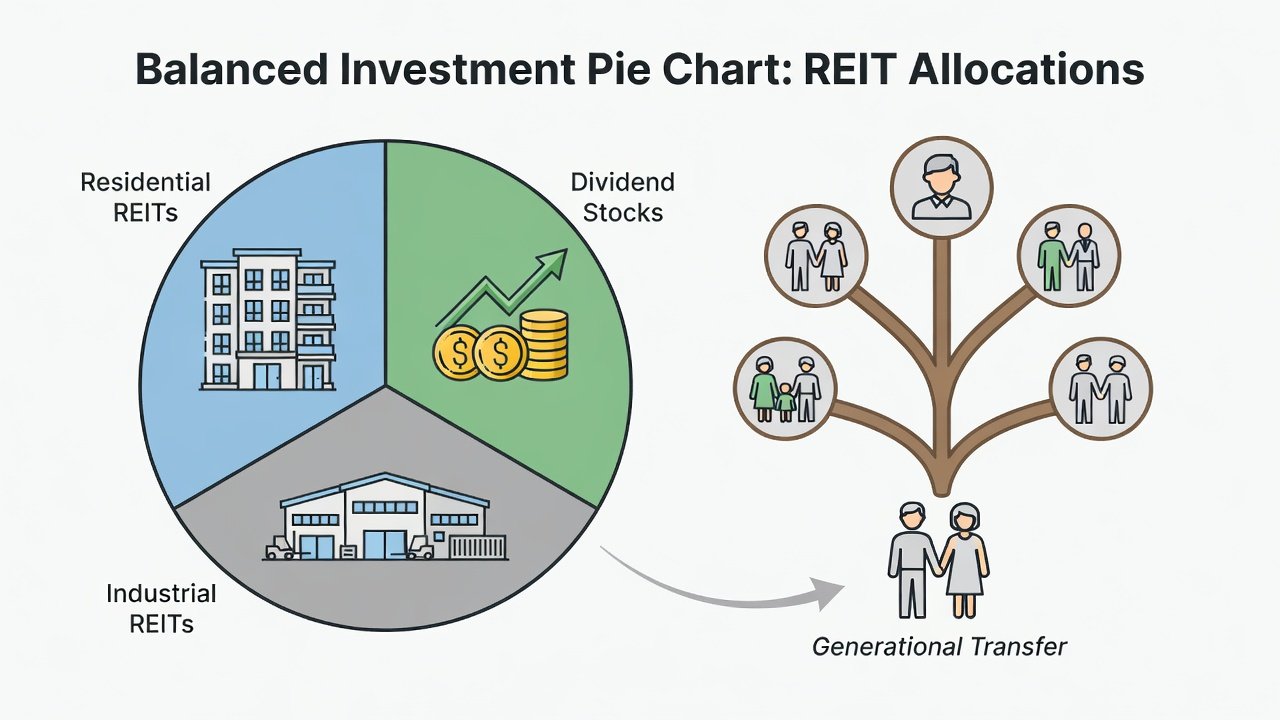
Start with a core allocation of 40-60% in equity REITs focused on residential and industrial properties for growth potential, balanced with 20-30% in mortgage REITs for higher yields. Diversify across sectors to mitigate risks. Include dividend aristocrats in stocks for added stability. Review allocations annually to adapt to economic changes while maintaining a growth-yield balance. Heirs benefit most when the portfolio includes a mix of established players and select newer entrants with strong management teams. Practical construction involves assessing family goals, such as funding college education versus long-term retirement income, and adjusting sector weights accordingly. For instance, industrial REITs tied to e-commerce logistics have shown resilience in shifting economies, making them suitable for multi-generational holdings.
Trust Structures and Legal Vehicles
Revocable living trusts allow seamless asset transfer while retaining control during your lifetime. Irrevocable trusts can remove assets from your taxable estate. Consult estate attorneys to establish these structures early, ensuring REIT holdings transfer directly to beneficiaries with minimal disruption. Additional options include dynasty trusts that can span multiple generations while preserving assets from estate taxes. Special needs trusts protect beneficiaries who require ongoing government assistance. Each structure carries distinct advantages: revocable trusts offer flexibility for changes in family circumstances, whereas irrevocable options provide stronger creditor protection. Working with professionals ensures the trust documents explicitly address dividend reinvestment and distribution schedules tailored to heirs' ages and financial maturity.
Tax-Efficient Gifting Methods
Utilize annual gift tax exclusions to transfer REIT shares or dividend income gradually. Donor-advised funds offer another avenue for charitable gifting that reduces estate size. These strategies help minimize capital gains taxes on appreciated REIT positions when passed to heirs. For official guidance, refer to IRS resources on gift taxes. Families can also leverage 529 plans funded by REIT dividends for education expenses, combining tax-free growth with generational benefits. Timing gifts around market dips allows transfer of assets at lower valuations, preserving more value for heirs. Documentation of all transfers remains essential to demonstrate compliance during any future audits.
Probate Avoidance Steps
Designate successor beneficiaries on brokerage accounts holding REITs and use payable-on-death designations where available. Holding assets in trusts bypasses probate entirely, speeding transfer and reducing costs. Update beneficiary forms regularly after major life events. Additional tactics include joint ownership with rights of survivorship for certain accounts and transferring REIT holdings into limited liability companies that can be willed directly. These steps collectively reduce legal fees and delays, ensuring heirs receive uninterrupted dividend payments. Coordination between financial institutions and estate planners prevents oversights that could otherwise trigger lengthy court proceedings.
Allocation Models Balancing Yield and Growth
A sample model might allocate 50% to high-yield REITs, 30% to growth-oriented dividend stocks, and 20% to bonds for stability. Adjust based on family risk tolerance. Historical examples include families holding REITs like those in the NAREIT index for over 40 years, generating compounding income that supported multiple generations. Another model emphasizes 60% equity REITs for appreciation potential and 40% in defensive sectors like healthcare properties during volatile periods. Regular rebalancing maintains the intended risk profile without excessive trading that incurs costs.
Risk Mitigation for Market Shifts
Diversify geographically and by property type. Maintain cash reserves equivalent to 2-3 years of dividends for downturns. Monitor interest rate impacts on REIT valuations and rebalance portfolios quarterly. Stress-test holdings against inflation and recession scenarios. Incorporating international REIT exposure can further hedge against domestic market corrections, while maintaining a portion in fixed-income instruments provides a buffer during equity market declines.
Real-World Examples of Multi-Decade REIT Holdings
One documented case involves a family that began accumulating shares in a major residential REIT in the 1980s. Through consistent reinvestment and trust-based transfers, the holdings now generate annual distributions supporting three generations, including grandchildren's education funds. Another example features a portfolio built around industrial REITs that adapted to supply-chain changes, delivering stable yields even through economic downturns. These cases highlight the importance of selecting REITs with strong governance and diversified tenant bases.
Practical Checklist for Successor Beneficiaries
- Review and update all beneficiary designations every 2-3 years to reflect life changes such as marriages, births, or divorces.
- Establish and fund revocable trusts with clear instructions for REIT distributions, including provisions for reinvestment versus cash payouts.
- Document tax basis for inherited assets to optimize future capital gains calculations for heirs.
- Coordinate with financial advisors and tax professionals on transfer timing to align with fiscal year planning.
- Educate heirs on managing inherited REIT portfolios through family meetings that cover basic investment principles and distribution rules.
- Conduct annual reviews of trust performance and adjust investment policies as family needs evolve.
FAQs on IRS Rules for Inherited Dividends
What is the step-up in basis for inherited REITs?
Heirs receive a step-up in cost basis to fair market value at the date of death, reducing future capital gains taxes. Confirm details via IRS Publication 551. This adjustment applies regardless of the original purchase price and can significantly lower tax obligations when heirs eventually sell shares.
How are inherited REIT dividends taxed?
Dividends received after inheritance are typically taxed as ordinary income, but qualified dividends may qualify for lower rates. Trusts may face different rules based on distribution timing, with complex trusts potentially subject to compressed tax brackets. Proper planning with a tax advisor ensures distributions are structured to minimize overall family tax exposure.
Can heirs defer taxes on REIT distributions?
Yes, through reinvestment in similar assets or specific trust vehicles, though consult professionals for compliance with current IRS regulations. Options such as 1031 exchanges apply in limited cases for direct real estate but not typically for REIT shares, making trust-based deferral strategies more relevant for generational planning.
Common Mistakes to Avoid
Failing to update beneficiary designations after major life events can lead to unintended recipients. Over-concentrating in a single REIT sector exposes the portfolio to property-type specific risks. Neglecting to educate heirs about the portfolio can result in premature liquidation of holdings. Always maintain comprehensive records and seek periodic professional reviews to prevent these pitfalls.
Conclusion
Implementing these legacy REIT dividend strategies positions families for enduring passive income. By combining thoughtful portfolio design, proper legal structures, and proactive tax planning, investors can create wealth that supports generations while navigating evolving markets effectively. Starting the process early maximizes the compounding effect and ensures a smooth transition for all involved parties.

No comments yet. Be the first!