 Bullish Portfolio

Introduction to the Bucket Retirement Income Strategy
Retirees in 2026 face unique challenges in generating sustainable passive income amid market volatility and inflation pressures. The bucket strategy divides assets into three time-horizon buckets to balance liquidity needs with long-term growth. This approach combines short-term cash reserves, medium-term fixed income, and long-term holdings focused on dividend aristocrats and high-yield REITs. By structuring portfolios this way, investors can create reliable cash flow while mitigating sequence-of-returns risk. The strategy has gained popularity for its practical framework that allows systematic withdrawals without selling growth assets during downturns. It aligns well with search intent around sustainable withdrawal planning for those approaching or in retirement. Many retirees appreciate how it provides both peace of mind and the potential for income growth over time.
Breaking Down the Three Buckets
Bucket 1: Short-Term Cash for Immediate Needs
This bucket typically covers one to three years of living expenses. It holds highly liquid assets such as money market funds, short-term Treasury bills, or high-yield savings accounts. The primary goal is capital preservation and easy access, ensuring retirees do not need to sell investments at unfavorable prices. This portion acts as a safety net during unexpected expenses or market corrections. For example, maintaining two years of expenses here allows flexibility if a major home repair arises or if medical costs increase suddenly.
Bucket 2: Medium-Term Bonds for Stability
Bucket 2 covers years four through seven. It focuses on intermediate-term bonds, bond ladders, or conservative bond ETFs. These holdings provide modest income and some growth potential while offering a buffer against equity market swings. Rebalancing here helps maintain duration targets as bonds mature. Investors often choose a mix of government and investment-grade corporate bonds to balance yield and safety. This bucket smooths the transition between cash needs and long-term growth assets.
Bucket 3: Long-Term Growth with Dividends and REITs
The longest horizon bucket, spanning eight years and beyond, targets capital appreciation and rising income. Allocations emphasize dividend aristocrats—companies with decades of consistent dividend increases—and REITs that own income-producing real estate. This bucket generates the bulk of passive income through qualified dividends and REIT distributions. Dividend aristocrats tend to come from stable sectors like consumer staples and healthcare, while REITs add exposure to commercial properties that can benefit from economic expansion.
Recommended Allocation Percentages
While individual circumstances vary, a common starting point for a 65-year-old retiree is 10-15% in Bucket 1, 25-30% in Bucket 2, and 55-65% in Bucket 3. Adjustments depend on risk tolerance, expected longevity, and other income sources such as Social Security or pensions. Conservative investors may increase the cash and bond buckets, while those comfortable with volatility can tilt more toward growth assets. Younger retirees or those with substantial pension income might reduce the defensive buckets further.
Step-by-Step Rebalancing Process
- Review portfolio values quarterly.
- Calculate current bucket percentages against targets.
- Transfer excess from Bucket 3 to replenish Buckets 1 and 2 as needed.
- Reinvest dividends and REIT distributions strategically to maintain allocation balance.
- Document changes for tax reporting and future reference.
Consistent rebalancing prevents drift and ensures the strategy remains aligned with retirement goals. Many advisors recommend automating transfers where possible to reduce emotional decision-making.
Why Dividends and REITs Excel in Bucket 3
Dividend aristocrats provide a history of growing payouts that can help combat inflation over long periods. REITs offer exposure to real estate without direct ownership hassles and often distribute high yields from rental income. Together they create a diversified income stream within the growth bucket. This combination has historically delivered both income and total returns that support rising withdrawal needs in later retirement years.
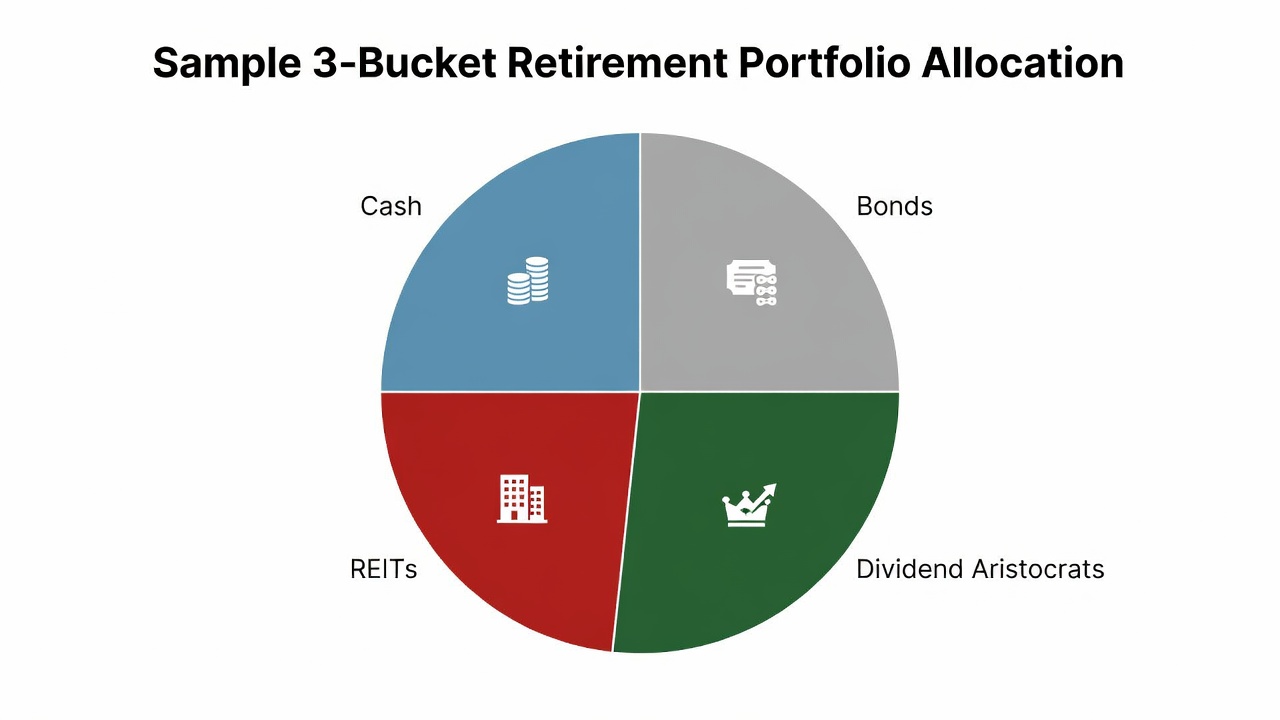
Sample 3-Bucket Portfolio Example
Consider a hypothetical $1 million portfolio for illustration. Bucket 1 might hold Treasury bills and cash equivalents. Bucket 2 could include a ladder of investment-grade corporate bonds. Bucket 3 would feature a diversified mix of dividend aristocrats across sectors and several REITs focused on healthcare, industrial, and residential properties. This structure provides layered income streams that can be drawn upon in sequence. Retirees can customize holdings based on personal preferences, such as favoring healthcare REITs for demographic tailwinds or industrial REITs for e-commerce growth.
Tax Considerations for 2026
Tax-efficient implementation is critical. Qualified dividends from aristocrats receive preferential long-term capital gains rates, while REIT distributions are often taxed as ordinary income. Placing REITs in tax-advantaged accounts like IRAs can reduce the annual tax burden. Retirees should consult current IRS guidelines on required minimum distributions and qualified dividend reporting. For detailed rules, refer to official IRS resources. Additionally, understanding wash-sale rules and capital gains harvesting can further optimize after-tax returns. Investors should also review state tax implications, as not all states conform to federal treatment of dividends and REIT income.
Mitigating Key Risks
Inflation can erode purchasing power, so Bucket 3 allocations should include assets with growth potential that historically outpace inflation. Sequence-of-returns risk is addressed by drawing first from cash and bond buckets during market declines. Diversification across multiple REIT subsectors and dividend payers reduces concentration risk. Regular stress testing of withdrawal rates helps maintain sustainability. Another important tactic is maintaining a flexible withdrawal rate that can be adjusted based on market conditions and personal spending needs.
Common Mistakes to Avoid
One frequent error is over-allocating to cash, which can limit long-term growth. Another is neglecting to rebalance after large market moves, allowing buckets to drift from targets. Some retirees chase the highest-yielding REITs without considering underlying property quality or debt levels. Failing to account for taxes when planning withdrawals can also reduce net income. Finally, ignoring healthcare cost inflation or longevity risk may leave the strategy underfunded in later years.
Frequently Asked Questions
How does the bucket strategy handle inflation?
Long-term buckets emphasize assets expected to deliver real returns above inflation through dividend growth and property appreciation.
What about sequence-of-returns risk?
By spending from defensive buckets first, retirees avoid selling equities during market lows, preserving the growth engine for later years.
Can this strategy work with smaller portfolios?
Yes, the principles scale; smaller accounts may simply adjust percentages and favor lower-cost ETF implementations.
How often should I review my buckets?
Quarterly reviews are recommended, with more frequent checks during periods of high market volatility or major life changes.
Are there alternatives to REITs for real estate exposure?
Some investors use real estate crowdfunding platforms or direct property ownership, though these may introduce liquidity and management considerations not present with publicly traded REITs.
Conclusion
The bucket strategy with dividends and REITs offers a structured, adaptable path to retirement income in 2026. By thoughtfully allocating across cash, bonds, and growth-oriented holdings, retirees can enjoy predictable withdrawals while positioning for long-term financial security. Regular reviews and professional guidance ensure the plan evolves with changing markets and personal needs. For additional investor education materials, visit the SEC investor resources and Investor.gov.

No comments yet. Be the first!