 Bullish Portfolio
Introduction to AI Predictive Models for 2026 Markets
Traders and analysts in 2026 are turning to sophisticated AI predictive models to navigate increasingly volatile stock markets. These systems go far beyond simple moving averages by integrating neural networks that process vast datasets for higher forecasting accuracy. This guide explores their mechanics, data foundations, architectural choices, and practical deployment for market analysis. Advanced models leverage machine learning to identify patterns invisible to traditional technical indicators, offering a competitive edge in trend prediction. As markets continue to react swiftly to global events, the ability to synthesize multiple data streams in real time becomes essential for both institutional and retail participants seeking consistent edges.
The shift toward neural network-driven forecasting reflects broader adoption of machine learning across finance. Rather than relying solely on historical price patterns, modern approaches incorporate unstructured data such as news sentiment and macroeconomic releases. This evolution enables more nuanced forecasts that account for shifting market regimes, liquidity conditions, and behavioral factors that often drive short-term deviations from fundamentals.
Core Data Foundations for Accurate Forecasting
Effective AI models rely on three primary data streams: historical price action, sentiment signals, and real-time market feeds. Historical datasets include decades of OHLCV data from exchanges, cleaned and normalized for training. Preprocessing steps typically involve handling missing values through interpolation, scaling features with techniques like MinMax or StandardScaler, and creating lagged variables to capture temporal dependencies. Sentiment signals draw from news APIs, social media scraping, and earnings call transcripts processed via NLP techniques such as transformer-based embeddings from models like BERT or FinBERT. Real-time feeds incorporate tick-level data from sources like exchanges and economic calendars, often streamed through WebSocket connections for low-latency updates.
Combining these inputs allows models to capture both quantitative trends and qualitative market psychology, improving robustness during events like earnings surprises or geopolitical shifts. For example, a model trained on S&P 500 constituents might fuse daily price history with Twitter volume spikes around earnings announcements to predict volatility clusters more reliably than price-only approaches.
LSTM Versus Transformer Architectures
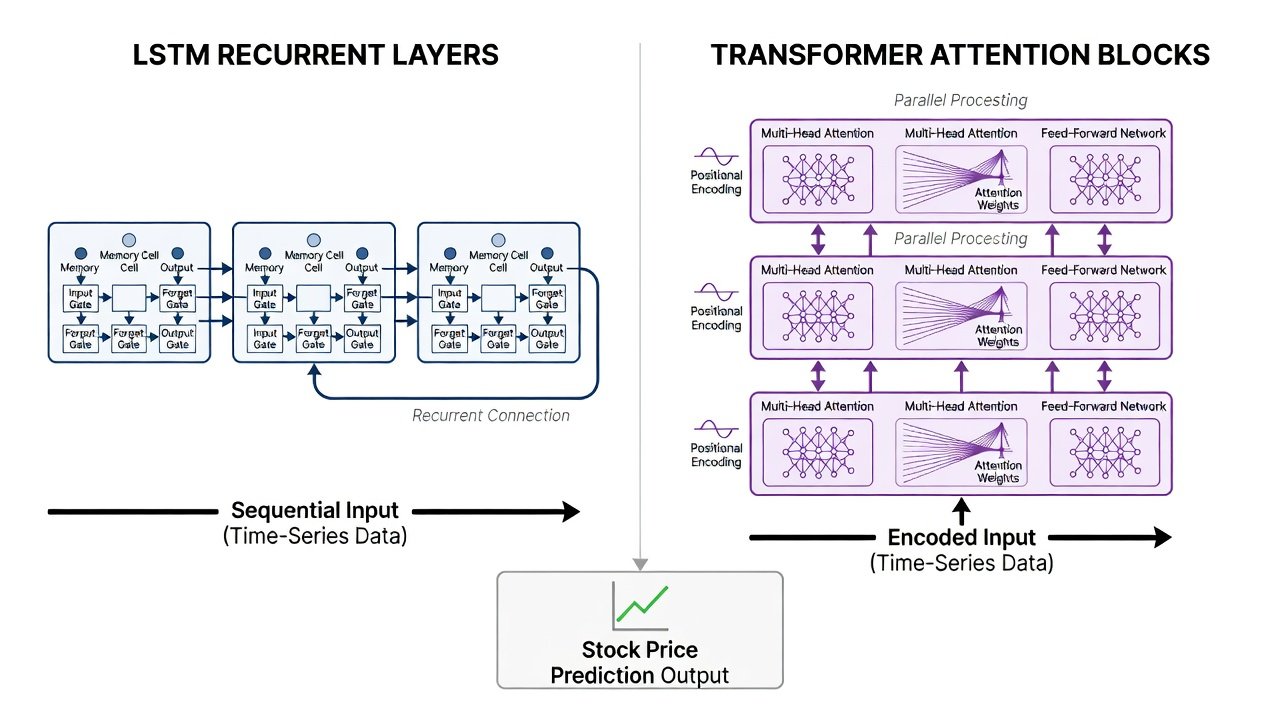
When selecting neural network designs, traders often compare LSTM and transformer models. LSTMs excel at sequential dependencies in time-series data through gated memory cells, making them suitable for medium-term trend capture with relatively modest computational requirements. Transformers, with self-attention mechanisms, handle longer sequences and parallel processing more efficiently, often delivering superior accuracy on multivariate inputs including sentiment overlays. Recent benchmarks show transformers outperforming LSTMs by 15-20% in volatile sectors such as technology and energy during 2025 backtests, though LSTMs require less computational overhead for simpler implementations.
Hybrid architectures that stack LSTM layers with attention modules are gaining traction, allowing practitioners to retain sequential memory while benefiting from global context modeling. Practitioners should evaluate both options based on available hardware, sequence length requirements, and desired inference speed for live trading environments.
Step-by-Step Implementation Guide
Building a functional pipeline involves several deliberate stages. Begin by collecting and preprocessing datasets using Python libraries like pandas and yfinance for historical prices, ensuring alignment across multiple tickers to avoid survivorship bias. Next, integrate sentiment via APIs such as NewsAPI or Twitter data pipelines with VADER or BERT embeddings, storing results in a time-series database like TimescaleDB for efficient querying. Construct the model architecture in TensorFlow or PyTorch, starting with LSTM layers or transformer encoders and experimenting with hyperparameters such as hidden dimension size, dropout rates, and learning rate schedules via tools like Optuna.
Train on 70/20/10 splits with walk-forward validation to prevent lookahead bias, monitoring validation loss closely to detect overfitting early. Integrate outputs with technical indicators like RSI and MACD for hybrid signals that combine statistical learning with domain expertise. Finally, deploy via cloud services such as AWS SageMaker or Google Cloud AI Platform for real-time inference and alerts, incorporating monitoring dashboards to track model drift over time.
Integrating Technical Indicators and Case Studies
Successful implementations rarely rely on AI outputs in isolation. Instead, they blend neural network predictions with established indicators to generate composite trading rules. For instance, a model might output a directional probability that is only acted upon when it aligns with a moving average crossover or elevated volume profile. This ensemble approach reduces noise and improves risk-adjusted performance.
Case studies from the semiconductor and renewable energy sectors in late 2025 demonstrate how transformer models reduced false signals by 25% compared to baseline LSTM setups. In one semiconductor volatility episode triggered by supply chain disruptions, the hybrid system correctly identified reversal points days ahead of traditional momentum indicators, enabling timely position adjustments. Similar gains appeared in clean energy stocks reacting to policy announcements, where sentiment-augmented transformers captured narrative shifts faster than price-only models.
Backtesting Protocols and Performance Metrics
Rigorous backtesting uses out-of-sample data across multiple market regimes, including bull, bear, and sideways periods. Key metrics include Sharpe ratio, maximum drawdown, precision-recall for directional accuracy, and mean absolute percentage error for price forecasts. Implement protocols that simulate slippage and transaction costs to mirror live trading conditions, while also stress-testing against extreme scenarios such as flash crashes or liquidity evaporation. Walk-forward optimization combined with Monte Carlo simulations of parameter uncertainty provides a more realistic picture of expected live performance than simple in-sample fitting.
Common Setup Challenges and FAQ
- How do I source quality training data? Start with verified exchange archives and augment with alternative datasets from providers like Quandl, always verifying timestamp integrity and corporate action adjustments.
- What hardware is needed for training? GPUs or TPUs accelerate convergence; cloud instances handle scaling without local infrastructure, though cost management through spot instances is advisable for frequent retraining cycles.
- How to handle regime shifts in 2026 markets? Incorporate online learning and ensemble methods that blend multiple models dynamically, retraining periodically on recent data windows.
- Are these models suitable for retail traders? Yes, with open-source frameworks and APIs lowering barriers, though professional oversight remains essential to interpret outputs and manage risk.
- How often should models be retrained? Monthly or quarterly retraining is common, triggered by performance degradation thresholds rather than fixed calendars.
Mistakes to Avoid When Deploying AI Models
Common pitfalls include overfitting to historical noise, neglecting transaction costs in backtests, and failing to account for data leakage during feature engineering. Another frequent error is treating model outputs as deterministic signals rather than probabilistic estimates, which can lead to oversized positions and excessive drawdowns. Always maintain a clear separation between research and production environments, and conduct regular audits of data pipelines to ensure ongoing quality.
Conclusion
AI predictive models represent a transformative approach to 2026 stock trend forecasting. By mastering data integration, architectural trade-offs, and disciplined backtesting, traders can build systems that deliver actionable insights. Continuous refinement and ethical data practices will determine long-term success in this evolving landscape. For deeper technical foundations, explore resources at TensorFlow, PyTorch, and Federal Reserve economic data.
No comments yet. Be the first!