 Bullish Portfolio

Introduction to Value Investing in 2026
Value investing remains a timeless strategy popularized by legends like Benjamin Graham and Warren Buffett. In 2026, with AI reshaping markets and regulatory shifts influencing transparency, it's more relevant than ever. This guide takes you from beginner basics to advanced techniques, teaching you how to spot undervalued stocks, calculate intrinsic value, screen using modern ratios like EV/EBITDA, build diversified portfolios, adapt to new realities, dodge pitfalls, and measure long-term success against growth investing.
Whether you're new to stocks or refining your approach, value investing focuses on buying quality companies at a discount to their true worth and holding long-term. Let's dive in.
Understanding the Foundations: What Makes Value Investing Tick?
At its core, value investing hunts for stocks trading below their intrinsic value—the present value of future cash flows. Unlike growth investing, which chases high-growth hype, value prioritizes margin of safety.
- Key Principles: Buy low (undervalued), sell high (when fairly valued), ignore short-term noise.
- 2026 Twist: AI tools now automate screening, but human judgment on moats (competitive advantages) is crucial.
For deeper reading on origins, check Investopedia.
Step 1: Calculating Intrinsic Value Like a Pro
Beginners start here. Intrinsic value isn't a single formula but a blend of methods. The gold standard is Discounted Cash Flow (DCF) analysis.
Beginner DCF Walkthrough
- Gather Data: Find free cash flow (FCF) from the last 5-10 years via Yahoo Finance or company filings.
- Project Future FCF: Assume conservative growth (3-5% annually for mature firms).
- Discount Back: Use WACC (Weighted Average Cost of Capital) as discount rate—typically 8-12% in 2026 amid stable rates.
- Terminal Value: Perpetual growth at 2-3% GDP rate.
- Sum and Divide: Enterprise value minus net debt, divided by shares outstanding.
Formula snapshot: Intrinsic Value = Σ(FCF_t / (1 + r)^t) + Terminal Value / (1 + r)^n
Advanced Tweaks for 2026
Incorporate AI-driven revenue forecasts. Adjust for regulatory risks like antitrust on Big Tech. Use Monte Carlo simulations for scenario analysis—tools like Excel or Python libraries make this accessible.
Alternative methods: Graham's formula (V = EPS × (8.5 + 2g)) updated for low rates, or asset-based valuation for cyclicals.
Step 2: Screening for Undervalued Stocks with Modern Ratios
Once you grasp intrinsic value, screen efficiently. Forget outdated P/E alone—use EV/EBITDA for capital-intensive firms.
- EV/EBITDA: Enterprise Value / EBITDA. Ideal < 8x for value plays (industry avg. 10-12x).
- Other Ratios: P/FCF < 15x, P/B < 1.5x, Debt/EBITDA < 3x.
- Quality Filters: ROIC > 10%, gross margins stable.
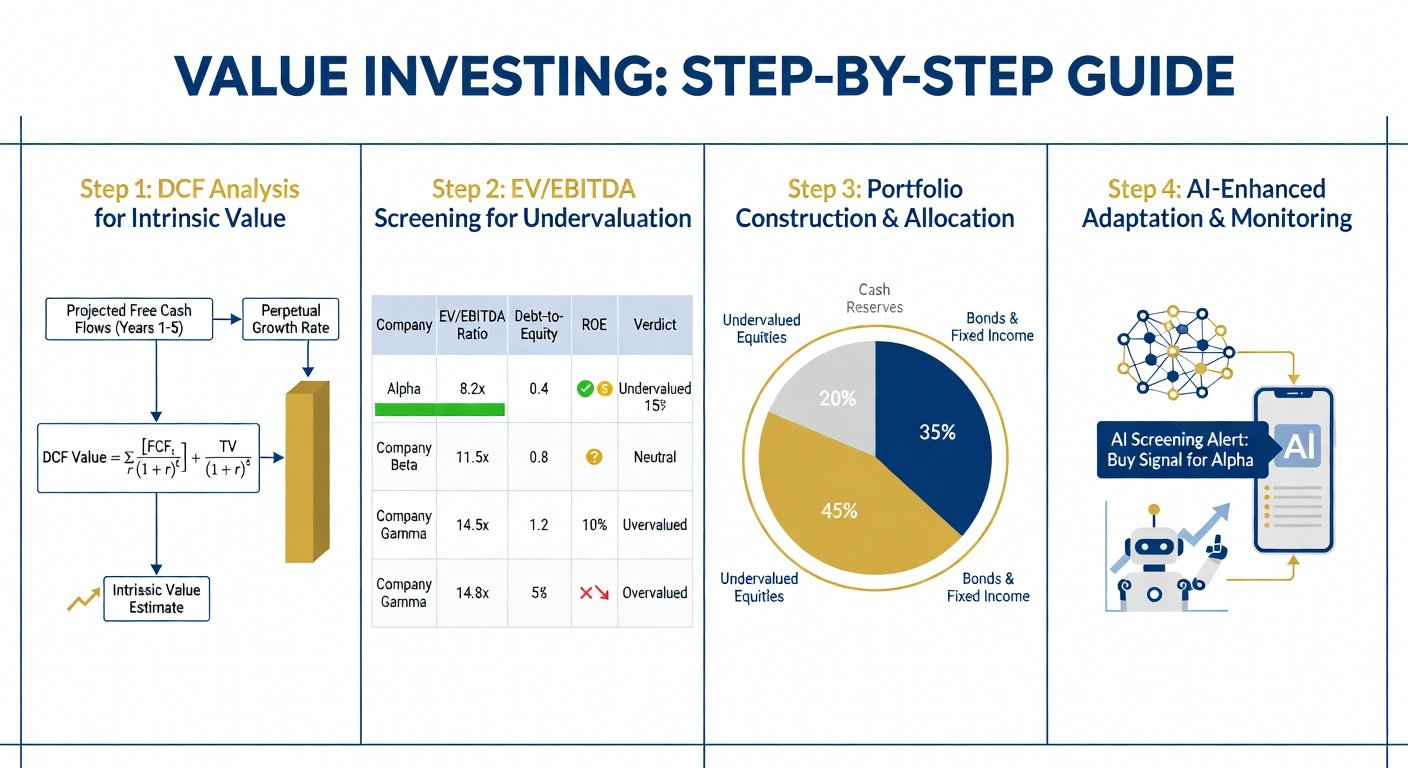
Use free screeners like Finviz or TradingView. In 2026, AI platforms like those from SEC EDGAR filings integrate real-time data. Example screen: Banks with EV/EBITDA < 6x, ROE > 12%.
Step 3: Building a Diversified Value Portfolio
Don't bet the farm on one stock. Aim for 15-30 holdings across sectors.
Allocation Strategy
- Core (60%): Blue-chips like consumer staples, financials.
- Cyclicals (20%): Energy, industrials—buy during troughs.
- Turnarounds (10%): Spinoffs or post-scandal gems.
- Cash (10%): For opportunities.
Rebalance annually. Use ETFs like Vanguard Value (VTV) for broad exposure, but pick winners yourself for alpha.
Position Sizing
Max 5% per stock, scale by conviction (margin of safety). Track via Google Sheets or apps like Portfolio Visualizer.
Adapting to AI-Driven Markets and Regulatory Changes
2026's markets pulse with AI: algorithmic trading, predictive analytics. Value investors adapt by:
- AI Moats: Favor firms with proprietary AI (e.g., healthcare diagnostics) over commoditized chatbots.
- Volatility Harvesting: AI-induced dips create buying ops—patience pays.
Regulations: EU AI Act and US SEC rules demand transparency. Screen for compliance; avoid black-box AI firms. Reference Berkshire Hathaway letters for timeless adaptation wisdom.
Common Mistakes to Avoid in Value Investing
Even pros slip up:
- Value Traps: Cheap for a reason (dying industries)—check earnings quality.
- Overpaying for 'Safe': High yields masking decline.
- Timing Obsession: Mr. Market is manic—ignore.
- Neglecting Inflation/AI Disruption: Stress-test models.
- Portfolio Drift: Review quarterly.
Avoid by sticking to checklists à la Mohnish Pabrai.
Metrics for Long-Term Outperformance vs. Growth Investing
Value crushes growth over decades: S&P Value Index beat Growth by 4% annualized (1926-2023 data). In 2026:
- Track: Sharpe Ratio (>1), Max Drawdown (<30%), IRR vs. benchmarks.
- Vs. Growth: Value wins in high-rate, mean-reverting environments. Growth shines in bubbles but crashes harder (e.g., 2022 Tech rout).
- 2026 Edge: AI hype inflates growth multiples—value's low EV/EBITDA shines.
Measure with tools like Morningstar. Historical edge: 15% CAGR for value portfolios vs. 12% growth (Buffett-era).
Conclusion: Start Your Value Journey Today
Value investing in 2026 demands discipline amid AI frenzy, but rewards patient wealth-builders. Calculate intrinsic values, screen smartly, diversify, adapt, and avoid traps. Compound at 15% annually, and you'll outperform. Open a brokerage, paper trade first, and scale up. Your future self thanks you.


No comments yet. Be the first!