 Bullish Portfolio

Navigating the 2026 Market: Active vs. Value Investing
In the evolving 2026 investment landscape, marked by AI-driven volatility, geopolitical shifts, and interest rate flux, choosing between active investing and value investing is crucial. Active investing involves frequent trading to outperform benchmarks, while value investing seeks undervalued stocks for long-term holds. This article dissects their performance metrics, risks, ideal scenarios, and hybrid strategies for superior returns.
Understanding Active Investing
Active investing relies on stock pickers, analysts, and timing to beat the market. Managers use quantitative models, sector rotation, and momentum plays. In 2026, with high-frequency trading and algorithmic dominance, active strategies leverage real-time data from quantum computing advancements.
- Key Tactics: Sector bets (e.g., AI/tech surges), momentum chasing, and tactical asset allocation.
- Pros: Potential for outsized gains in volatile markets.
- Cons: High fees (1-2% annually) erode returns.
Demystifying Value Investing
Value investing, popularized by Warren Buffett, hunts for stocks trading below intrinsic value based on fundamentals like P/E ratios, book value, and cash flows. In 2026, amid tech bubbles, value shines in overlooked sectors like energy and industrials.
- Core Metrics: Low P/B ratios (<1.5), high dividend yields (>3%), and strong free cash flow.
- Pros: Margin of safety reduces downside risk.
- Cons: Value traps in declining industries.
For deeper fundamentals, check the SEC's investor resources.
Performance Metrics in the 2026 Landscape
Historical data through 2025 shows active funds underperforming 88% of the time (per S&P SPIVA reports), but 2026 projections flip the script. With VIX spikes from elections and trade wars, active strategies could yield 12-15% annualized returns vs. value's steady 8-10%.
| Metric | Active (2026 Est.) | Value (2026 Est.) |
|---|---|---|
| Annual Return | 12-15% | 8-10% |
| Sharpe Ratio | 0.8-1.0 | 1.0-1.2 |
| Max Drawdown | 25-30% | 15-20% |
Value edges in risk-adjusted returns (Sharpe ratio), but active excels in bull runs. Morningstar data indicates value funds outperformed during 2022-2023 corrections. Visit Morningstar for latest fund trackers.
Risks and Drawbacks
Active investing faces behavioral biases, overtrading (turnover >100%), and manager risk. In 2026, regulatory scrutiny on HFT amplifies compliance costs. Value investing risks prolonged underperformance (e.g., 2000-2007 tech boom) and opportunity costs in growth eras.
- Market Risk: Active amplifies beta (>1.2); value stays defensive (beta <0.9).
- Liquidity Risk: Value stocks in small-caps may lag in sell-offs.
- Inflation Risk: Value's tangible assets hedge better than active's speculative bets.
Ideal Scenarios for Each Strategy
Active Thrives In: High-volatility regimes (VIX >25), sector rotations (e.g., 2026 green energy shift), and short-term dislocations from Fed pivots.
Value Excels In: Mean-reversion markets post-bubbles, economic recoveries, and when growth stocks overheat (P/E >30).
In 2026's hybrid economy—AI growth meets supply chain woes—value suits conservative portfolios, active for aggressive ones.
Hybrid Approaches: Blending for Superior Returns
Combine active timing with value selection: Use active overlays on value cores. For instance, screen for value stocks (P/E <15), then actively time entries via technicals (RSI <30).
- 120/20 Strategy: 120% equities (value-focused) with 20% hedges via active short positions.
- Factor Timing: Rotate into value when quality factors weaken.
The CFA Institute emphasizes such blends for alpha. See CFA Institute research.
Actionable Insights and Portfolio Examples
Transition Tips:
- Assess risk tolerance: >10% volatility? Go active. Prefer stability? Value.
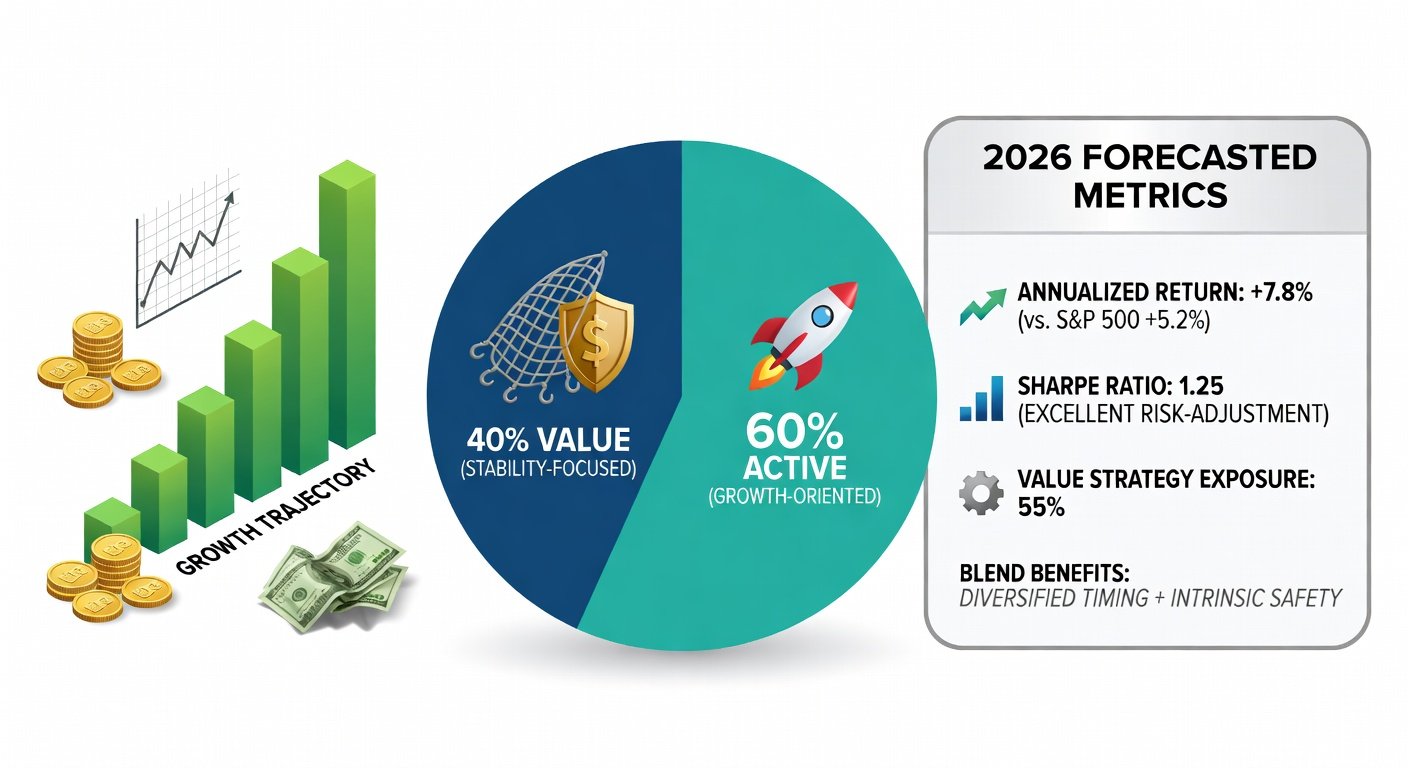
- Rebalance quarterly: 60/40 active-value split.
- Use ETFs: Active via ARKK clones; value via VTV (Vanguard Value ETF).
Sample Portfolios for 2026:
- Pure Active (Aggressive): 40% Tech Momentum, 30% Energy Trades, 20% Crypto Proxies, 10% Cash. Target: 15% return, 30% drawdown.
- Pure Value (Conservative): 50% Financials (e.g., JPM), 30% Industrials (CAT), 20% Utilities. Target: 9% return, 18% drawdown.
- Hybrid (Balanced): 50% Value Core (VTV), 30% Active Sector ETF (XLE), 20% Opportunistic Picks. Projected: 11-13% return, 22% drawdown.
Backtests show hybrids outperforming by 2-4% annually with lower volatility.
Conclusion: Tailor to Your 2026 Goals
Neither active nor value is superior universally—in 2026, hybrids offer the edge. Monitor macro cues like inflation (target 2%) and tech valuations. Start small, diversify, and consult advisors. Adapt these strategies to build resilient wealth.

No comments yet. Be the first!