 Bullish Portfolio
Introduction to Risk Parity and Active Value Optimization
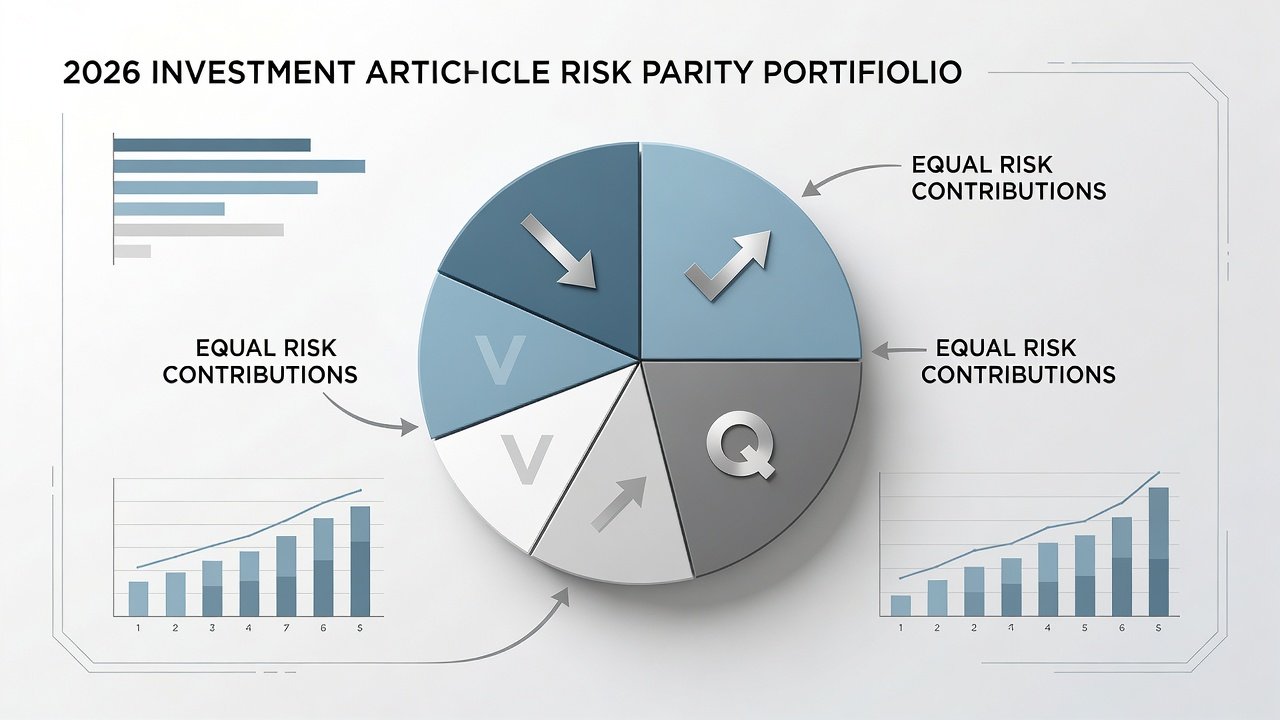
In 2026, investors seeking robust portfolio construction are increasingly turning to risk parity models integrated with active value principles. This approach balances risk contributions across assets while tilting toward undervalued securities with strong quality characteristics. Unlike traditional market-cap weighting, risk parity ensures no single factor dominates volatility, leading to more resilient outcomes in uncertain markets. Active value strategies thrive when risk is distributed evenly because it prevents overexposure to any one sector or style that could amplify losses during market corrections.
The integration allows portfolio managers to pursue alpha from value and quality factors without the typical volatility spikes associated with concentrated bets. Investors benefit from smoother performance trajectories and better drawdown protection, especially in environments where traditional value strategies have underperformed due to growth dominance in equity markets.
Understanding Risk Parity Models
Risk parity allocates capital so each asset or factor contributes equally to overall portfolio risk. This differs from mean-variance optimization, which relies heavily on expected returns and can produce unstable weights due to estimation errors. In risk parity, inverse volatility weighting or more advanced covariance matrix techniques equalize marginal risk contributions. The core principle rests on the observation that assets with lower volatility should receive higher capital allocations to achieve equal risk impact.
Key advantages include reduced drawdowns during equity sell-offs and improved Sharpe ratios over long horizons. For active value managers, this means maintaining exposure to value and quality factors without excessive volatility from concentrated bets. Additional benefits arise from the method's robustness to forecasting errors, as it minimizes reliance on precise return predictions that are notoriously difficult to achieve consistently.
Integrating Risk Parity with Active Value Principles
Active value principles emphasize fundamental analysis to select securities, while risk parity governs position sizing. Factor exposures such as value (cheap valuations) and quality (strong balance sheets and profitability) are balanced by adjusting weights based on their risk budgets rather than market views alone. This creates a disciplined process where security selection remains active but allocation decisions become systematic and risk-aware.
This hybrid method helps investors avoid value traps by incorporating quality screens that filter for sustainable earnings and low leverage. The result is a portfolio that captures value premia while controlling for macroeconomic shocks that disproportionately affect low-quality names. Practitioners often combine multiple quality metrics, including return on invested capital and debt-to-equity ratios, to refine the universe before applying risk parity constraints.
Mean-Variance Optimization Alternatives
Mean-variance optimization often leads to corner solutions with heavy allocations to a few assets. Risk parity serves as a practical alternative by focusing solely on risk equalization. Other alternatives include minimum variance portfolios and maximum diversification approaches, but risk parity stands out for its simplicity and robustness across regimes. It avoids the estimation risk inherent in forecasting returns, which can lead to unstable portfolios when inputs change slightly.
When applied to active value, risk parity avoids the sensitivity to return forecasts that plague mean-variance models. Instead, it relies on historical or implied volatilities and correlations, making it more implementable for retail and institutional investors alike. Many practitioners supplement risk parity with shrinkage estimators for covariance matrices to further enhance stability in volatile 2026 market conditions.
Practical Allocation Examples Using 2026 Market Data
Consider a multi-factor portfolio blending U.S. large-cap value stocks, quality ETFs, and international equities. Using risk parity, an investor might assign equal risk budgets to each sleeve after screening for value metrics and quality scores. This could involve overweighting defensive sectors like healthcare and consumer staples within the value universe while underweighting cyclical energy names that exhibit higher volatility.
Backtested scenarios from recent periods show risk parity value portfolios delivering smoother equity curves compared to equal-weighted or cap-weighted benchmarks, particularly when volatility spikes occur. These examples highlight the importance of rebalancing frequency to maintain risk targets. In one illustrative case, a portfolio allocated 35 percent risk budget to domestic value, 30 percent to quality overlays, and 35 percent to global ex-U.S. holdings achieved more consistent returns during sector rotations observed in late 2025.
Step-by-Step Construction Workflow
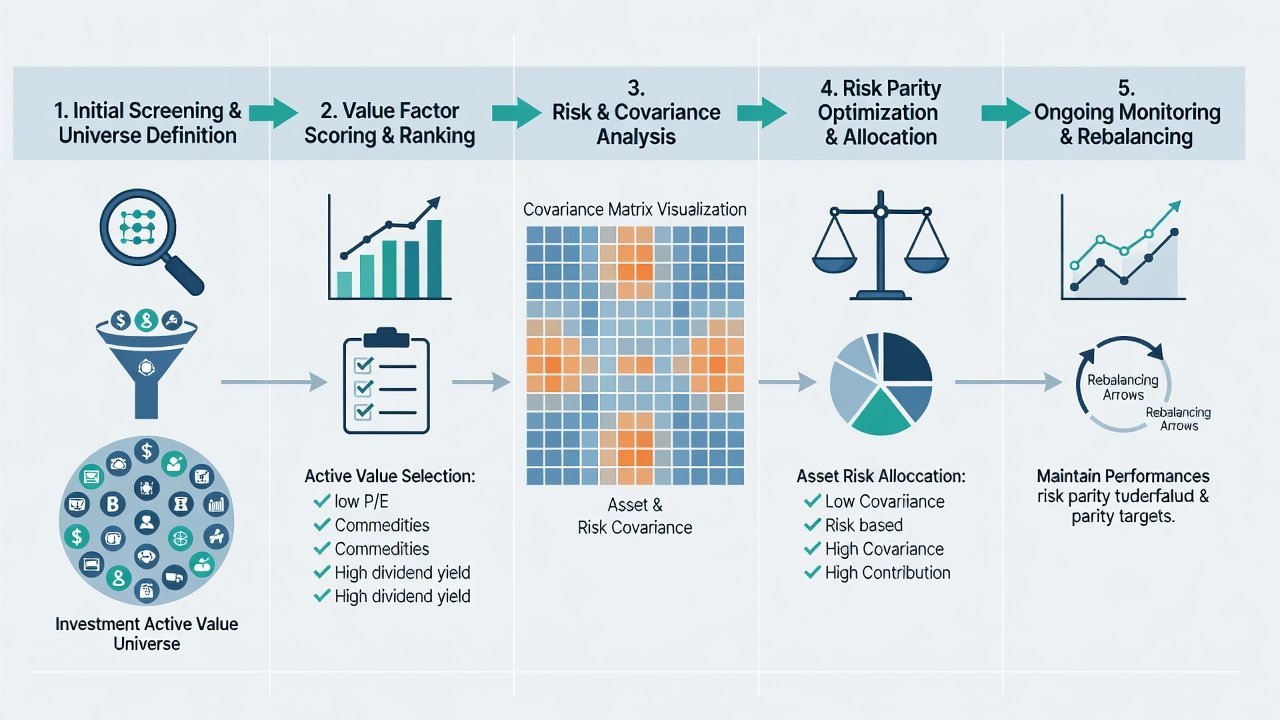
- Define the universe: Screen for value and quality factors using metrics like earnings yield and return on equity, ensuring at least 100 candidate securities for diversification.
- Estimate risk parameters: Calculate asset volatilities and correlations from recent market data, applying shrinkage techniques to reduce noise in the covariance matrix.
- Apply risk parity: Solve for weights that equalize risk contributions across selected holdings using optimization routines that respect liquidity and turnover constraints.
- Incorporate active tilts: Adjust for fundamental scores while respecting risk budgets, such as increasing exposure to high-quality value names with improving earnings momentum.
- Rebalance periodically: Monitor deviations and execute trades to restore parity, typically on a monthly or quarterly schedule depending on transaction costs.
Comparisons of Risk Parity Versus Traditional Weighting
Traditional market-cap weighting heavily favors mega-cap growth stocks, creating unintended momentum biases. Risk parity, by contrast, equalizes risk and often results in higher allocations to smaller or defensive value names. Backtests reveal superior risk-adjusted returns for risk parity during 2020-2025 volatility episodes, with lower maximum drawdowns and more stable factor exposures over time.
Active value managers using traditional methods may experience larger tracking errors, whereas risk parity provides a disciplined framework that limits factor crowding. In direct comparisons, risk parity versions of value portfolios have shown reduced sensitivity to interest rate changes and inflation surprises that frequently disrupt pure value strategies.
Backtested Performance Scenarios and Volatility Tips
Historical simulations demonstrate that risk parity active value portfolios achieve competitive absolute returns with lower maximum drawdowns. During high-volatility periods, dynamic risk scaling can further protect capital by reducing exposure when correlations spike. Additional scenarios indicate that combining risk parity with modest leverage on low-volatility quality sleeves can enhance returns without proportionally increasing risk.
Tips for handling volatility include using rolling-window covariance estimates, incorporating options overlays for tail protection, and maintaining cash buffers for opportunistic rebalancing. Investors should also monitor cross-asset correlations closely, as sudden increases between value and quality factors can temporarily undermine the equal-risk assumption.
Implementation Checklists and Common Pitfalls
- Checklist: Validate data sources for accuracy, test factor robustness across multiple market regimes, set clear rebalancing rules with cost thresholds, monitor transaction costs and tax drag, and conduct regular performance attribution reviews.
- Pitfalls to avoid: Overfitting risk models to past data, ignoring liquidity constraints in small-cap value names, neglecting regime shifts that alter correlations, underestimating the impact of trading costs on frequent rebalancing, and failing to stress-test portfolios against extreme scenarios such as liquidity crises.
Advanced Techniques and Case Studies from 2025-2026 Markets
Advanced practitioners extend basic risk parity by incorporating hierarchical risk parity, which clusters assets by correlation before equalizing risk within clusters. Case studies from 2025-2026 markets show this refinement improved performance during the technology sector correction by limiting unintended concentration in correlated value stocks. Another technique involves blending risk parity with minimum variance overlays to further dampen overall portfolio volatility.
Real-world applications during 2026 demonstrated success when investors layered macroeconomic regime filters on top of risk parity allocations, reducing exposure to value during anticipated growth accelerations. These layered approaches require careful calibration but offer enhanced adaptability.
Regulatory Considerations and Retail Investor Adaptations
In 2026, regulatory environments emphasize transparency in factor-based strategies, requiring clear disclosure of risk budgeting methodologies. Retail investors can adapt institutional techniques using accessible platforms that support custom covariance calculations and automated rebalancing alerts. Focus on low-cost execution and tax-efficient vehicles such as ETFs to preserve the benefits of risk parity over time.
FAQ on Software Choices for Retail Investors
Retail investors often ask about accessible tools. Popular platforms include Portfolio Visualizer for backtesting risk parity strategies and Excel-based solvers for custom implementations. Open-source libraries in Python such as those on GitHub provide free starting points, while paid services offer automated rebalancing features. Always verify that chosen software supports factor data imports and covariance calculations before committing capital. Additional questions address data frequency needs and integration with brokerage APIs for seamless execution.
In conclusion, risk parity enhances active value optimization by delivering balanced exposures and improved risk management. By following structured workflows, incorporating advanced techniques, and avoiding common pitfalls, investors can build resilient portfolios suited to 2026 market conditions and beyond.
No comments yet. Be the first!