 Bullish Portfolio

Introduction
Active value investors operating in 2026 must navigate a landscape marked by shifting interest rates, sector-specific rotations, and heightened geopolitical influences that can rapidly alter asset valuations. Rebalancing serves as the cornerstone of maintaining a portfolio's alignment with fundamental value metrics, including low price-to-book ratios, robust free cash flow generation, and sustainable dividend yields. Unlike passive strategies, active value approaches require ongoing vigilance to ensure that holdings remain undervalued relative to intrinsic worth while still allowing room for opportunistic adjustments. This comprehensive guide provides investors with detailed, step-by-step methods to implement effective rebalancing, supported by real-world scenarios, cost-benefit analyses, and integration strategies with modern screening technologies. By focusing on practical execution rather than abstract theory, readers will gain tools to enhance long-term returns while mitigating unnecessary risks.
Understanding Rebalancing in Value Investing
Portfolio rebalancing involves periodically adjusting asset weights to restore them to predetermined targets. For value investors, this process prioritizes preservation of exposure to securities trading at discounts to their fundamental values. In 2026, market conditions have amplified the importance of this discipline because rapid price swings in cyclical sectors can quickly push even carefully selected holdings away from their core value characteristics. Rebalancing is not merely mechanical; it demands continuous assessment of whether drifted positions still meet rigorous value criteria or if fresh opportunities warrant capital reallocation. Investors who neglect this step risk concentration in overvalued names or missed entries into newly discounted assets.
Calendar-Based vs. Threshold-Triggered Approaches
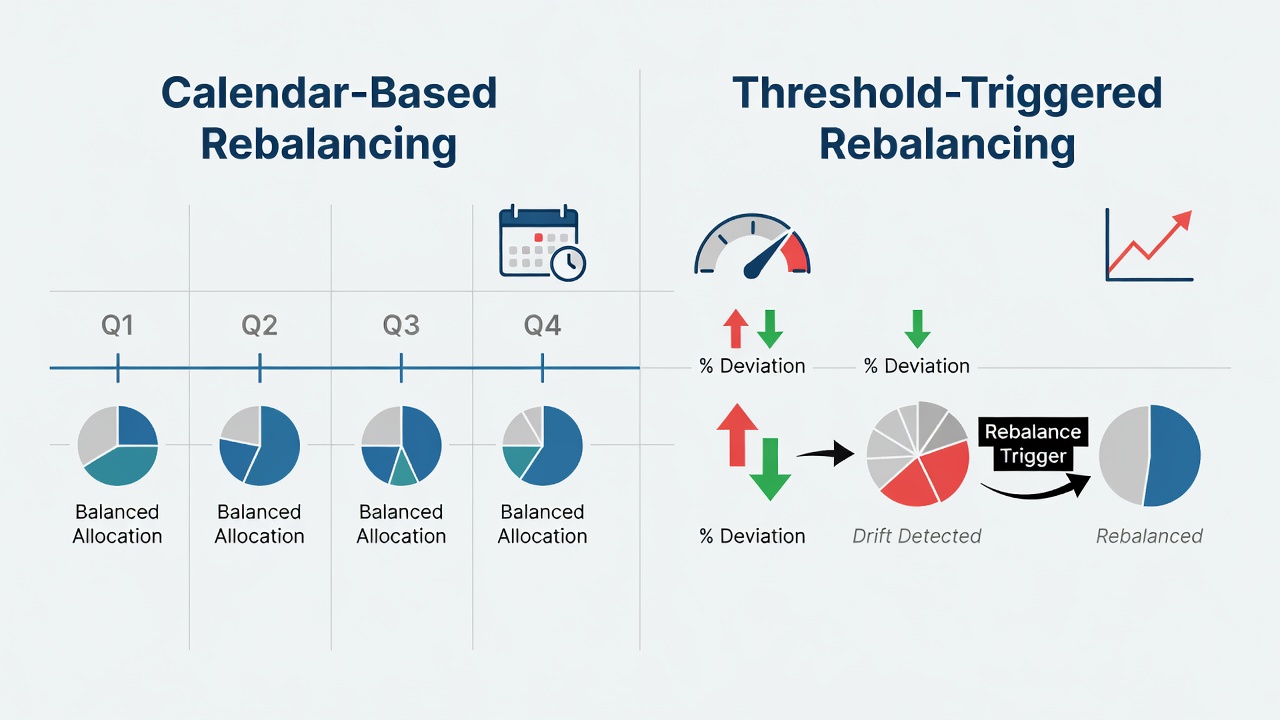
Calendar-based rebalancing follows fixed schedules such as quarterly reviews or annual resets. This method provides predictability, simplifies planning for tax events, and reduces the temptation to overreact to daily volatility. Threshold-triggered rebalancing, conversely, initiates trades only when an asset's weight deviates by a predefined percentage, commonly five to ten percent from its target allocation. The latter approach can capture momentum shifts more responsively yet risks higher turnover if markets remain choppy. A hybrid strategy often yields superior results for active value portfolios: conduct structured calendar reviews every quarter while activating immediate trades solely when thresholds are breached and the position no longer satisfies value screens. This combination balances discipline with responsiveness, preventing both inertia and excessive activity.
Analyzing Transaction Costs
Transaction costs encompass brokerage commissions, bid-ask spreads, and potential price impact from larger trades. Active value investors must quantify these expenses before executing any rebalancing trade to ensure the expected improvement in portfolio quality exceeds the frictional costs. For instance, a small drift in a highly liquid large-cap value stock may not justify immediate action if round-trip costs consume more than half the anticipated alpha. Investors should maintain a running cost ledger that factors in both explicit fees and implicit market impact, updating it after each rebalancing cycle. In practice, batching multiple adjustments into a single trading window can reduce overall expenses compared with piecemeal executions.
Tax-Efficient Timing Strategies
Taxes represent one of the largest drags on net returns for taxable accounts. Strategic timing of rebalancing trades can preserve more capital for compounding. Loss harvesting during periods when positions breach thresholds allows investors to offset realized gains elsewhere in the portfolio. Whenever feasible, defer sales of appreciated holdings until they qualify for long-term capital gains treatment. Coordination with dividend ex-dates further optimizes outcomes, as selling just after a distribution avoids immediate tax on the payout while still achieving the desired allocation shift. Guidance from official sources such as the IRS helps clarify current holding period requirements and wash-sale rules that must be observed during rebalancing.
Integrating Screening Tools
Modern screening platforms enable value investors to identify replacement candidates efficiently during rebalancing windows. Effective screens combine quantitative factors such as earnings yield above the market median with qualitative overlays including management integrity and competitive moat durability. By running automated alerts on a weekly basis, investors can maintain a shortlist of high-conviction opportunities ready for deployment when rebalancing capital becomes available. Integration of these tools with portfolio management software creates a seamless workflow that flags both overweight positions and undervalued substitutes simultaneously.
Real-World Example and Decision Framework
Imagine a mid-sized value portfolio with a target 8 percent allocation to a manufacturing stock that has appreciated sharply due to temporary supply-chain improvements. When the position reaches 12 percent, the threshold is crossed. The decision framework proceeds as follows: first, re-evaluate intrinsic value using updated financials; second, compare the holding against five screened alternatives that exhibit superior margins of safety; third, model net-of-tax and net-of-cost outcomes for partial sale versus full retention. If the original holding still offers the highest expected return after costs, the position may remain intact or even receive additional capital on future weakness. Otherwise, proceeds are redeployed into the screened replacement. This structured process prevents emotional attachment from overriding objective value analysis.
- Step 1: Run the entire portfolio through updated value screens on a monthly cadence.
- Step 2: Quantify allocation drift and estimate all-in transaction costs for corrective trades.
- Step 3: Apply tax-impact modeling to determine optimal lot selection for sales.
- Step 4: Execute only those trades where projected alpha net of costs exceeds a predefined hurdle rate.
- Step 5: Document every decision with supporting valuation notes for future performance attribution.
Comparing Outcomes
Back-tested simulations across multiple market regimes demonstrate that threshold-based systems tend to generate modestly higher risk-adjusted returns during volatile periods by avoiding low-value trades. Calendar approaches, however, provide psychological comfort and reduce behavioral errors. Blended implementations consistently deliver the best long-term Sharpe ratios when paired with strict adherence to value metrics. Investors who track rolling three-year outcomes typically observe improved consistency and lower drawdowns compared with either pure method alone.
Risk Management Considerations
Rebalancing introduces its own risks, including opportunity cost from cash drag and potential underperformance if value spreads narrow unexpectedly. To mitigate these, maintain a small cash buffer sized to expected rebalancing needs and establish clear stop-loss rules based on fundamental deterioration rather than price alone. Stress testing the rebalancing plan against historical drawdown scenarios helps ensure the strategy remains viable under adverse 2026 conditions.
Performance Tracking and Continuous Improvement
Effective tracking requires more than simple return reporting. Investors should measure the contribution of rebalancing decisions to excess return, turnover ratios, and after-tax performance. Quarterly attribution reports that isolate the impact of allocation shifts versus security selection enable ongoing refinement. Resources available through the SEC offer additional frameworks for evaluating portfolio manager effectiveness in this area.
Conclusion
Rebalancing in 2026 demands a thoughtful blend of structure, cost awareness, and value discipline. By combining calendar discipline with threshold triggers, rigorously analyzing costs and taxes, and leveraging screening tools, active value investors can sustain their edge while adapting to evolving market realities.
FAQ
What is the most common rebalancing mistake value investors make?
Over-trading in response to short-term price noise instead of waiting for sustained drifts that threaten core value characteristics.
How frequently should performance be reviewed?
Conduct detailed attribution analysis quarterly while evaluating full-cycle effectiveness annually to capture complete market regimes.
Can rebalancing actually reduce long-term returns?
Yes, when cumulative transaction and tax costs exceed the benefit of restored allocations; always model net impact before trading.
Should investors rebalance during major market events?
Only if the event causes fundamental value metrics to change materially; otherwise, adhere to pre-established rules to avoid panic-driven decisions.

No comments yet. Be the first!