 Bullish Portfolio

Introduction to Blending Options with Active Value Investing
Active value investing centers on identifying undervalued stocks through rigorous fundamental analysis and holding positions for meaningful long-term appreciation. In 2026, layering options strategies onto this foundation allows investors to generate additional income, protect against downside moves, and navigate volatility while staying true to core value principles. This comprehensive guide delivers step-by-step instructions, real implementation examples, and decision frameworks tailored for intermediate investors who want to move beyond passive indexing.
Traditional passive value approaches rely on broad market exposure, but active strategies demand continuous monitoring and tactical adjustments. Options provide the precision tools needed to fine-tune risk and reward without abandoning the margin-of-safety concept that defines successful value investing. Throughout 2026, market conditions including shifting interest rates and sector rotations create opportunities where these combined techniques can outperform standalone equity holdings.
Core Concepts: Active Value Investing vs. Passive Approaches
Active value investors scrutinize financial statements, assess management quality, calculate intrinsic values using discounted cash flow models, and seek companies trading at discounts to their true worth. They actively manage entry and exit points based on changing fundamentals. Passive investors, by contrast, simply allocate to indexes and accept market returns. Integrating options bridges these worlds by adding income generation and hedging layers that respect the long-term orientation of value portfolios while addressing short-term market noise.
Using Covered Calls on Undervalued Holdings
Covered calls combine stock ownership with the sale of call options, producing premium income that augments total returns on value positions. This approach suits holdings expected to appreciate gradually rather than explosively, allowing investors to collect yield while retaining ownership. Choose stocks with durable competitive advantages and reasonable valuations to minimize the chance of early assignment disrupting long-term plans.
Step-by-step implementation begins with screening for undervalued names using earnings multiples, free cash flow yields, and balance sheet strength. Next, select out-of-the-money call strikes with expirations between 30 and 45 days to balance premium collection against time decay. Sell the calls, collect the premium, and monitor the position for potential roll-outs if the stock approaches the strike. Repeat the process monthly to compound income over time.
Consider an example with a manufacturing company whose shares trade at a 30 percent discount to intrinsic value. Selling monthly calls at a 5 percent out-of-the-money strike can add meaningful yield while the investor waits for the market to recognize the company’s worth. Rebalance strike selection if volatility rises, ensuring the strategy remains aligned with the underlying value thesis.
Learn more about covered calls from Investopedia.
Protective Puts for Downside Risk Management
Protective puts function as portfolio insurance, giving the right to sell shares at a predetermined price if markets decline sharply. This hedge preserves capital during corrections without forcing investors to sell their undervalued holdings prematurely. Deploy protective puts when macroeconomic signals or technical indicators suggest elevated downside risk, such as during earnings seasons or geopolitical events.
Compare outcomes versus traditional value holding: an unprotected position might suffer full market drawdowns, whereas a put-protected portfolio limits losses to the deductible equivalent of the premium paid. Investors should size the hedge according to overall portfolio exposure and re-evaluate the cost-benefit ratio quarterly. Rolling puts forward as expiration approaches maintains continuous protection while adapting to changing volatility levels.
Volatility Plays on Value Stocks
Volatility strategies allow active value investors to profit from temporary mispricings caused by fear or uncertainty. Common tactics include selling cash-secured puts on high-conviction names at attractive support levels or constructing iron condors around known event dates. These approaches monetize elevated implied volatility while maintaining a bullish bias on the underlying fundamentals.
- Screen for companies with strong moats experiencing short-term sentiment shocks.
- Calculate support zones using both fundamental valuation floors and technical levels.
- Sell options at deltas that reflect acceptable probability of assignment.
- Exit or adjust positions promptly if new information alters the original value thesis.
- Track aggregate portfolio Greeks to avoid unintended directional exposure.
Risk-Reward Comparisons Versus Traditional Value Approaches
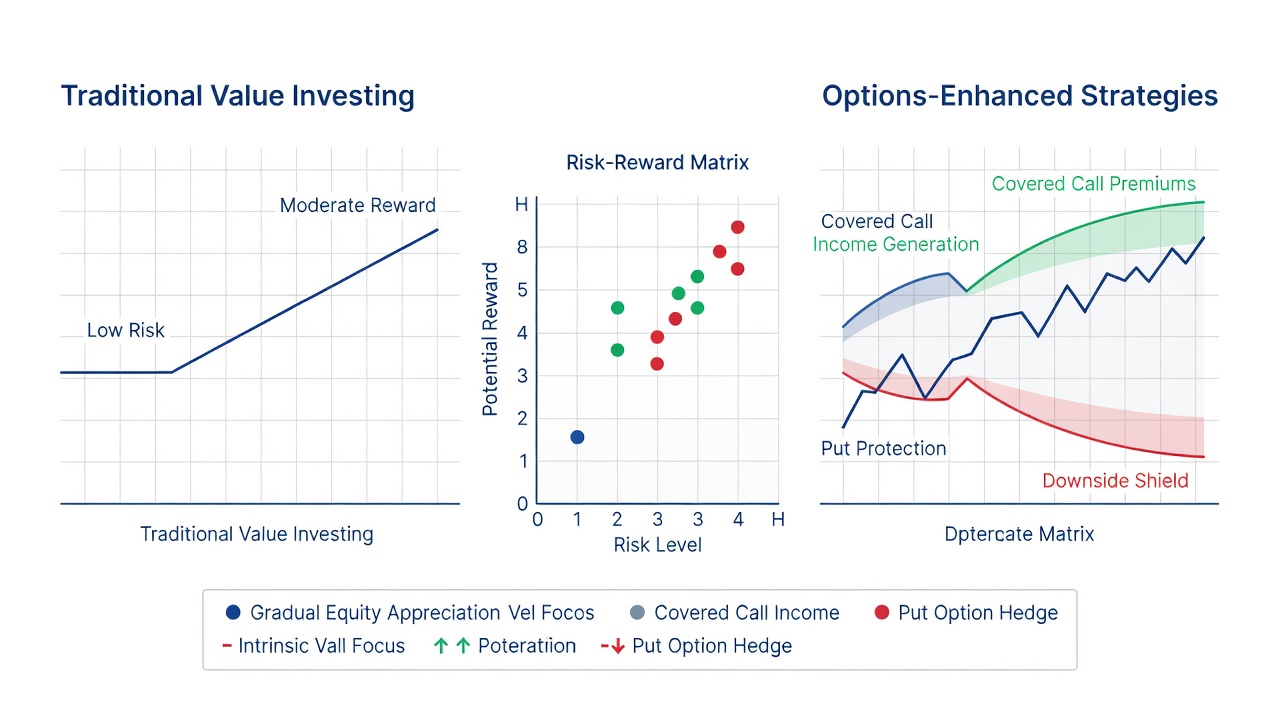
Traditional value portfolios deliver returns primarily through price appreciation and dividends. Options-enhanced versions add premium income and defined-risk profiles. In sideways markets, covered call overlays often outperform by harvesting time decay. During sharp rallies, however, upside can be capped, requiring investors to weigh income benefits against opportunity costs. Protective strategies reduce maximum drawdowns but introduce ongoing premium expenses. Investors should model multiple scenarios using historical volatility data to determine the optimal mix for their risk tolerance.
Real-World Case Studies from Recent Market Cycles
During the 2022 bear market, value investors who overlaid protective puts on bank holdings limited losses to single digits while unprotected peers experienced deeper declines. In the subsequent recovery phase of 2023 through 2025, energy sector value names enhanced with covered calls delivered incremental income that compounded meaningfully over multiple quarters. These examples illustrate how disciplined options use can smooth returns without sacrificing the core value discipline of owning high-quality businesses at attractive prices.
Common Pitfalls to Avoid
Many investors over-leverage options positions, transforming conservative value portfolios into speculative vehicles. Others neglect dividend capture considerations when selecting strikes or ignore tax treatment of short-term gains. Failing to maintain adequate cash reserves for assignment or allowing positions to drift from the original fundamental thesis are additional frequent mistakes. Always document the rationale for each options overlay and conduct quarterly portfolio reviews to ensure alignment with long-term objectives.
Tax Implications and Broker Tools
Options transactions frequently generate short-term capital gains taxed at ordinary income rates, making tax-advantaged accounts preferable for active strategies. Brokers offering integrated options analytics, probability calculators, and portfolio-level risk views streamline implementation. Resources from established exchanges provide educational modules on approval levels and margin requirements. Investors should verify platform capabilities for rolling positions and tracking cost basis before executing complex overlays.
Explore options education and tools at CBOE.
Practical Steps for Getting Started in 2026
Begin by confirming options trading approval with your broker. Build a watchlist of 10 to 15 undervalued stocks meeting strict fundamental criteria. Paper trade covered calls and protective puts for at least one full market cycle before committing capital. Allocate no more than 20 percent of the equity portfolio to options overlays initially. Reassess strategy performance monthly using both total return and risk-adjusted metrics. Scale successful tactics gradually while maintaining diversification across sectors.
FAQ Section
How do options affect long-term value holding periods?
Assignment can interrupt holding periods, yet rolling techniques and careful strike selection allow investors to maintain core positions across multiple cycles.
Which brokers best support these strategies?
Platforms featuring comprehensive options chains, research integration, and tax reporting tools provide the infrastructure needed for active value overlays.
Are there regulatory considerations?
Investors must meet broker-specific approval criteria and should consult official guidance from SEC investor resources regarding options trading permissions and disclosures.
What market environments favor options-enhanced value strategies?
Range-bound or moderately volatile markets often reward covered call writing, while elevated uncertainty periods suit protective put purchases and volatility selling.
Conclusion
Integrating options into active value investing strategies equips investors with versatile tools for income enhancement and risk control in 2026. Success hinges on disciplined execution, unwavering focus on underlying fundamentals, and continuous learning. By starting with small position sizes and expanding proven techniques, investors can achieve more resilient portfolios that outperform traditional value approaches across varying market regimes.


No comments yet. Be the first!