 Bullish Portfolio

Introduction to Active Value Investing for High-Net-Worth Individuals
In 2026, high-net-worth individuals (HNWIs) navigate complex markets influenced by technological disruption, geopolitical tensions, shifting monetary policies, and evolving regulatory landscapes. Active value approaches merge deep fundamental analysis with the pursuit of undervalued assets, delivering sophisticated wealth preservation that surpasses simple passive indexing. These strategies focus on securities priced below intrinsic value while employing active management informed by rigorous research and timely adjustments.
Active value investing adapts timeless principles from Benjamin Graham to modern realities, incorporating AI analytics, alternative datasets, and real-time economic indicators. For HNWIs, the emphasis lies on personalization, tax optimization, liquidity management, and building resilience against volatility that can erode wealth rapidly in uncertain times.
Comparing Active Value Methods to Standard Approaches
Passive strategies offer low-cost, broad exposure through market-cap indexes but often overlook mispricings in less efficient corners of the market. Active value methods, by contrast, demand intensive due diligence to exploit discrepancies, frequently generating better risk-adjusted outcomes in areas such as small-cap equities, distressed debt, and niche private markets. HNWIs gain from this hands-on style through higher potential returns during dislocations, though it requires greater involvement and expertise.
Distinctions include continuous position monitoring versus buy-and-hold passivity, systematic mitigation of behavioral biases via disciplined valuation frameworks, and selective integration of growth characteristics rather than rigid avoidance. In the wake of 2025 interest rate stabilization and sector rotations, active value has demonstrated advantages in capturing opportunities that passive vehicles routinely miss. Federal Reserve data underscores how policy shifts create windows for value-oriented repositioning.
Customized Portfolio Construction
Effective construction begins with a full review of net worth, cash flow requirements, family governance structures, and multi-generational goals. Core allocations typically range from 40-60% in value equities vetted through discounted cash flow and comparable analysis, while 20-30% targets actively managed fixed income with credit-focused selection. The balance flows into alternatives for true diversification.
Implementation involves setting strict value entry points, such as purchasing only when securities trade at a 40% or greater discount to intrinsic value, followed by scenario modeling for inflation, recession, or geopolitical shocks. Incorporating ESG considerations can further enhance sustainable value creation. Real-world application might see an HNWI family allocating 15% to emerging-market value plays screened for governance improvements, yielding resilient performance amid global uncertainty.
Advanced Risk Assessment Techniques
Standard metrics like volatility fall short for concentrated wealth. Instead, HNWIs employ Monte Carlo simulations tuned for tail events, liquidity-adjusted stress tests, and factor decomposition that accounts for hidden correlations across illiquid holdings. Dynamic hedging via options, calibrated to prevailing volatility surfaces, provides an additional layer of protection.
Macro overlays derived from central bank communications and leading indicators enable proactive beta adjustments. This multi-layered framework has proven effective at limiting drawdowns during recent market swings. SEC guidance on risk disclosures further informs institutional-grade practices suitable for private wealth.
Diversification Across Alternative Assets
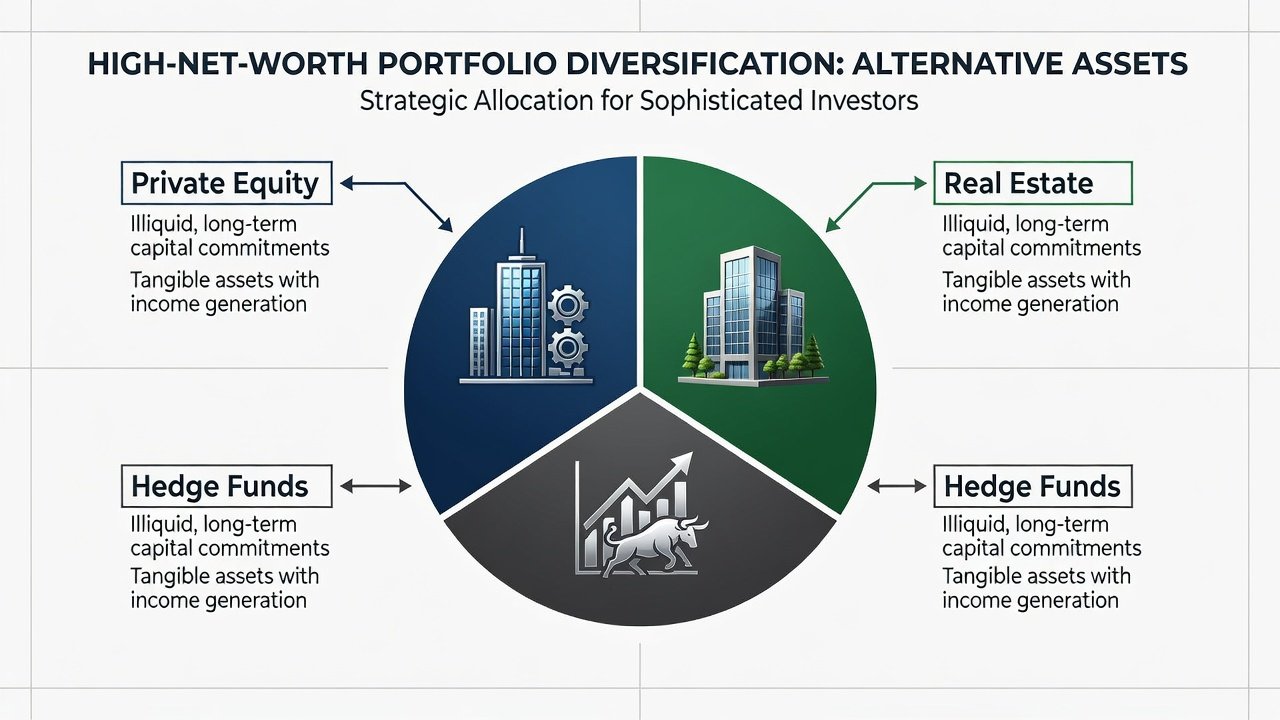
Alternatives serve as critical stabilizers. Private equity allows operational value enhancement through active ownership, while direct real estate or funds focus on cash-flowing assets with strong fundamentals. Event-driven hedge funds and infrastructure investments add inflation hedging and low correlation benefits. In 2025-2026 conditions, many HNWIs increased exposure to private credit, securing covenant-protected yields that outperformed public fixed income amid tighter lending standards.
Successful diversification requires manager selection based on alignment of interests, transparent fee structures, and proven value creation cycles rather than recent performance alone. Periodic re-underwriting of each alternative sleeve prevents style drift.
Step-by-Step Implementation Guide
- Perform a complete net-worth mapping that includes illiquid assets, liabilities, and contingent obligations.
- Develop a curated watchlist of 25-40 candidates using multi-factor screens focused on margin of safety.
- Conduct exhaustive due diligence encompassing financial modeling, competitive positioning, management quality, and ESG risks.
- Determine position sizing through conviction scoring and correlation matrices to avoid unintended concentrations.
- Define rebalancing protocols triggered by valuation breaches or fundamental changes, not arbitrary timelines.
- Embed ongoing tax-loss harvesting and charitable giving strategies to enhance after-tax outcomes.
- Schedule quarterly reviews with investment committees or advisors to incorporate new data and adjust course.
Case Studies from Recent Market Conditions
Following 2026 regulatory announcements, one multi-family office deployed active value tactics by building positions in undervalued industrial and materials companies at 0.65x book value. Subsequent engagement led to governance reforms and a 28% price recovery within ten months. Another example involved shifting capital from momentum-driven technology holdings into energy-transition infrastructure trading at depressed multiples due to short-term sentiment, preserving capital and generating steady distributions during sector turbulence.
Actionable Checklists
- Refresh intrinsic value estimates for every holding on a quarterly basis using updated financials.
- Evaluate alternative managers annually against custom benchmarks and peer groups.
- Model after-tax performance projections biannually with tax counsel.
- Monitor geopolitical and regulatory developments through dedicated intelligence feeds.
- Review liquidity profiles and redemption terms across alternatives every six months.
Expert Insights and Mistakes to Avoid
Seasoned practitioners stress patience and process discipline over chasing short-term alpha. Common pitfalls include over-concentration in familiar sectors, neglecting liquidity planning during market stress, and allowing fees to erode net returns. Avoiding these requires documented investment policy statements and independent oversight.
FAQs on Tax Implications and Performance Tracking
What tax considerations matter most for active value strategies?
Short-term trading triggers higher ordinary income rates, making long-term holding and tax-efficient vehicles essential. Strategies such as opportunity zone investments and donor-advised funds provide deferral and reduction opportunities. Cross-border HNWIs should address treaty benefits and reporting requirements early.
How can performance be tracked rigorously?
Compare results to bespoke benchmarks blending value factors, alternatives, and risk metrics rather than broad indexes alone. Key indicators include after-tax internal rate of return, maximum drawdown, and attribution separating security selection from allocation effects. IMF economic outlooks supply useful context for forward-looking evaluations.
Conclusion
Active value investing equips HNWIs with a robust framework for 2026 and beyond by uniting analytical rigor with adaptive diversification. When executed with discipline and professional guidance, these approaches support both capital preservation and meaningful long-term growth across market cycles. Tailoring execution to personal circumstances remains the decisive factor in achieving sustained success.


No comments yet. Be the first!