 Bullish Portfolio

Introduction: Why Bias Awareness Matters in 2026 Value Investing
Active value investing demands rigorous analysis and disciplined execution, yet cognitive biases frequently undermine even the most experienced practitioners. In the unpredictable landscape of 2026 markets, characterized by rapid shifts in interest rates, geopolitical tensions, and sector rotations, the ability to recognize and neutralize these biases on a daily basis separates successful investors from those who repeatedly underperform. This comprehensive guide delves into evidence-based daily habits, detailed mental frameworks, step-by-step exercises, real-world case studies from recent volatile periods, and robust accountability systems. By embedding these practices into your routine, you can enhance screening accuracy, optimize entry and exit timing, and build a more resilient portfolio approach.
Understanding Key Cognitive Biases in Value Investing
Cognitive biases distort how investors interpret data and make decisions. Two of the most pervasive in active value investing are overconfidence and anchoring. Overconfidence manifests when investors believe their analytical skills or market insights are superior, leading them to overweight personal judgments over objective metrics. Anchoring occurs when initial reference points, such as a stock's 52-week high or an original purchase price, unduly influence subsequent evaluations. These biases directly affect the use of screening tools by introducing skewed assumptions into valuation models and disrupt entry timing by causing either premature commitments or prolonged hesitation.
Overconfidence Versus Anchoring: Impact on Screening Tools and Entry Timing
Overconfidence often results in overly aggressive screening criteria, where investors apply optimistic growth projections or ignore downside risks in quantitative filters. For instance, an overconfident investor might screen for stocks with low price-to-earnings ratios while dismissing high debt levels, assuming their superior research will uncover hidden value. This can lead to concentrated bets in volatile sectors. Anchoring, by contrast, causes investors to fixate on historical entry prices, delaying sales even when new information signals fundamental deterioration. In screening, this bias might keep outdated multiples in models rather than refreshing them with current earnings data. During portfolio construction, overconfidence accelerates entries into seemingly undervalued names without sufficient margin of safety, while anchoring prolongs holding periods beyond rational justification. Comparing the two, overconfidence inflates perceived edge in tool outputs, whereas anchoring creates inertia that misses timely rebalancing opportunities. Both erode long-term returns but respond well to structured daily interventions.
Building a Morning Bias-Check Routine
Establishing a consistent morning routine is foundational for bias mitigation. Allocate 20 to 25 minutes before market open to reset your mindset. Begin by journaling three holdings and articulating fresh reasons to repurchase them at prevailing prices, which directly challenges anchoring. Next, refresh your primary screening dashboard with the latest financial ratios and macroeconomic indicators. Then perform a quick contrarian scan: identify one widely held market narrative and list three counterarguments. Conclude by setting a single intention for the day, such as avoiding any new position without a pre-mortem review. This sequence creates psychological distance from yesterday's conclusions and prepares you for objective analysis. Investors who maintain this routine report fewer impulsive trades and improved adherence to value thresholds.
Step-by-Step Exercises for Neutralizing Biases
Incorporate these targeted exercises into your workflow for measurable progress. Exercise 1: Pre-Mortem Analysis – Before committing capital, assume the investment has declined sharply within six months and generate at least five plausible explanations, including macroeconomic surprises or company-specific setbacks. Document each and assign probability weights. Exercise 2: Devil's Advocate Drill – Dedicate ten minutes to constructing the strongest possible case against your thesis, focusing on overlooked competitive threats or valuation multiples that appear stretched. Share this written argument with a colleague or record it for later review. Exercise 3: Range Estimation Practice – Replace single-point price targets with wide valuation bands derived from multiple scenarios (base, bear, and bull cases). This reduces overconfidence by highlighting uncertainty ranges. Exercise 4: Bias Logging – After each research session, note any moments where you felt strong conviction and cross-reference against data that contradicts it. Repeat these exercises consistently for at least 30 days to rewire habitual thinking patterns.
Real-World Market Examples from Volatile Periods
Examining past volatility reveals how biases played out in practice. During the sharp 2022 inflation-driven selloff, overconfident value investors screened aggressively for cheap industrial stocks without adjusting for supply-chain disruptions, resulting in prolonged drawdowns. Anchored investors, fixated on pre-2021 entry prices, missed re-entry points in quality financials once rates stabilized. In the 2025 technology sector rotation, those applying daily pre-mortems avoided overexposure to overvalued software names misclassified as value opportunities. Similarly, the 2020 pandemic volatility demonstrated anchoring effects when investors clung to pre-crisis multiples, delaying purchases in resilient consumer staples that later delivered strong rebounds. These episodes underscore the value of embedding bias checks into daily processes rather than relying on periodic reviews.
Daily and Weekly Checklists for Progress Tracking
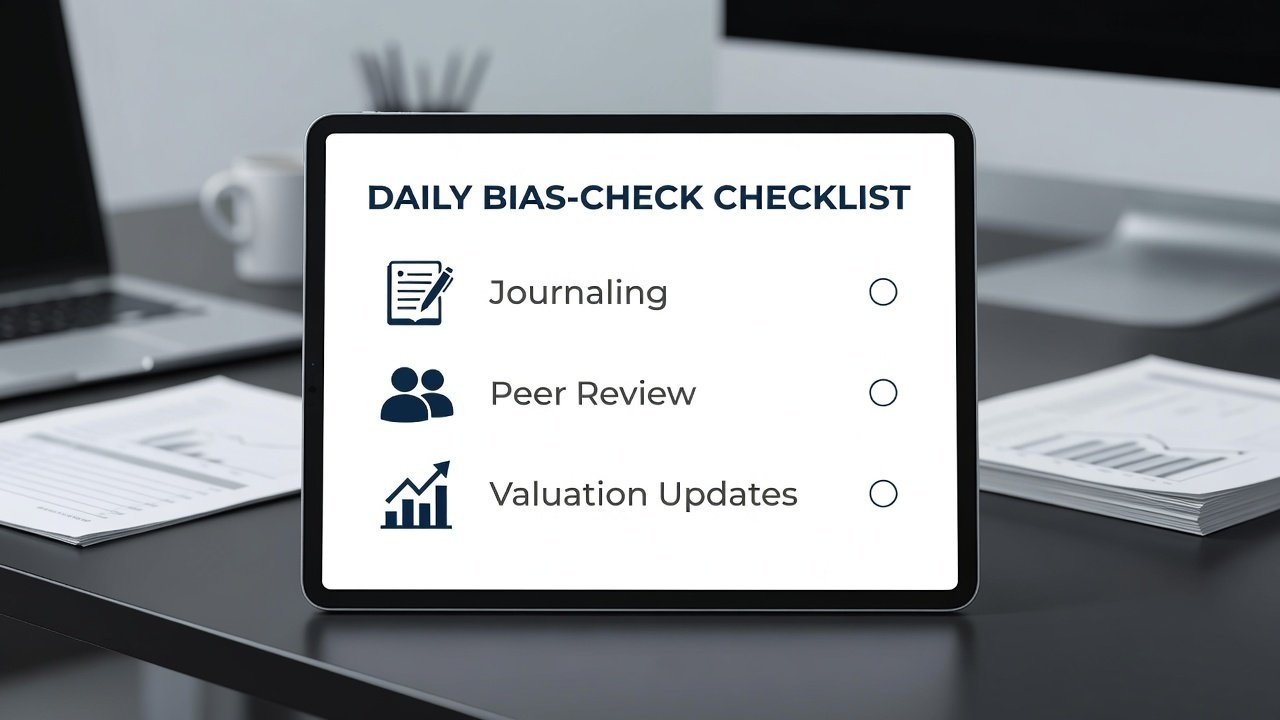
Implement structured checklists to monitor adherence and outcomes. Daily checklist items include: updating at least one valuation model with fresh data; identifying a single potential bias encountered during research; reviewing one existing position through a contrarian lens; and logging any emotional reactions to price movements. Weekly, expand to a deeper audit: calculate the win rate on decisions flagged for bias risk; compare actual portfolio turnover against your stated strategy; and review screening tool outputs for signs of recency bias. Monthly, aggregate results into a simple scorecard tracking metrics such as average holding period length and deviation from target allocation bands. Consistent use of these checklists transforms abstract awareness into quantifiable improvement.
Creating Accountability Systems
Accountability amplifies the effectiveness of individual habits. Maintain a dedicated investment journal with prompts such as: “What assumption am I most reluctant to test today and why?” or “Which screening result surprised me and how did I respond?” Schedule monthly peer review sessions with one or two trusted investors where each participant presents their top three holdings and fields rigorous questions. Establish a small mastermind group that meets quarterly to review collective performance against bias-related goals. For added structure, consider sharing anonymized decision logs with a mentor. These systems introduce external perspectives that surface blind spots and reinforce disciplined execution over time.
How These Habits Scale for Beginners and Experienced Practitioners
Beginners benefit from starting with a simplified version: adopt the morning bias-check routine and one exercise per week, gradually layering in checklists after 60 days. This measured approach prevents overwhelm while building foundational awareness. Experienced practitioners, who may have developed entrenched patterns across multiple cycles, gain the most from peer review mechanisms and advanced range estimation techniques that challenge long-held assumptions. Both groups should track progress through the same checklists, adjusting frequency based on available time and portfolio complexity. Over 90 days, most investors observe clearer decision logs and reduced emotional reactivity regardless of experience level.
Conclusion
Daily habits centered on bias recognition form the cornerstone of effective active value investing in 2026. Through morning routines, targeted exercises, comprehensive checklists, and layered accountability systems, investors can systematically reduce the influence of overconfidence and anchoring on screening tools and timing decisions. The real-world examples from recent volatile periods illustrate the tangible costs of unchecked biases and the protective power of consistent practice. Begin with small, repeatable actions, measure your progress rigorously, and refine continuously to cultivate a lasting competitive edge. For additional regulatory guidance on investment practices, consult the U.S. Securities and Exchange Commission and explore professional standards from the CFA Institute.

No comments yet. Be the first!