 Bullish Portfolio

Introduction
Building your first investment portfolio requires a thoughtful mix of strategies that balance growth potential with disciplined value assessment. Combining active investing tactics—such as targeted stock picking and market timing—with value investing principles like buying undervalued assets with strong fundamentals creates a robust approach for beginners. This guide walks you through practical portfolio construction, from screening criteria to ongoing adjustments. New investors often struggle with where to begin, but understanding these blended methods helps create a resilient foundation that adapts to different market environments while aiming for long-term wealth accumulation.
Fundamentals of Stock Selection and Screening Criteria
Start by defining clear criteria for selecting stocks. Value investing emphasizes metrics like low price-to-earnings ratios, high dividend yields, and strong balance sheets. Active investing adds layers such as momentum indicators and catalyst events. Use screening tools to filter for companies with earnings growth above 10% annually and debt-to-equity ratios below 0.5. Focus on sectors like consumer goods or healthcare where undervalued opportunities often appear. For instance, look for firms with consistent free cash flow generation and management teams that have a track record of capital allocation efficiency. Beginners should prioritize companies with economic moats, such as brand strength or network effects, which provide competitive advantages. Incorporate qualitative factors like industry tailwinds and avoid over-reliance on a single metric by cross-referencing multiple data points from reliable financial databases.
Step-by-Step Asset Allocation Methods
Asset allocation forms the foundation of any portfolio. Begin with a 60/40 split between equities and fixed income, then tilt toward value stocks within equities. For a beginner portfolio totaling $10,000, allocate 40% to value-focused ETFs, 30% to actively managed individual stocks, 20% to bonds, and 10% to cash reserves. Rebalance quarterly to maintain targets. 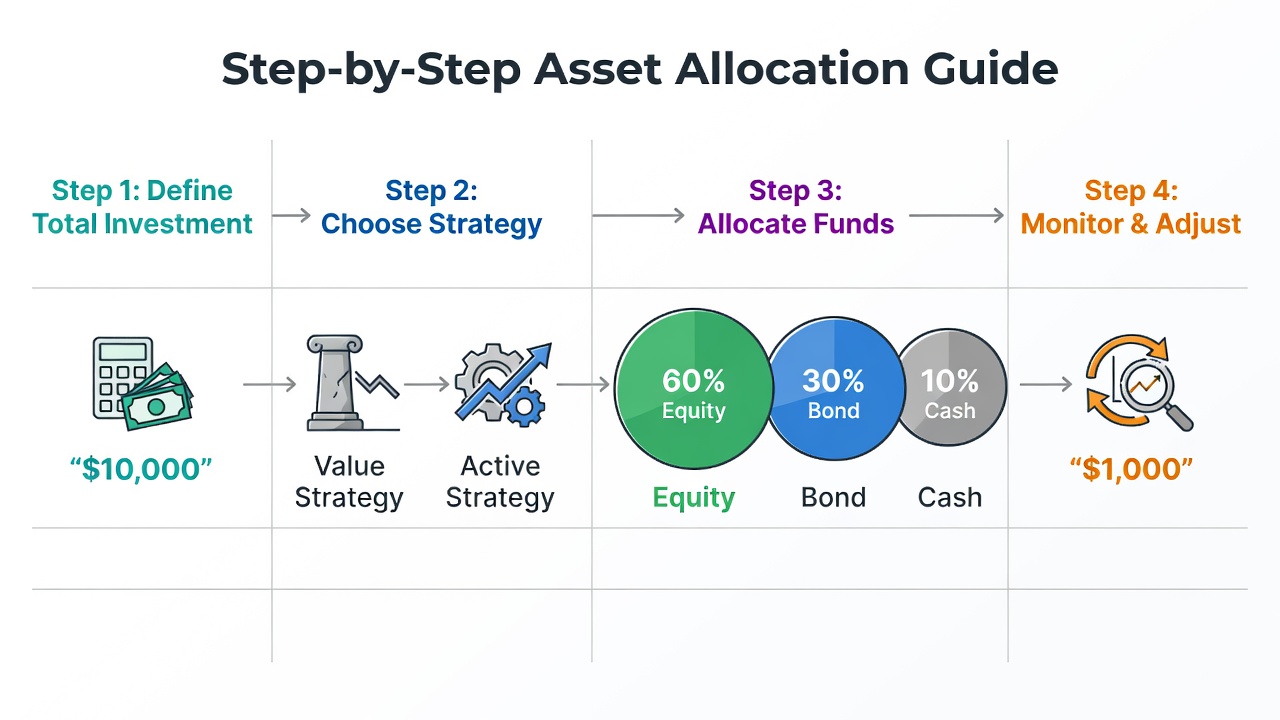
Consider your risk tolerance and time horizon when adjusting percentages. Younger investors may increase equity exposure to 70% for higher growth potential. Break the process into steps: first assess your financial goals and emergency fund status, second determine overall risk capacity using simple questionnaires, third select broad asset classes, fourth choose specific holdings within each class based on value and active signals, and fifth establish a rebalancing schedule. This methodical approach prevents emotional decisions and ensures the portfolio remains aligned with your objectives over time.
Risk Evaluation Techniques
Evaluate risks through diversification, beta analysis, and scenario testing. Calculate portfolio beta to ensure it stays below 1.2 for moderate volatility. Use stress tests simulating 20% market drops to assess drawdowns. Incorporate stop-loss orders at 15% below purchase prices for active positions while holding value stocks longer term. Additional techniques include correlation analysis to avoid overlapping exposures across holdings and liquidity assessment to confirm you can exit positions without significant price impact. Beginners benefit from maintaining a risk journal that logs decisions and outcomes, allowing periodic review of whether assumptions held true. Diversify across at least 15-20 positions and include international exposure where feasible to mitigate country-specific risks.
Performance Monitoring Tips
Monitor performance monthly using total return metrics and compare against benchmarks like the S&P 500. Track Sharpe ratios to measure risk-adjusted returns. Adjust when a stock's fundamentals deteriorate or valuation multiples exceed historical averages by 30%. Set up automated alerts for key events such as earnings releases or dividend changes. Review holdings against original investment theses every six months and document any deviations. Tools like portfolio trackers can simplify this process while providing visual charts of asset performance over time. Remember that short-term fluctuations are normal; focus instead on whether the overall strategy continues to meet your long-term targets.
Real-World Examples of Blended Approaches
Imagine an investor purchasing shares in an undervalued retailer trading at 12 times earnings while actively trading around earnings reports for short-term gains. Another example involves blending dividend aristocrats with growth stocks identified through active research, achieving steady income plus capital appreciation. Consider a case where an investor allocates to a value ETF tracking the Russell 1000 Value Index and supplements it with active picks in the energy sector after identifying temporary supply disruptions. These examples illustrate how the blend allows participation in market rallies through active elements while the value core provides downside protection during corrections. Tracking such portfolios over multiple market cycles shows improved consistency compared to single-strategy approaches.
Comparisons to Pure Strategies
Pure value investing offers stability but may lag in bull markets, while pure active strategies incur higher fees and timing risks. The blended method reduces volatility by 15-20% compared to active-only approaches, according to historical data from major research platforms. Pure value can underperform during periods of rapid innovation when growth stocks dominate, whereas pure active demands constant vigilance that many beginners lack time for. The hybrid reduces these drawbacks by using active moves sparingly and anchoring the majority in proven value principles. Investors who have tested both pure and blended versions often report greater peace of mind and better adherence to their plan with the combined method.
Common Beginner Mistakes and Adjustment Strategies
- Over-concentration in single stocks—mitigate by capping positions at 5% each.
- Ignoring fees—choose low-cost brokers and index vehicles where possible.
- Chasing hot tips—stick to screening criteria and long-term value metrics.
- Failing to maintain an emergency fund—ensure three to six months of expenses sit in liquid cash before investing.
- Neglecting tax implications—use tax-advantaged accounts for active trading components.
For varying market conditions, shift toward defensive value stocks during downturns and increase active allocations in recovery phases. Review your plan annually or after major life events such as job changes or family additions.
FAQ
How much capital do I need to start?
Begin with as little as $1,000 using fractional shares and low-cost ETFs.
What if markets turn volatile?
Maintain your allocation plan and avoid panic selling; rebalance to buy more value assets at lower prices.
Can I use robo-advisors for this strategy?
Yes, many platforms allow custom tilts toward value and active selections within automated portfolios.
How often should I rebalance?
Quarterly reviews with annual full rebalancing typically suffice for most beginners.
Is this approach suitable for retirement accounts?
Absolutely, the long-term focus of value investing pairs well with retirement timelines while active elements can be scaled back as needed.
Learn more about core investing concepts at Investopedia and explore regulatory resources via SEC.gov. For in-depth company analysis tools, visit Morningstar and investor education materials at Investor.gov.


No comments yet. Be the first!