 Bullish Portfolio

Introduction to Tools for Active Value Investors
Active value investing combines rigorous fundamental analysis with timely decision-making. In 2026, investors need robust software to screen stocks, build intrinsic value models, and monitor portfolios dynamically. This guide details ten essential tools that support these strategies, including setup steps and practical applications. Blending active trading signals with classic value metrics such as intrinsic value calculations allows investors to capitalize on market inefficiencies while maintaining a margin of safety. The right toolkit transforms raw data into actionable insights, helping identify undervalued opportunities before the broader market recognizes them.
1. Yahoo Finance for Initial Screening
Yahoo Finance provides free access to financial statements and key ratios. Start by creating an account, then use the screener to filter by P/E ratios below 15 and ROE above 10%. This quickly identifies candidates for deeper value analysis. Customize watchlists to track multiple undervalued stocks simultaneously. Export data directly into spreadsheets for further modeling. The platform also offers historical price charts that reveal long-term trends supporting value theses.
2. Finviz for Visual Stock Discovery
Finviz offers heatmaps and advanced filters. Set parameters for low PEG ratios and high free cash flow yields. Premium unlocks real-time data, but the free version suffices for daily scans of undervalued opportunities. Users can visualize sector rotations and compare multiple metrics side by side. The interactive map highlights outliers where value gaps appear widest, making it ideal for active investors seeking quick entry points.
3. Morningstar for Comprehensive Research
Morningstar delivers detailed analyst reports and fair value estimates. Integrate their intrinsic value calculations with your models. Visit Morningstar for portfolio tracking features that flag margin of safety gaps. The platform also provides stewardship ratings and sustainability metrics increasingly relevant in 2026. Investors often cross-reference these reports with their own DCF models to validate assumptions about growth rates and discount factors.
4. TradingView for Technical Confirmation
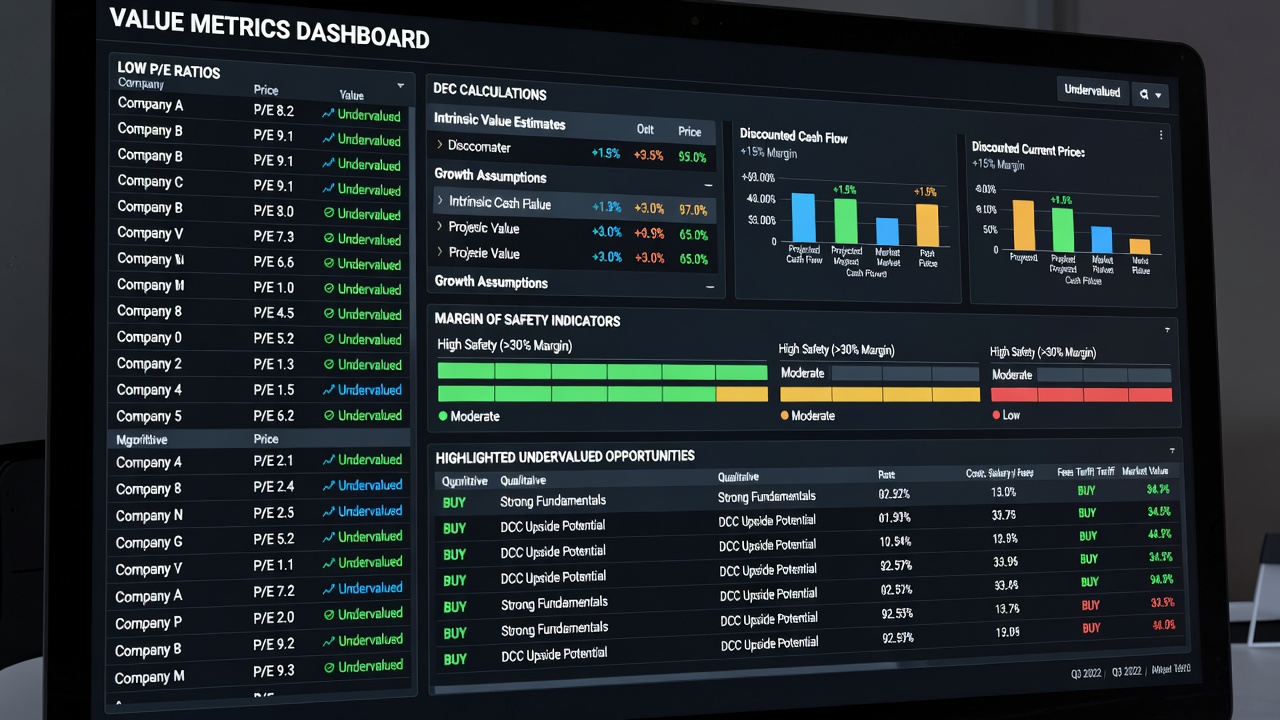
Active value investors layer technicals onto fundamentals. Use TradingView charts to confirm entry points after value screens. Free charts work well; premium adds advanced alerts for 2026 market volatility. Create custom indicators that combine moving averages with value-based thresholds. Many investors set price alerts triggered when a screened stock approaches its calculated intrinsic value, enabling rapid active responses.
5. GuruFocus for DCF Modeling
GuruFocus specializes in discounted cash flow tools. Import company data and adjust growth rates to calculate intrinsic value. Compare free trial outputs against manual Excel models for accuracy. The platform includes historical financials spanning decades, allowing users to stress-test assumptions against various economic cycles. This depth proves especially useful when evaluating cyclical businesses common in value portfolios.
6. Seeking Alpha for Community Insights
Seeking Alpha aggregates quant ratings and earnings transcripts. Follow value-focused authors to spot mispricings. Premium access provides deeper transcripts useful for active monitoring. Readers benefit from crowdsourced commentary that sometimes surfaces overlooked risks or catalysts. Combine these qualitative insights with quantitative screens to refine buy and sell decisions.
7. Portfolio Visualizer for Backtesting
Test value strategies historically with Portfolio Visualizer. Upload holdings and simulate rebalancing based on intrinsic value updates. Free core features support most investor needs. Advanced Monte Carlo simulations help assess portfolio resilience under different 2026 market scenarios. This forward-looking analysis complements traditional value metrics by quantifying downside protection.
8. Google Sheets with Custom Scripts
Build valuation models in Google Sheets using IMPORTXML for live data pulls. Step-by-step: link to SEC filings, calculate DCF, and set conditional formatting for buy signals when price is 30% below value. Automate updates with Google Apps Script so models refresh daily without manual intervention. This flexible approach lets investors tailor every formula to their specific value criteria while keeping costs at zero.
9. Bloomberg Anywhere for Professional Depth
Bloomberg provides terminal-level data for institutional-grade analysis. Active users leverage it for real-time news alongside value metrics, though costs reflect enterprise features. The terminal excels at aggregating macroeconomic indicators that influence intrinsic value estimates across entire sectors. Professional investors often rely on its charting capabilities to overlay technical signals on fundamental data.
10. Value Line for Historical Context
Value Line offers ranked reports with long-term performance data. Use their timeliness ranks to prioritize value stocks showing improving fundamentals. The service includes detailed industry analyses that reveal competitive positioning within value universes. Many long-term investors consult these reports before finalizing portfolio allocations.
Integration Tips for Active Decision-Making
Combine tools by exporting screens from Finviz into Morningstar for valuation. Update models weekly and set alerts in TradingView. This workflow ensures value metrics drive active trades. Create a central dashboard in Google Sheets that pulls outputs from multiple platforms. Schedule monthly reviews to recalibrate assumptions based on new earnings data and macroeconomic shifts expected in 2026.
Free vs Premium Comparisons
- Free tiers like Yahoo Finance handle basic screening effectively for most individual investors.
- Premium upgrades in GuruFocus add automated DCF scenarios for faster analysis and deeper historical datasets.
- Evaluate ROI by tracking time saved versus subscription costs in your 2026 portfolio reviews.
- Many investors begin with free versions and upgrade selectively once they identify which premium features deliver measurable improvements in decision speed.
Real-World Example: Identifying an Undervalued Stock
An investor screens for energy stocks with Finviz, then runs DCF in GuruFocus to confirm 25% undervaluation. Portfolio Visualizer backtests the addition, leading to a purchase confirmed by TradingView momentum. The process continues with ongoing monitoring through Morningstar alerts, allowing timely adjustments if fundamentals deteriorate. This integrated approach turned a routine screen into a high-conviction position that outperformed the broader market over the following quarters.
Common Mistakes to Avoid When Selecting Tools
Over-reliance on a single platform often leads to blind spots. Always cross-verify data across at least two sources. Ignoring setup time can reduce the net benefit of premium tools. Focus on features that directly support intrinsic value calculations rather than flashy extras. Finally, avoid chasing every new software release; stable, well-supported platforms tend to deliver more consistent results for long-term value strategies.
FAQ on Tool Selection and ROI Tracking
How do I choose between free and paid tools?
Start with free versions for core screening, then upgrade if premium features accelerate your value calculations by more than the subscription expense.
What metrics track tool effectiveness in 2026?
Monitor portfolio alpha generated from tool-identified picks and compare against benchmarks using Portfolio Visualizer reports.
Can these tools integrate with brokerage accounts?
Many export CSV data for import into platforms like Fidelity for seamless active value execution.
How often should investors refresh their tool stack?
Conduct an annual review each January to evaluate whether new data sources or updated features better support evolving market conditions and personal strategy refinements.
Mastering these resources positions investors to thrive amid evolving 2026 markets by grounding active moves in solid value principles. Consistent application of these tools builds both analytical skill and disciplined decision-making frameworks essential for long-term success.

No comments yet. Be the first!