 Bullish Portfolio

Introduction to Sector ETFs and Index Fund Synergies
Experienced investors in 2026 recognize that core index fund holdings provide broad market exposure and low costs, yet they often seek ways to enhance returns without disrupting the foundation. Sector ETFs offer a precise tool for this purpose by allowing targeted exposure to high-potential industries while maintaining overall portfolio discipline. This approach suits those aiming for incremental performance improvements amid evolving economic conditions driven by technological innovation, shifting trade policies, and demographic changes. Integrating sector ETFs involves identifying sectors with strong momentum, determining appropriate allocation weights, and applying rigorous risk controls. The result is a hybrid portfolio that combines the stability of broad indexes with opportunistic sector tilts designed to capture alpha in specific areas of the economy.
By layering sector ETFs onto a foundation of total market or S&P 500 index funds, investors can fine-tune exposure without selling core positions. This method preserves the benefits of low-cost diversification while addressing gaps in sector representation that broad indexes may underweight during certain market cycles.
Identifying High-Potential Sectors for 2026
Begin by analyzing macroeconomic trends, technological advancements, and regulatory shifts. Sectors such as technology, healthcare, and renewable energy frequently demonstrate resilience and growth potential. Use data from government sources like the Federal Reserve to gauge interest rate impacts on cyclical industries. Technology remains attractive due to continued advancements in artificial intelligence and cloud computing, while healthcare benefits from aging populations and breakthroughs in biotechnology. Renewable energy gains traction from policy incentives and falling production costs in solar and wind infrastructure.
Key indicators include earnings growth forecasts, supply chain developments, and consumer spending patterns. Avoid over-reliance on short-term hype; instead, cross-reference multiple data points to validate sector strength. Investors should also examine labor market statistics from the Bureau of Labor Statistics and global supply data to identify emerging opportunities in industrials and materials sectors.
Practical Screening Process
- Review sector performance relative to the S&P 500 over rolling 12-month periods.
- Assess valuation metrics such as price-to-earnings ratios compared to historical averages.
- Monitor policy changes from official regulatory bodies including the U.S. Securities and Exchange Commission.
- Evaluate correlation matrices to ensure new sector exposure adds genuine diversification rather than redundant risk.
Calculating Optimal Allocation Weights
Optimal weights balance conviction in a sector with overall risk tolerance. A common starting point is limiting any single sector ETF to 5-15% of the total equity allocation. This prevents concentration risk while allowing meaningful impact. Advanced techniques involve solving for weights that maximize expected return subject to volatility constraints, often using spreadsheet models or portfolio optimization software.
Use quantitative methods such as mean-variance optimization or simple percentage overlays based on expected excess returns. For example, an investor might assign 8% to technology if its projected excess return over the broad market justifies the added volatility. Revisit weights quarterly to adapt to new information such as earnings reports or macroeconomic releases.
Step-by-Step Implementation Guide
- Assess current index fund allocations and identify gaps by reviewing holdings reports from your brokerage platform.
- Select 2-3 sector ETFs with complementary characteristics, ensuring low overlap with existing index components.
- Model portfolio returns and volatility using historical data adjusted for forward estimates, incorporating stress scenarios like rising interest rates.
- Execute trades during low-volatility windows to minimize slippage and transaction costs.
- Document the rationale for future reference and tax planning, including expected holding periods.
- Set automated alerts for significant market moves that may require tactical adjustments.
Risk Assessment Techniques
Effective risk management requires evaluating correlation between sector ETFs and core holdings. Low-correlation sectors provide true diversification benefits. Stress-test the portfolio against scenarios such as inflation spikes or geopolitical events using Monte Carlo simulations or historical drawdown analysis. Investors should calculate metrics including standard deviation, value-at-risk, and conditional value-at-risk to understand tail risks.
Tools include Sharpe ratio calculations, maximum drawdown analysis, and beta measurements relative to benchmarks. Regular monitoring helps maintain the intended risk profile. For instance, if a technology sector ETF exhibits rising beta during a market rally, reducing its weight can preserve overall stability. Incorporate liquidity analysis to ensure sector ETFs can be traded efficiently during volatile periods.
Real-World Portfolio Examples and Comparison Tables
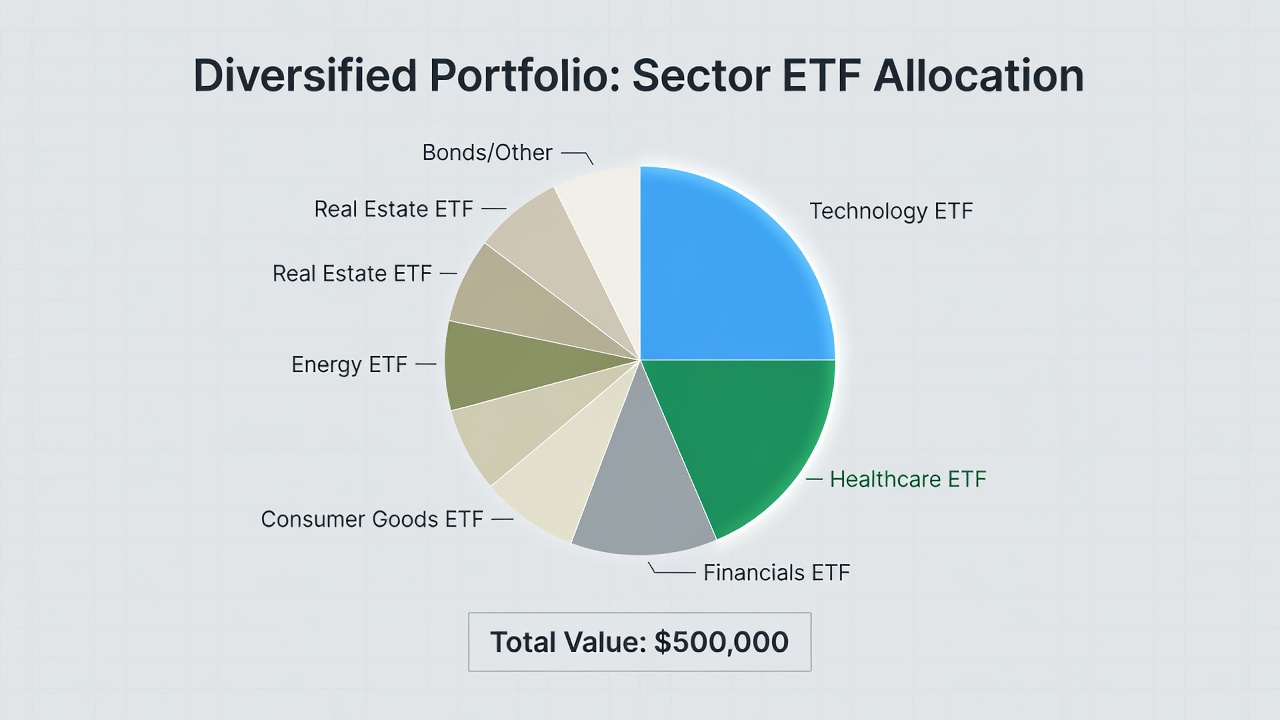
Consider a sample $500,000 portfolio with 70% in a total market index fund, 20% in sector ETFs (10% technology, 5% healthcare, 5% industrials), and 10% in fixed income. Historical backtests show improved risk-adjusted returns compared to a pure index approach, though past performance does not guarantee future results. Another example involves a more aggressive allocation with 12% technology, 8% clean energy, and 5% financials overlaid on a 65% core index position. This configuration captured higher growth during periods of economic expansion while requiring more frequent rebalancing.
| Portfolio Type | Annualized Return | Volatility | Sharpe Ratio | Max Drawdown |
|---|---|---|---|---|
| Core Index Only | 9.8% | 15.2% | 0.58 | -22% |
| With Sector Overlays | 11.4% | 16.1% | 0.65 | -19% |
| Aggressive Sector Tilt | 12.9% | 18.7% | 0.62 | -25% |
Common Mistakes to Avoid
Many investors over-allocate to recently outperforming sectors, leading to style drift and increased volatility. Another frequent error is neglecting correlation analysis, which can result in unintended concentration. Failing to account for expense ratios and tracking error in sector ETFs can erode the intended performance edge over time. Always compare multiple ETFs within the same sector before committing capital.
Tools and Resources for Ongoing Management
Portfolio management platforms and free government data sources help track sector performance. Investors benefit from using screening tools that incorporate fundamental ratios and macroeconomic indicators. Tax implications should be reviewed with reference to official guidance from the IRS to optimize holding periods and account types.
Conclusion
Sector ETFs serve as powerful enhancers when thoughtfully integrated into index fund portfolios. By focusing on disciplined allocation and ongoing oversight, investors position themselves for improved outcomes in 2026 and beyond. The key lies in maintaining a rules-based framework that adapts to changing conditions without abandoning core principles of diversification.
FAQ
How often should sector ETF allocations be reviewed?
Quarterly reviews align with earnings seasons and economic data releases, allowing timely adjustments without excessive trading. Annual deep reviews can incorporate updated macroeconomic forecasts.
What tax implications arise from frequent rebalancing?
Short-term rebalancing may trigger ordinary income tax rates; strategic use of tax-advantaged accounts mitigates this impact. Long-term holding of sector ETFs within taxable accounts can qualify for preferential capital gains treatment.
Can sector ETFs be used in retirement accounts?
Yes, sector ETFs work well in IRAs and 401(k) plans where tax efficiency is less critical, allowing investors to focus purely on return and risk objectives.
How do sector ETFs compare to individual stock picking?
Sector ETFs provide instant diversification within an industry while avoiding single-stock risk, making them suitable for investors who prefer broad exposure over concentrated bets.

No comments yet. Be the first!