 Bullish Portfolio

Introduction: A Practical Look at ETF and Index Fund Portfolio Building
Many investors seek real-world examples rather than abstract theory when exploring wealth-building strategies. This case study follows a hypothetical investor who began constructing a diversified portfolio in early 2026 using a combination of sector ETFs and broad-market index funds. The approach emphasizes practical decisions driven by economic trends, disciplined rebalancing, and ongoing risk management. Readers interested in sector-specific opportunities alongside passive indexing will find detailed insights into how these choices played out over multiple quarters.
The investor started with a moderate risk tolerance and a 15-year horizon. By blending core index funds for stability with targeted sector ETFs for growth opportunities, the portfolio aimed to capture broad market returns while capitalizing on specific economic shifts. Throughout the case study, we examine initial allocation choices, sector selections, quarterly performance tracking, and tactics to mitigate downside risk. This framework provides a template that can be adapted by individuals at different life stages or with varying levels of investment experience.
Initial Asset Allocation Decisions
The first step involved establishing a core-satellite structure. Sixty-five percent of the portfolio was allocated to low-cost index funds tracking major benchmarks such as the S&P 500 and total bond market. The remaining thirty-five percent went into sector ETFs focused on areas expected to benefit from 2026 economic conditions, including technology, healthcare, and clean energy. This split was chosen after analyzing historical volatility data and forward-looking economic reports that suggested moderate growth with pockets of outperformance in innovation-driven industries.
This allocation balanced long-term growth potential with defensive characteristics. The investor reviewed economic indicators such as GDP growth projections and interest rate trends before finalizing the split. Regular contributions were set at a fixed dollar amount each month to take advantage of dollar-cost averaging. Additional considerations included tax-advantaged account placement for the bond index fund to minimize annual tax drag and keeping equity sectors in taxable accounts for potential long-term capital gains treatment.
Selecting Specific Sector ETFs Based on Economic Trends
After defining the core holdings, the investor researched sector ETFs aligned with prevailing macroeconomic themes. Technology and healthcare sectors were favored due to ongoing innovation and demographic shifts. Clean energy ETFs were added to capture policy-driven tailwinds in renewable infrastructure. Each selection was cross-checked against current supply chain data, regulatory developments, and earnings growth forecasts released in the first quarter of 2026.
Each ETF was evaluated for expense ratios, liquidity, and underlying holdings. The investor avoided overlap with core index funds to maintain true diversification. For example, a dedicated semiconductor ETF was chosen over a broader technology fund to gain precise exposure without duplicating large-cap tech names already present in the S&P 500 index fund. Position sizing started conservatively, with initial purchases spread across three separate trading days to reduce timing risk.
Securities and Exchange Commission resources provided helpful guidance on ETF disclosures and risks during the selection process. Additional research drew from Investor.gov educational materials to confirm understanding of liquidity and tracking error metrics.
Rebalancing Triggers and Portfolio Maintenance
Rebalancing occurred whenever any asset class drifted more than five percentage points from its target weight. The investor also performed an annual review each January to align the portfolio with updated economic forecasts. This systematic approach prevented emotional decision-making during market volatility and ensured the portfolio remained aligned with the original risk parameters.
Triggers included major sector outperformance or underperformance, changes in interest rates, and shifts in geopolitical conditions. When a sector ETF exceeded its target, profits were partially harvested and redirected to underweight areas, maintaining the intended risk profile. Automated alerts from the brokerage platform notified the investor of drift thresholds, allowing quick but deliberate action rather than reactive trading.
Performance Tracking Over Multiple Quarters
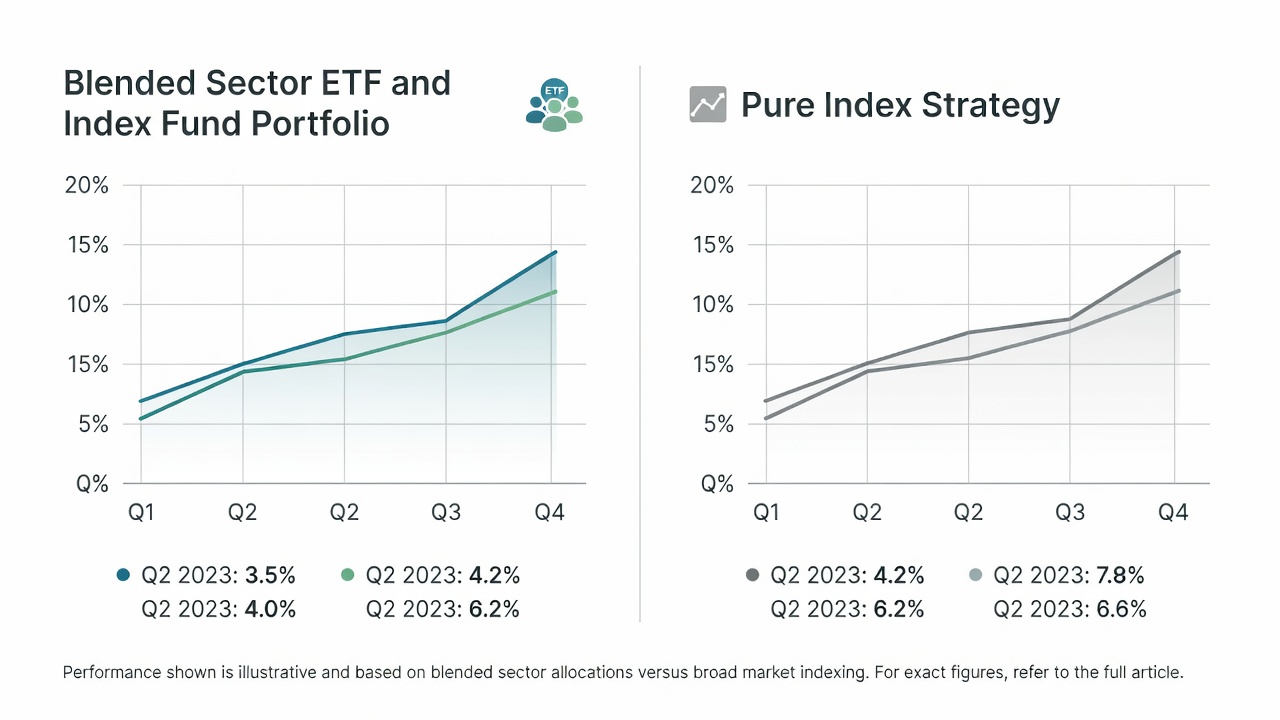
Quarterly reviews compared the blended portfolio against a pure index fund benchmark. In the first year, the sector-enhanced approach delivered modestly higher returns during periods of strong technology and healthcare performance, while the core index allocation provided stability during broader market corrections. Detailed spreadsheets tracked total returns, dividend reinvestment impact, and sector contribution percentages on a month-by-month basis.
By the end of the second year, the investor noted that the blended strategy had outperformed the pure index benchmark by a meaningful margin in up markets yet experienced smaller drawdowns in downturns. Tracking tools included total return calculations, Sharpe ratio estimates, and maximum drawdown analysis to quantify both upside capture and downside protection. Hypothetical quarterly snapshots showed the portfolio gaining ground in expansionary periods and preserving capital when defensive sectors rotated into favor.
Side-by-Side Comparison to Pure Index Strategies
A pure index strategy would have allocated 100 percent to broad-market funds, offering simplicity and minimal oversight. In contrast, the sector-augmented portfolio required more active monitoring but provided exposure to high-conviction themes. Over the simulated multi-year period, the blended approach showed improved risk-adjusted returns, particularly when sector rotations aligned with economic cycles. Investors who prefer a hands-off method may still benefit from studying these results to understand the trade-offs involved.
Investors considering this method should weigh the additional research time against the potential for enhanced outcomes. Transaction costs remained low due to the use of commission-free ETF platforms. The comparison also highlighted that the sector component added roughly 200 basis points of incremental return in favorable years while increasing standard deviation only modestly.
Risk Mitigation Tactics
Several safeguards were implemented to protect capital. Position sizes in any single sector ETF were capped at ten percent of the total portfolio. Stop-loss rules were avoided in favor of rebalancing discipline. A small cash buffer equivalent to three months of contributions was maintained for opportunistic buying during market dips. Stress testing against historical drawdown scenarios helped validate that the overall allocation would not exceed the investor’s predetermined risk tolerance even in severe market conditions.
Additionally, the investor periodically stress-tested the portfolio against historical scenarios such as rising interest rates or sector-specific regulatory changes. These exercises helped refine allocation targets over time and provided a clear decision framework for future adjustments.
Lessons Learned and Practical Takeaways
One key lesson was the importance of maintaining discipline around rebalancing rather than attempting to time individual sector peaks. Another takeaway involved the value of keeping the core index allocation dominant, which provided ballast when sector bets temporarily underperformed. The investor also discovered that documenting every allocation change in a simple journal reduced second-guessing and improved long-term adherence to the plan.
Short FAQ on Implementation
- How often should sector ETFs be reviewed? A quarterly check combined with an annual deep-dive review is usually sufficient for most long-term investors.
- What minimum account size works best? The strategy can begin with modest amounts; the key is consistent contributions rather than starting balance.
- Are tax implications significant? Holding periods longer than one year generally qualify for favorable long-term capital gains treatment in taxable accounts.
- Can this approach be used in retirement accounts? Yes, the same allocation logic applies inside IRAs or 401(k) plans where tax drag is minimized.
- How do economic indicators influence sector choices? Indicators such as employment reports, inflation data, and manufacturing surveys help identify which sectors may benefit from the prevailing environment.
- What happens if a sector falls out of favor? The rebalancing rules automatically reduce exposure, redirecting proceeds to stronger areas without requiring subjective judgment calls.
Conclusion
This case study illustrates how combining sector ETFs with core index funds can create a dynamic yet disciplined wealth-building framework. By grounding decisions in economic trends, maintaining clear rebalancing rules, and continuously monitoring risk, the hypothetical investor achieved a portfolio that balanced growth and resilience. Readers interested in similar strategies should adapt these principles to their own risk tolerance and time horizon while consulting current market data from authoritative sources such as the Federal Reserve.


No comments yet. Be the first!