 Bullish Portfolio

Avoid These ETF Investing Mistakes with Sector & Index Funds 2026
Exchange-traded funds continue to attract investors seeking low-cost, diversified exposure to markets, yet many undermine their long-term results through repeated strategic errors. Sector ETFs and broad index funds each carry unique risks when used incorrectly. This in-depth guide explores the most common pitfalls, explains why they occur, and delivers actionable steps to correct them. Whether you are building a core portfolio or fine-tuning an existing allocation, understanding these mistakes helps reduce volatility and improve consistency amid shifting 2026 market conditions.
Over-Concentration in Volatile Sectors
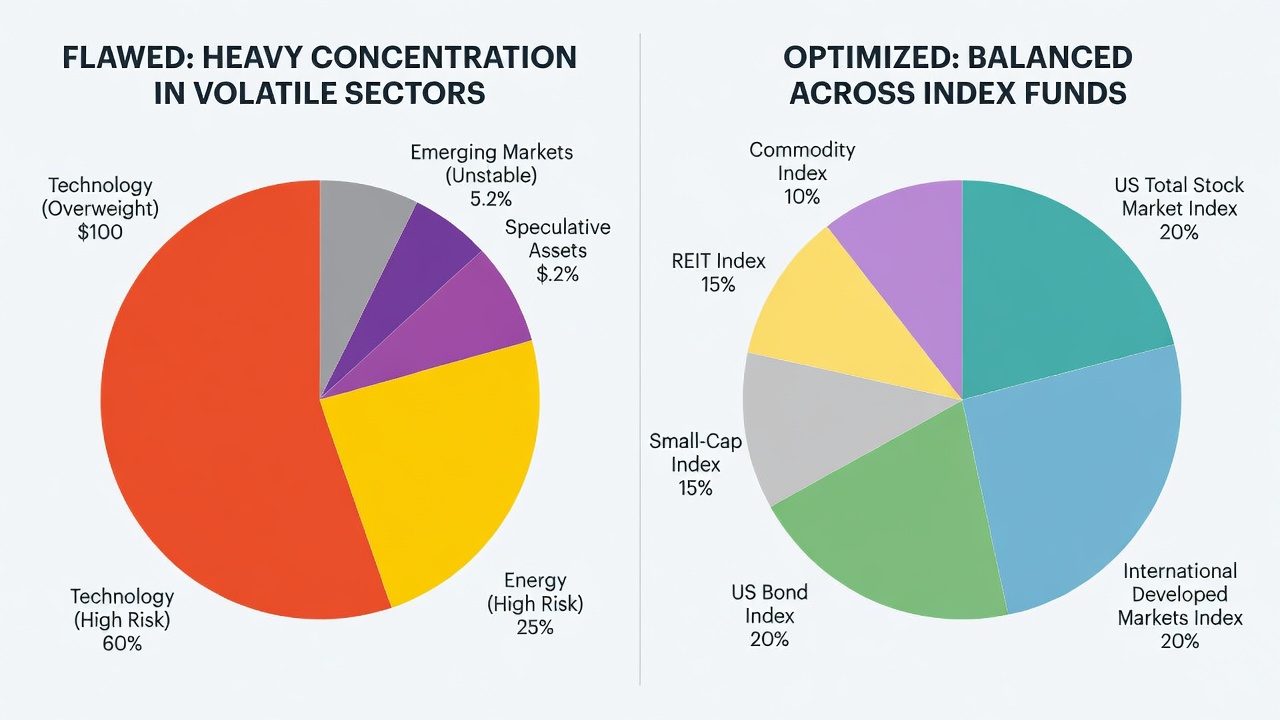
Allocating excessive capital to a single sector creates outsized exposure to industry-specific shocks. Technology, energy, and biotechnology ETFs often experience sharp drawdowns when supply chains break, regulatory changes occur, or commodity prices swing. A portfolio that drifts above 25 percent in one sector rarely delivers the stability most investors expect from ETF strategies.
Real-World Example of Costly Over-Concentration
Consider an investor who placed 45 percent of equity holdings into a semiconductor sector ETF during a period of strong chip demand. When export restrictions and inventory corrections hit the industry, the position fell sharply. The remainder of the portfolio, held in broad index funds, could not offset the loss quickly enough. After rebalancing to a 12 percent sector cap, the same investor recovered ground faster during the subsequent market rebound because the overall allocation remained diversified.
To avoid this trap, establish explicit sector limits in your investment policy statement before purchasing any ETF. Review holdings monthly and trigger automatic alerts when any sector exceeds your predetermined threshold. Broad market index funds such as those tracking the S&P 500 or total stock market serve as effective anchors that naturally limit sector drift.
Neglecting Expense Ratios and Hidden Costs
Expense ratios directly erode compounding returns over multi-year periods. Investors sometimes select sector ETFs with higher fees for perceived alpha potential while overlooking that many broad index funds now carry significantly lower costs. The difference becomes material across decades of ownership.
Compare total cost of ownership by examining management fees, bid-ask spreads, and securities lending revenue. Some sector ETFs also carry premium pricing during high-demand periods, widening effective spreads. Reviewing official filings remains the most reliable method for confirming current expense ratios.
Cross-reference data on the SEC website and educational resources from Investor.gov to verify fee structures before committing capital. A modest reduction in annual expenses can preserve thousands of dollars in a retirement account over a 20-year horizon.
Poor Rebalancing Habits
Allowing allocations to drift silently increases unintended risk. Strong performance in one sector can push its weighting far above the original target, while lagging areas shrink. Without a disciplined schedule, the portfolio gradually becomes riskier than intended.
Expanded Quarterly Rebalancing Checklist
- Export current holdings and calculate exact percentage weights for every ETF.
- Compare weights against your written target allocation, noting any drift beyond five percentage points.
- Identify tax-advantaged accounts first for rebalancing trades to minimize realized gains.
- Execute trades in a single session to reduce market timing exposure.
- Document the rationale and new weights for future reference.
- Schedule the next review on your calendar and set automated reminders.
Investors who rebalance only once per year often discover that sector ETFs have grown to dominate equity exposure during bull markets. Semi-annual or quarterly reviews keep the portfolio aligned with risk tolerance and prevent emotional decision-making during volatility spikes common in 2026.
Misaligned Asset Allocation
Asset allocation must reflect personal time horizon, income needs, and risk capacity rather than market trends. Many investors chase recent sector winners without considering how those holdings fit their overall plan. A 30-year-old may comfortably hold 80 percent equities, while someone five years from retirement benefits from greater allocation to broad bond index funds and defensive sector ETFs.
Review life events annually: marriage, home purchase, career change, or inheritance can all justify modest adjustments. Use target-date or total-market index funds as core holdings and limit satellite sector positions to 10-15 percent of equity exposure.
Side-by-Side Comparison of Approaches
| Aspect | Flawed Approach | Corrected Approach |
|---|---|---|
| Sector weighting | Single sector at 35 percent | Maximum 15 percent per sector |
| Rebalancing frequency | Once per year, ad-hoc | Quarterly with 5 percent drift rule |
| Expense ratio focus | Ignored differences | Selected lowest-cost share classes |
| Allocation review | Static for multiple years | Adjusted after major life events |
| Tax efficiency | Rebalanced in taxable accounts | Prioritized tax-advantaged accounts |
Additional Common Mistakes to Avoid
Beyond the four primary pitfalls, investors frequently overlook liquidity considerations when trading niche sector ETFs. Low-volume funds can produce wide spreads that erode returns on entry and exit. Always verify average daily volume and use limit orders during volatile sessions.
Another frequent error involves ignoring correlations between sectors. Adding multiple technology-related ETFs may appear diversified while actually concentrating risk in the same underlying drivers. Review correlation matrices available through major fund providers to ensure genuine diversification.
Tax efficiency also deserves attention. Sector ETFs that distribute significant capital gains can create unexpected tax bills. Holding such funds inside IRAs or 401(k) accounts often proves more efficient than taxable brokerage accounts. Consult IRS.gov resources for current rules on ETF distributions.
Conducting a Thorough Portfolio Audit
Perform a comprehensive audit at least once per year using the following expanded process:
- List every ETF position and its current market value.
- Calculate weighted average expense ratio across the entire portfolio.
- Flag any sector exceeding 20 percent of total equity allocation.
- Assess liquidity metrics and bid-ask spreads for smaller holdings.
- Verify alignment with your written investment policy statement.
- Project forward-looking returns under different 2026 market scenarios.
- Document action items and assign deadlines for corrections.
Many investors benefit from using free portfolio analysis tools offered by major brokerage platforms to automate data collection before manual review.
Conclusion
Successful ETF investing with sector and index funds requires ongoing discipline rather than one-time decisions. By limiting sector concentrations, monitoring expenses, maintaining a rebalancing schedule, and aligning allocations with personal circumstances, investors can navigate 2026 market conditions more effectively. Regular audits and clear checklists transform potential mistakes into opportunities for stronger, more resilient portfolios.
FAQ
How often should investors rebalance sector ETF allocations?
Most investors achieve good results with quarterly reviews, adjusting only when allocations drift more than five percentage points from targets. This frequency balances transaction costs against risk control.
Do broad index funds eliminate the need for sector ETFs?
Broad index funds provide core stability and natural diversification. Limited sector exposure can enhance returns when used as satellite positions under strict weighting caps and regular monitoring.
What resources help verify current ETF expense ratios?
Official filings on SEC.gov and educational materials at Investor.gov supply transparent, up-to-date fee information for nearly all registered ETFs.
How should 2026 market volatility influence ETF choices?
Higher volatility favors broad index funds for core holdings and smaller, carefully monitored sector positions. Maintaining lower average expense ratios becomes even more important when returns are uncertain.
Is it better to hold sector ETFs in taxable or tax-advantaged accounts?
Tax-advantaged accounts such as IRAs generally suit sector ETFs that distribute capital gains. Taxable accounts work better for broad index funds with low turnover and minimal distributions.

No comments yet. Be the first!