 Bullish Portfolio

Introduction to Fusion Energy Investment Opportunities
Fusion energy represents one of the most promising frontiers in clean power generation, attracting significant investor attention ahead of 2026. Unlike traditional renewables such as solar and wind, fusion promises virtually limitless energy with minimal environmental impact and no long-lived radioactive waste. This article explores bullish stock picks in the fusion sector, examining projected growth trajectories, competitive positioning against established renewables, and key factors that could drive returns for high-growth investors. The global push toward decarbonization creates powerful tailwinds for fusion developers as governments and corporations seek reliable alternatives to intermittent renewables that require extensive battery storage.
As fusion firms advance from experimental stages toward potential commercialization, investors must balance high-reward potential against extended development timelines and technical uncertainties. The sector's appeal lies in its ability to deliver baseload power without carbon emissions, positioning it as a potential game-changer in the energy transition. This comprehensive guide covers company overviews, regulatory developments, technological milestones, risk factors, and practical evaluation steps to help investors make informed decisions in this emerging field.
Market Size Forecasts and Competitive Landscape
The fusion energy market is projected to expand rapidly as technological barriers continue to fall. Industry analysts anticipate substantial revenue opportunities for leading players by the early 2030s, making 2026 a pivotal year for strategic positioning. Fusion companies compete not only with established nuclear fission but also with solar, wind, and battery storage solutions. Their primary advantage lies in providing continuous, weather-independent power that can integrate seamlessly into existing grid infrastructure without the need for massive overbuilds of intermittent sources.
Competitive positioning favors firms with robust private funding, proprietary reactor designs, and strategic partnerships with utilities or technology giants. While traditional renewables currently dominate new capacity additions worldwide, fusion's potential for lower long-term operating costs and higher energy density could disrupt the sector once net-energy-gain achievements are scaled to commercial levels. Investors should monitor how fusion's unique value proposition evolves relative to improving renewable technologies and next-generation battery systems.
Top Bullish Stock Picks for 2026
Four leading fusion companies stand out due to their technological progress, capital backing, and clear commercialization roadmaps. Each offers distinct pathways that could generate significant returns if milestones are met on schedule.
1. Commonwealth Fusion Systems
Backed by major investors including Breakthrough Energy Ventures, this firm focuses on high-temperature superconductors to enable compact tokamak reactors. Its aggressive timeline targets a demonstration of grid-connected power in the early 2030s, leveraging recent advances in magnet technology that have dramatically reduced the size and cost of reactor designs.
2. TAE Technologies
TAE pursues aneutronic fusion using advanced beam-driven field-reversed configurations. Recent milestones in plasma stability and temperature control have strengthened its position among investors seeking differentiated approaches that avoid neutron-related material challenges common in other fusion methods.
3. Helion Energy
Helion's pulsed, magneto-inertial method emphasizes rapid iteration cycles and lower capital requirements per prototype. Partnerships with large technology firms underscore its potential for early revenue through direct power purchase agreements once initial systems come online.
4. Tokamak Energy
This UK-based developer combines spherical tokamaks with high-temperature magnets, benefiting from substantial government support and international research collaborations that accelerate testing and regulatory approval processes.
Side-by-Side Comparison of Leading Players
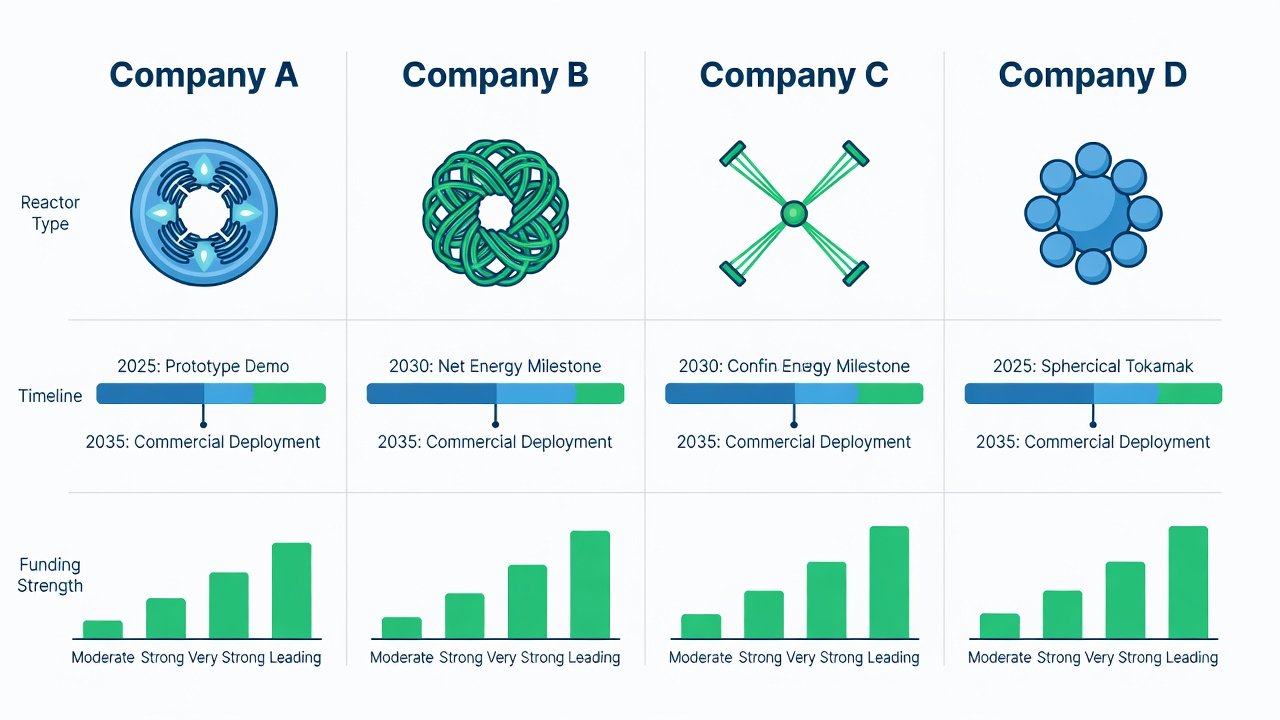
- Reactor Design: Commonwealth Fusion Systems and Tokamak Energy favor tokamak configurations optimized for steady-state operation, while TAE Technologies and Helion Energy pursue alternative approaches that may simplify engineering and reduce construction timelines.
- Timeline to Commercialization: Helion targets initial demonstrations around 2028, whereas the others project first grid power in the early 2030s, reflecting differences in technical risk tolerance and funding strategies.
- Funding Profile: All maintain strong venture capital support, with public-market exposure available through clean-energy ETFs that hold related holdings in nuclear and advanced energy sectors.
- Market Focus: North American firms prioritize private-sector contracts with data centers and industrial users, while European players leverage supportive regulatory frameworks for broader grid integration.
Regulatory Tailwinds and Technological Milestones
Supportive policies in the United States and Europe are accelerating fusion development through targeted funding and streamlined permitting. Recent legislation provides tax incentives and dedicated research programs for advanced nuclear technologies. The U.S. Department of Energy has funded multiple fusion projects, creating greater visibility and credibility for private-sector progress. Additional momentum comes from international frameworks that recognize fusion's potential contribution to net-zero targets.
Key technological milestones include sustained plasma confinement records and repeated net energy gain demonstrations achieved in recent experimental campaigns. These breakthroughs materially reduce technical risk profiles and attract follow-on capital from both public and private sources. Organizations such as the International Energy Agency continue to highlight fusion's role in long-term decarbonization scenarios, further validating the sector's strategic importance.
Risk Factors: Development Timelines and Valuations
Investors must carefully account for extended development timelines, potential regulatory delays, and technical setbacks that could push commercialization further into the future. Fusion stocks frequently trade at premium valuations that reflect anticipated future potential rather than current revenue generation. Continued fundraising needs may lead to shareholder dilution, while market volatility tends to intensify whenever major milestones slip or competing clean-energy technologies achieve faster cost declines. Understanding these risks helps investors size positions appropriately within a diversified portfolio.
Practical Steps for Evaluating Fusion Growth Stocks
- Review quarterly technical updates and peer-reviewed publications to obtain objective indicators of progress rather than relying solely on press releases.
- Assess the track records of management teams in scaling complex energy technologies from laboratory to commercial deployment.
- Compare capital burn rates against remaining technical milestones and available cash reserves to gauge runway sustainability.
- Monitor evolving policy developments through official government channels and legislative trackers for early signs of new incentives or barriers.
- Diversify exposure by allocating across multiple fusion companies or through clean-energy ETFs that include adjacent nuclear and advanced energy holdings.
- Stress-test valuation models against delayed commercialization scenarios to understand downside risks in various timeline outcomes.
- Engage with investor presentations and earnings calls to gain qualitative insights into strategic partnerships and supply-chain developments.
Mistakes to Avoid When Investing in Fusion Stocks
Common pitfalls include over-concentrating portfolios in a single fusion name without adequate diversification, chasing momentum based on hype rather than verifiable milestones, and underestimating the capital intensity required for reactor construction. Investors should also avoid ignoring regulatory or supply-chain bottlenecks that could delay timelines by years. Maintaining a long-term perspective and setting clear criteria for position sizing helps mitigate emotional decision-making during periods of high volatility.
Frequently Asked Questions
When will fusion energy reach commercial scale?
Optimistic forecasts point to pilot plants in the late 2020s with initial commercial deployments likely occurring throughout the 2030s, though actual timelines depend heavily on continued technical success and sustained funding.
Are fusion stocks suitable for conservative portfolios?
Most pure-play fusion companies remain high-risk growth vehicles. Conservative investors typically limit exposure to small allocations or gain indirect access through broadly diversified clean-energy funds.
How do fusion valuations compare to traditional renewables?
Fusion firms often command higher multiples due to their transformative long-term potential, though they currently generate minimal revenue and carry greater execution risk than mature renewable operators.
Conclusion
Fusion energy stocks offer compelling upside potential for investors willing to accept development risks in pursuit of substantial returns between 2026 and 2030. By focusing on verifiable technological milestones, supportive regulatory environments, and disciplined evaluation frameworks, market participants can position themselves effectively ahead of possible commercialization breakthroughs. Ongoing monitoring of the companies highlighted in this guide will remain essential as the sector continues to mature and attract broader institutional interest.


No comments yet. Be the first!