 Bullish Portfolio

Introduction: Why Data Centers Are a Standout Sector for 2026
The explosive demand for artificial intelligence and cloud computing continues to reshape the digital infrastructure landscape. Investors seeking growth in 2026 are turning to data center REITs and operators as primary vehicles to capture this trend. This article delivers a detailed comparison to help you identify the most promising bullish picks while navigating valuations, regulatory risks, and portfolio construction. The sector benefits from structural tailwinds that show no signs of slowing, as enterprises and hyperscalers alike race to deploy AI models at scale.
AI workloads require massive, reliable power and connectivity. As hyperscale cloud providers expand capacity, both REITs and operators stand to benefit, though their risk profiles and return drivers differ significantly. Understanding these nuances allows investors to select the right mix for their objectives rather than treating the entire sector as homogeneous.
Market Forecasts and AI-Driven Demand Through 2026
Global data center capacity is projected to grow substantially through 2026, fueled by generative AI training and inference needs. Hyperscalers such as Amazon, Microsoft, and Google continue signing long-term leases at record rates. REITs benefit from stable triple-net leases, while operators often capture higher margins through managed services and power optimization. Industry analysts anticipate that AI-related workloads could account for a growing share of total capacity utilization by the end of the forecast period.
Key growth drivers include rising power density requirements per rack and the shift toward liquid cooling solutions. These trends favor companies with modern facilities and access to affordable electricity. Regions with abundant renewable or nuclear power are becoming preferred locations for new builds, influencing site selection strategies across both REITs and operators. Supply chain constraints around transformers and specialized cooling equipment may create bottlenecks, rewarding firms with secured procurement agreements.
Data Center REITs vs Operators: Structural Differences
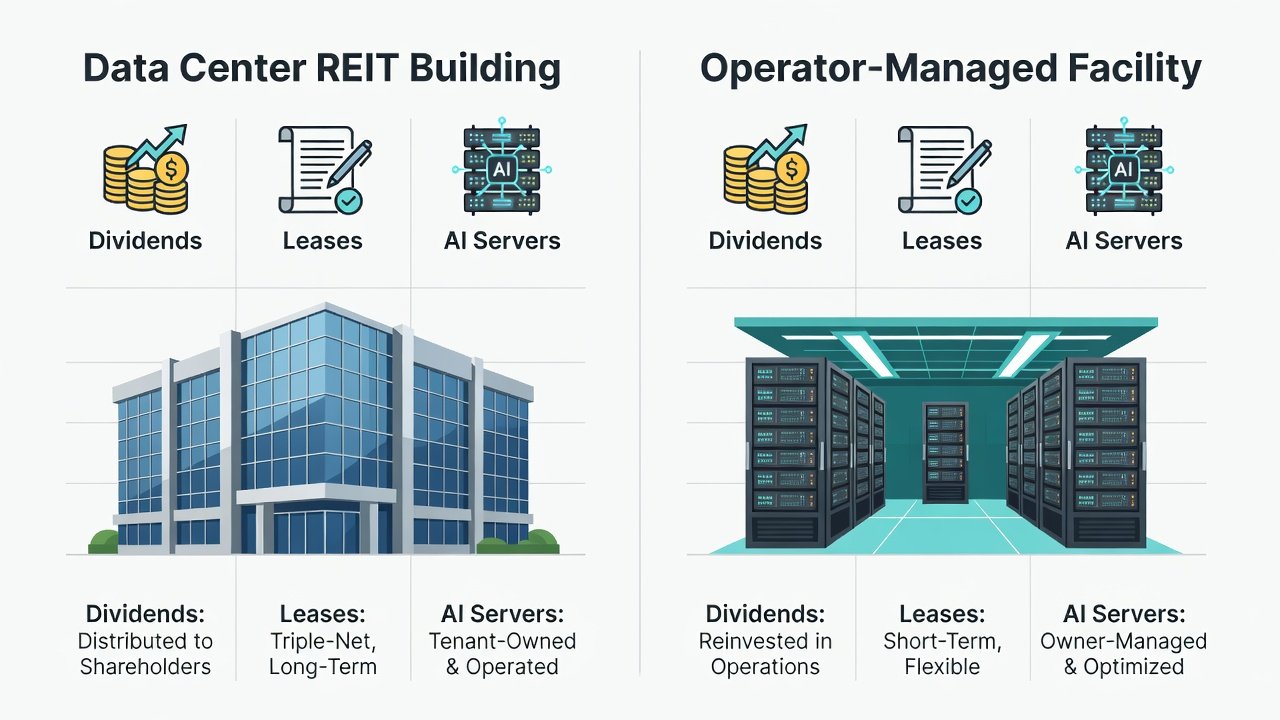
REITs own and lease physical real estate, offering investors predictable rental income and dividend yields. Operators focus on managing facilities, providing colocation, and sometimes developing custom builds. This operational flexibility can lead to higher growth but also greater earnings volatility. REITs must distribute most of their taxable income as dividends, which creates a natural floor for yields but limits retained earnings for aggressive expansion.
REITs typically trade at lower multiples due to their regulated structure and dividend requirements. Operators often command premium valuations reflecting their service revenue streams and ability to upsell value-added offerings such as managed security and network connectivity. Investors should consider whether they prioritize income stability or total return potential when choosing between the two models.
Comparison of Business Models
REITs generate revenue primarily through long-term leases with built-in escalators, providing visibility into future cash flows. Operators may combine lease income with variable fees tied to power usage or additional services, creating upside during periods of high utilization but introducing cyclicality. Both models face similar capital expenditure demands for new developments, yet operators can sometimes accelerate returns by offering turnkey solutions to tenants.
Key Company Profiles and 2026 Earnings Outlook
Leading REITs include established players with diversified portfolios across North America and Europe. Their 2026 earnings growth is expected to stem from lease escalators and new developments coming online. Operators emphasize edge computing and AI-optimized facilities, positioning them for outsized revenue gains if demand accelerates. Portfolio managers often review development pipelines and signed lease backlogs from recent earnings reports to assess visibility.
When evaluating individual names, focus on tenant concentration risk and the proportion of facilities already powered and connected versus those still under construction. Companies with a higher percentage of operational megawatts tend to deliver more predictable results in the near term. Geographic exposure also matters, as markets with constrained power availability may support higher rental rates over time.
Valuation Metrics and Dividend Sustainability
Common metrics for comparison include funds from operations (FFO) multiples, enterprise value per megawatt, and dividend payout ratios. REITs generally offer more sustainable dividends backed by long-term contracts, while operators reinvest more heavily into growth initiatives. Investors should examine historical FFO growth rates alongside forward guidance to determine whether current valuations embed realistic expectations.
Focus on companies maintaining payout ratios below 70% of FFO to ensure resilience during any short-term demand fluctuations. Dividend growth history and the presence of variable-rate debt that could pressure interest coverage ratios are additional factors worth monitoring. A disciplined approach to these metrics helps separate sustainable income producers from those stretching to maintain yields.
Regulatory Risks and Mitigation Strategies
Key risks include zoning restrictions, environmental permitting delays, and potential changes in energy regulations. Data center operators face additional scrutiny around water usage and carbon emissions in certain jurisdictions. Local opposition to new facilities can delay projects by months or years, particularly in residential-adjacent areas.
Review SEC disclosures regularly for updates on environmental compliance and power purchase agreements that can offset regulatory headwinds. Energy department resources provide insights into federal incentives for renewable integration that may benefit compliant operators. Proactive engagement with community stakeholders and early investment in green power contracts have proven effective at reducing permitting friction for leading firms.
Step-by-Step Evaluation Framework
- Assess power capacity pipeline and utilization rates across existing and planned sites.
- Compare lease duration, renewal options, and credit quality of major tenants using public filings.
- Evaluate management track record in delivering development projects on time and on budget through case studies of past builds.
- Analyze balance sheet strength using debt-to-EBITDA ratios and liquidity reserves.
- Project free cash flow generation under different AI adoption scenarios, including base, upside, and stress cases.
- Review ESG policies and renewable energy commitments to gauge long-term regulatory resilience.
Investor Checklist for Bullish 2026 Picks
- Confirm exposure to AI hyperscale customers through lease announcements and earnings commentary.
- Verify geographic diversification across stable power markets with favorable regulatory environments.
- Check recent earnings calls for management commentary on 2026 guidance and development timelines.
- Assess liquidity and ability to fund growth without excessive dilution or high-cost debt.
- Review insurance coverage for physical and cyber risks associated with critical infrastructure.
- Compare peer valuations on an enterprise-value-per-megawatt basis to identify relative value opportunities.
Common Mistakes to Avoid
Many investors overlook the distinction between powered and unpowered capacity when evaluating growth pipelines, leading to overstated expectations. Another frequent error is concentrating holdings in a single operator without considering the stability offered by REIT lease structures. Ignoring local energy policy shifts can also expose portfolios to sudden cost increases or development halts. Diversification across both REITs and operators, combined with ongoing monitoring of power markets, helps mitigate these pitfalls.
Portfolio Allocation Examples
A balanced approach might allocate 60% to established REITs for income stability and 40% to high-growth operators. Adjust based on your risk tolerance and time horizon. For example, a moderate-risk investor could place core holdings in two REITs with strong dividend histories while adding satellite positions in operators focused on AI-ready facilities. Rebalance annually and monitor power cost trends closely through industry reports.
Stress testing the allocation against scenarios such as delayed AI rollout or higher interest rates provides additional confidence in the strategy. Investors with shorter horizons may tilt more heavily toward REITs, while those comfortable with volatility can increase operator exposure for potential capital appreciation.
Conclusion: Positioning for 2026 Success
Data center REITs and operators both offer compelling exposure to AI tailwinds. By applying the evaluation framework and checklist above, investors can construct portfolios positioned for attractive total returns. Stay disciplined with valuation discipline and focus on quality tenants to maximize upside while managing downside risks. Continuous monitoring of technological shifts in cooling and power delivery will further enhance decision-making as the sector evolves.

No comments yet. Be the first!