 Bullish Portfolio

Introduction to Data Center REITs in 2026
The data center sector continues to attract strong investor interest heading into 2026, fueled by explosive demand for artificial intelligence infrastructure and widespread cloud migration across industries. Data center REITs offer a unique way to gain exposure through real estate investment trusts that own, develop, and operate these critical facilities. Unlike traditional property REITs focused on offices or retail, data center operators benefit from long-term leases, high barriers to entry due to specialized infrastructure needs, and recurring revenue streams tied directly to digital transformation trends. As businesses increasingly rely on data-intensive applications, these REITs position themselves at the intersection of real estate and technology, providing investors with opportunities for both income and capital appreciation in a rapidly evolving landscape.
This article examines REIT structures and ownership models in depth, explores key market drivers such as AI demand and cloud migration, highlights stock examples with valuation metrics and dividend forecasts, outlines risk factors including interest rate sensitivity and regulatory hurdles, and provides practical investment tools including a detailed step-by-step investor checklist and a comparison table of top REITs versus traditional operators. By the end, readers will have a comprehensive framework for evaluating these assets within broader portfolios.
Understanding REIT Structures and Ownership Models
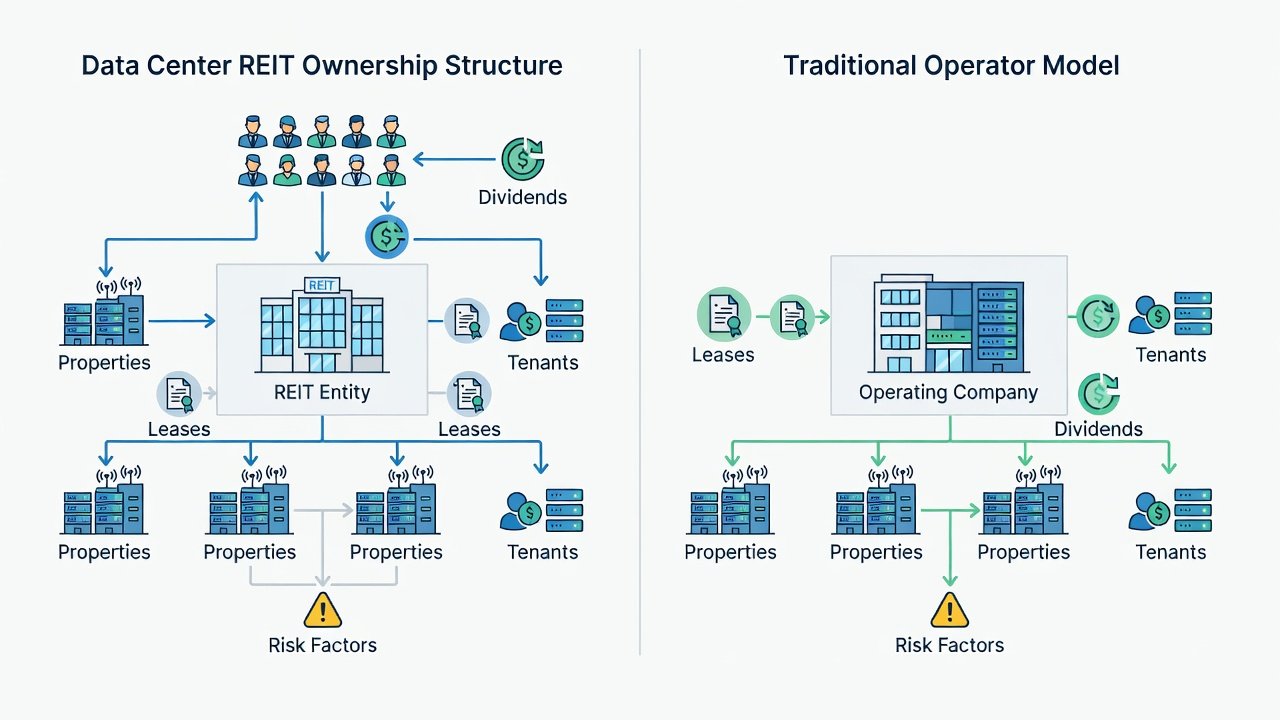
Data center REITs typically operate under an umbrella partnership REIT (UPREIT) structure, allowing property owners to contribute assets in exchange for operating partnership units that can later be converted to shares. This model provides significant tax advantages by deferring capital gains taxes and facilitates growth through acquisitions without immediate cash outlays. Some entities use a traditional REIT format with direct ownership of facilities, which simplifies governance but may limit flexibility in joint ventures. Others partner with hyperscale cloud providers through joint ventures or sale-leaseback arrangements, sharing development costs while securing long-term tenants. These structures help manage the high capital intensity of building facilities equipped with advanced cooling systems, redundant power supplies, and high-speed connectivity while maintaining compliance with REIT distribution requirements that mandate paying out at least 90 percent of taxable income as dividends.
Ownership often involves triple-net leases where tenants cover operating expenses, taxes, and insurance, creating stable cash flows for REIT investors. Examples include master lease agreements with major technology firms that span 10 to 15 years, offering visibility into future revenues. Investors should examine the mix of owned versus leased land and the proportion of stabilized versus development assets when assessing a REIT's portfolio quality.
Key Market Drivers: AI Demand and Cloud Migration
Artificial intelligence workloads require massive computing power and specialized hardware, driving hyperscalers to secure additional data center capacity at an unprecedented pace. Training large language models and running inference at scale demand low-latency, high-density environments that traditional facilities may not support. Cloud migration by enterprises further accelerates this need as companies shift workloads to providers like Amazon Web Services, Microsoft Azure, and Google Cloud to reduce on-premises costs and improve scalability. Regional factors such as renewable energy availability in Nordic countries or tax incentives in emerging markets also influence site selection and expansion plans.
These drivers create sustained leasing demand and support rental rate growth for well-positioned REITs. For instance, the rise of edge computing for real-time applications like autonomous vehicles adds another layer of demand for distributed facilities. Supply constraints from lengthy permitting processes and power grid limitations further tighten the market, benefiting existing owners with high occupancy. Monitoring quarterly earnings reports from major cloud providers can provide leading indicators of leasing activity in the REIT space.
Stock Examples, Valuation Metrics, and Dividend Forecasts
Leading data center REITs include Equinix, known for its global interconnection platform, and Digital Realty, which emphasizes hyperscale and colocation services across multiple continents. Other notable players focus on specialized niches such as carrier-neutral facilities or government-secure environments. Valuation metrics commonly used include funds from operations (FFO) multiples, adjusted funds from operations (AFFO) to account for maintenance capital expenditures, net asset value estimates derived from property appraisals, and enterprise value to EBITDA ratios that incorporate debt levels. Investors also monitor occupancy rates, same-store revenue growth, and development yield on cost to gauge operational health and future potential.
Dividend forecasts remain positive due to predictable lease escalators often tied to inflation indices and robust development pipelines that add new income streams upon stabilization. Qualitative factors such as tenant credit quality and geographic diversification influence the sustainability of payouts. Portfolio managers frequently compare these metrics against broader REIT indices to identify relative value opportunities.
Risk Factors and Mitigation Strategies
Data center REITs face interest rate sensitivity because higher borrowing costs can pressure development returns, increase refinancing expenses, and compress valuation multiples in a rising rate environment. Regulatory hurdles such as zoning restrictions, energy consumption limits from local utilities, and environmental compliance requirements around water usage for cooling add complexity and potential delays to new projects. Supply chain disruptions affecting specialized equipment like transformers or generators, along with power availability constraints in high-demand regions, represent ongoing operational challenges.
Other risks include tenant concentration where a few large hyperscalers account for significant revenue, cybersecurity threats to facility operations, and shifts in technology that could render older facilities obsolete. Mitigation involves maintaining conservative balance sheets with staggered debt maturities, diversifying across multiple tenants and markets, investing in energy-efficient upgrades, and engaging proactively with regulators during site planning. Regular stress testing of cash flow models under various interest rate scenarios helps investors prepare for volatility.
Step-by-Step Investor Checklist
- Assess overall portfolio allocation goals and risk tolerance to determine suitable exposure levels to real estate and technology sectors.
- Review recent FFO growth trends, occupancy rates, and lease renewal statistics for target REITs using the latest earnings releases.
- Evaluate development pipelines, land banks, and power procurement strategies to assess capacity for future expansion without excessive dilution.
- Analyze lease expiration schedules, tenant credit profiles, and concentration risks to ensure revenue stability.
- Compare dividend payout ratios, AFFO coverage, and historical distribution growth against sector peers and broader market benchmarks.
- Consider interest rate hedging strategies, floating versus fixed debt ratios, and overall balance sheet strength through credit ratings.
- Review geographic and customer diversification to reduce exposure to regional economic or regulatory shifts.
- Consult tax advisors on REIT distribution treatment, potential unrelated business taxable income issues in certain accounts, and overall portfolio tax efficiency.
- Monitor macroeconomic indicators such as corporate IT spending forecasts and hyperscaler capital expenditure guidance for forward-looking signals.
Comparison Table: Data Center REITs vs Traditional Operators
| Metric | Data Center REITs | Traditional Operators |
|---|---|---|
| Ownership Model | REIT with tax advantages and mandatory distributions | Corporate structures or private equity with flexible reinvestment |
| Dividend Focus | High distribution requirement supporting income investors | Variable or growth-oriented payouts depending on strategy |
| Lease Stability | Long-term triple-net leases with built-in escalators | Shorter or operational service contracts with more variability |
| Capital Access | Public equity and debt markets for liquidity | Private funding rounds or bank financing with less transparency |
| Risk Profile | Interest rate sensitive with regulatory overlays | Operational execution and technology obsolescence focus |
| Development Approach | Phased builds with pre-leasing emphasis | Speculative builds or build-to-suit for specific clients |
FAQs on Tax Implications and Portfolio Allocation Strategies
What are the tax implications of investing in data center REITs?
REIT dividends are often taxed as ordinary income rather than qualified dividends, although a portion may qualify as return of capital that reduces cost basis. Investors should review Form 1099-DIV annually and consider holding REITs in tax-advantaged accounts such as IRAs where distributions can grow tax-deferred. State tax treatment varies, and foreign investors may face withholding requirements. Always consult a qualified tax professional for advice tailored to individual circumstances.
How should investors allocate data center REITs in a diversified portfolio?
Many financial advisors suggest limiting total real estate exposure to 5-15 percent of a diversified portfolio, with data center REITs forming a tactical subset based on growth outlook and correlation to other assets. Consider blending with broader equity, fixed income, and international holdings to manage sector-specific volatility. Rebalance annually or after significant market moves, and use dollar-cost averaging for new positions to mitigate timing risk.
What role do data center REITs play in retirement income planning?
These REITs can contribute to retirement portfolios through reliable dividend streams that may grow over time with inflation-linked escalators. However, their sensitivity to interest rates requires pairing with other income sources less affected by rate changes. Focus on those with strong balance sheets and diversified tenant bases for long-term income sustainability.
Conclusion
Data center REITs present compelling opportunities for 2026 as AI and cloud trends continue to reshape digital infrastructure needs worldwide. By understanding ownership structures, market drivers, valuation approaches, risks, and allocation strategies in detail, investors can make more informed decisions aligned with their objectives. Always conduct thorough due diligence using public filings and consider professional financial advice before making investment commitments. Staying informed about technological shifts and regulatory developments will further enhance decision-making in this dynamic sector.
For more on REIT regulations and filings, visit the SEC. Macroeconomic context is available from the Federal Reserve, while industry data and best practices can be found at NAREIT.

No comments yet. Be the first!