 Bullish Portfolio
Introduction
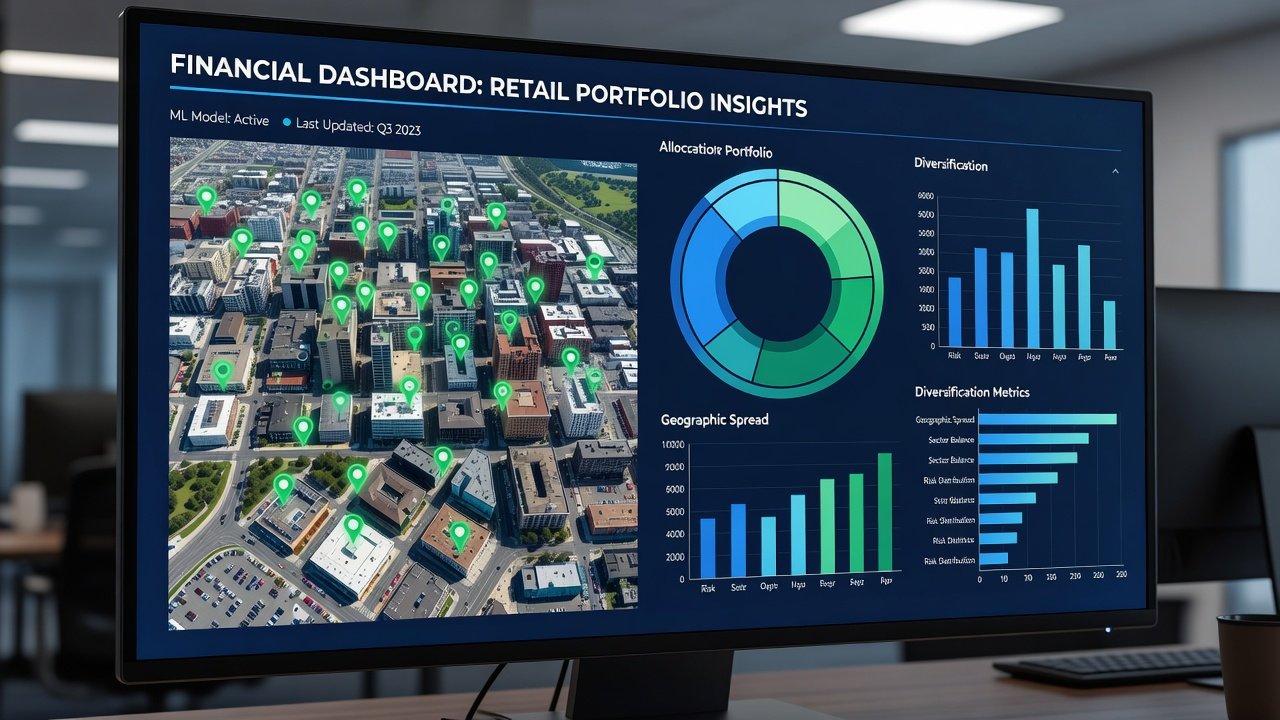
Portfolio managers in 2026 face unprecedented market volatility driven by geopolitical shifts, climate events, and rapid technological change. Traditional data sources such as financial statements and macroeconomic indicators often lag behind real-time developments. Integrating alternative data with machine learning (ML) offers a powerful solution for refining asset allocation and achieving true diversification. This approach fuses unconventional signals like satellite imagery and transaction streams with sophisticated models to reduce volatility and generate alpha. By leveraging these techniques, advanced managers can move beyond static benchmarks and create adaptive portfolios that respond to emerging patterns in global supply chains, consumer behavior, and environmental factors. The result is not only better risk-adjusted returns but also a competitive edge in an era where data velocity continues to accelerate.
Key Alternative Data Sources for Modern Portfolios
Alternative data encompasses non-traditional datasets that provide unique insights into economic activity. Satellite imagery reveals supply chain movements, agricultural yields, and retail foot traffic through high-resolution analysis of parking lots, shipping ports, and crop fields. Transaction streams from credit cards or point-of-sale systems deliver granular consumer spending patterns across regions and sectors. Additional sources include social media sentiment, web scraping of job postings, and IoT sensor data from logistics networks. These sources complement conventional data, enabling earlier detection of trends that affect asset prices. For example, satellite monitoring of oil storage facilities can signal inventory buildups weeks before official reports, allowing proactive adjustments in energy sector allocations.
Data Preprocessing Techniques
Raw alternative data requires rigorous cleaning before ML ingestion. Steps include normalizing satellite pixel values to account for weather interference, handling missing transaction records through sophisticated imputation methods like k-nearest neighbors, and aligning timestamps across heterogeneous sources using time-series interpolation. Feature engineering transforms raw signals into predictive variables, such as deriving retail sales momentum from anonymized card data or calculating vegetation indices from multispectral satellite bands. Dimensionality reduction via principal component analysis or autoencoders prevents overfitting when datasets contain thousands of variables. Noise filtering is critical; managers often apply Kalman filters to satellite time series to smooth orbital variations. Data fusion techniques merge streams at different frequencies, ensuring high-frequency transaction data aligns with lower-frequency imagery updates. Validation protocols, including outlier detection with isolation forests, maintain dataset integrity throughout the pipeline.
Machine Learning Models for Asset Allocation
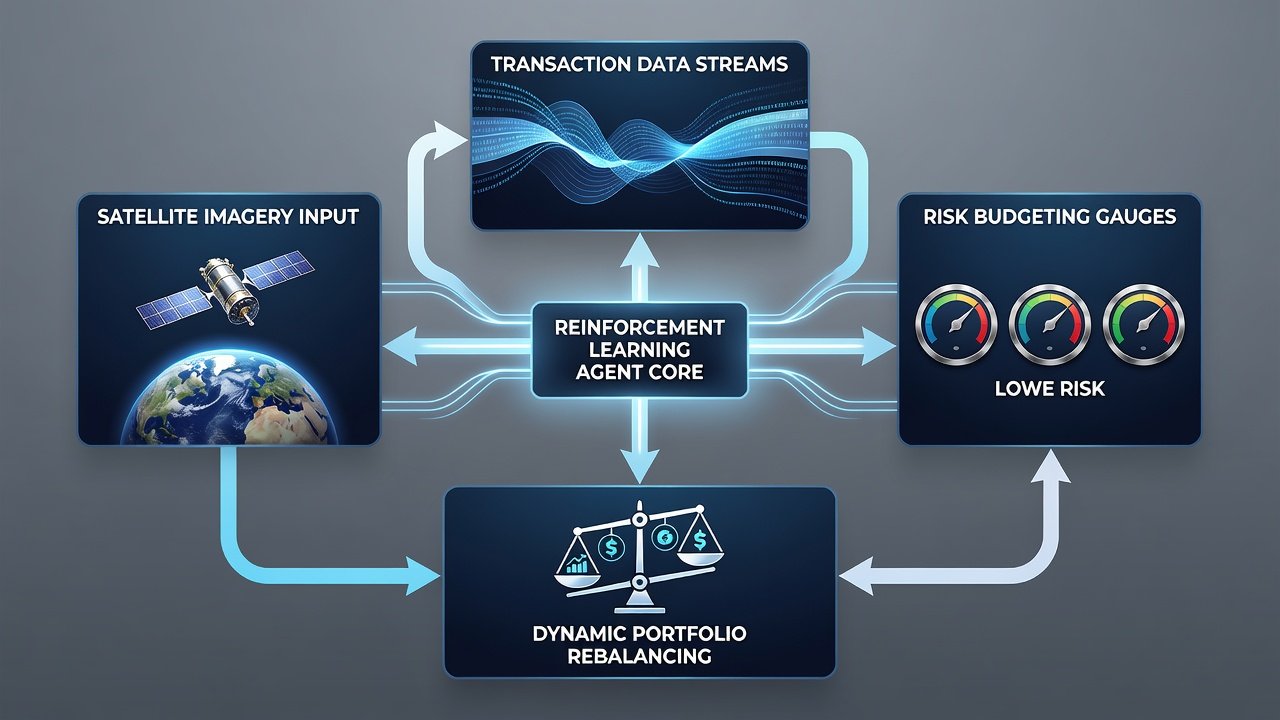
Supervised learning algorithms like gradient boosting machines and deep neural networks map alternative features to expected returns and risk metrics with high precision. Unsupervised methods such as k-means clustering and Gaussian mixture models identify hidden asset correlations uncovered through satellite or transaction patterns. Reinforcement learning extends these capabilities by treating allocation as a continuous optimization problem. Ensemble approaches combine multiple models to improve robustness, while explainability tools like SHAP values help managers understand which alternative signals drive specific recommendations. These models support mean-variance optimization that incorporates forward-looking signals unavailable in legacy systems, allowing for scenario analysis under various economic regimes.
Reinforcement Learning for Dynamic Rebalancing
Reinforcement learning excels at sequential decision-making in portfolio management. Agents learn optimal rebalancing policies by maximizing cumulative rewards while penalizing excessive turnover and transaction costs. Common implementations use deep Q-networks or proximal policy optimization to handle continuous action spaces representing weight adjustments across dozens of assets. In practice, an agent trained on 2025-2026 market regimes can adjust allocations weekly in response to new satellite or transaction signals, outperforming static quarterly rebalancing strategies. Training environments simulate market impact and slippage to ensure policies remain realistic. Managers can incorporate multi-agent setups where separate agents handle equity, fixed income, and commodity sleeves before a meta-agent synthesizes final weights.
Integrating Risk Budgeting Frameworks
Risk budgeting allocates capital according to marginal risk contributions rather than equal weighting. When fused with ML outputs, risk budgets become dynamic: volatility forecasts derived from alternative data adjust position sizes automatically. This integration helps maintain target risk levels even during regime shifts detected by satellite monitoring of key industries. Techniques such as hierarchical risk parity combine clustering with risk parity principles, enhanced by ML-predicted correlations from transaction flows. Practical implementation involves solving quadratic optimization problems at each rebalance, constrained by liquidity and regulatory exposure limits. The approach proves especially valuable in multi-asset portfolios where traditional volatility measures fail to capture tail risks highlighted by alternative indicators.
Step-by-Step Implementation Guidance
- Identify relevant alternative datasets aligned with investment universe through vendor evaluation and internal data audits.
- Build secure data pipelines with encryption, API rate limiting, and access controls compliant with data privacy standards.
- Apply preprocessing pipelines using scalable tools such as Apache Spark or cloud-based ETL services for cleaning and feature creation.
- Train and validate ML models with walk-forward optimization and cross-validation across multiple market cycles to avoid look-ahead bias.
- Deploy reinforcement learning agents in a sandbox environment with historical replay before transitioning to live trading with strict kill switches.
- Monitor model drift using statistical tests on incoming data distributions and retrain quarterly or after significant market events.
- Conduct ongoing performance attribution to isolate contributions from alternative data versus traditional factors.
Real-World Case Studies
One hedge fund integrated satellite imagery of parking lots with transaction data to forecast retail earnings surprises, achieving superior Sharpe ratios compared with traditional models during extensive 2025 backtests. The strategy focused on consumer discretionary stocks and adjusted positions days ahead of earnings releases. Another manager used reinforcement learning on shipping lane satellite feeds combined with port transaction volumes to anticipate commodity price movements, reducing maximum drawdowns substantially versus benchmark portfolios. A third example involved a pension fund applying risk-budgeted ML models to global equities, where alternative signals from agricultural satellites improved diversification across regions during supply disruptions. These cases demonstrate measurable improvements in both return consistency and downside protection when alternative data integration is executed thoughtfully.
Common Pitfalls to Avoid
- Overfitting to noisy alternative signals without rigorous cross-validation and out-of-sample testing across unseen market conditions.
- Ignoring regulatory constraints on data sourcing, privacy, and model explainability that can lead to compliance issues.
- Neglecting latency issues when streaming high-frequency transaction data, resulting in stale signals during fast-moving markets.
- Failing to stress-test models against black-swan events absent from historical data, leaving portfolios vulnerable to extreme scenarios.
- Underestimating data vendor costs and integration complexity, which can erode net alpha if not budgeted properly from the outset.
- Over-relying on single data sources without diversification of signals, increasing concentration risk in model inputs.
FAQ
How do regulators view alternative data usage?
Regulators such as the U.S. Securities and Exchange Commission require that data sources be obtained legally and that models remain explainable to investors. Transparency in data lineage and bias mitigation are increasingly emphasized in examinations.
What data quality issues commonly arise?
Noise, missing values, selection bias, and temporal misalignment are frequent challenges. Robust preprocessing, ensemble validation, and continuous monitoring mitigate these risks effectively.
Is reinforcement learning suitable for all portfolio sizes?
Smaller portfolios may face higher relative transaction costs; reinforcement learning policies should incorporate cost-aware reward functions and minimum trade size constraints to remain viable.
How can managers address data privacy concerns?
Employ anonymization techniques, obtain proper consents where required, and partner with vendors who maintain strict compliance with frameworks such as GDPR and emerging global standards.
Conclusion
Integrating alternative data with ML equips advanced portfolio managers with tools for superior 2026 diversification. By mastering preprocessing, reinforcement learning, and risk budgeting, practitioners can systematically reduce volatility while capturing new sources of alpha. Continuous monitoring, adherence to regulatory standards, and iterative refinement remain essential for sustainable implementation that delivers lasting value across market cycles.
No comments yet. Be the first!