 Bullish Portfolio

Introduction to Reinforcement Learning in Modern Portfolio Management
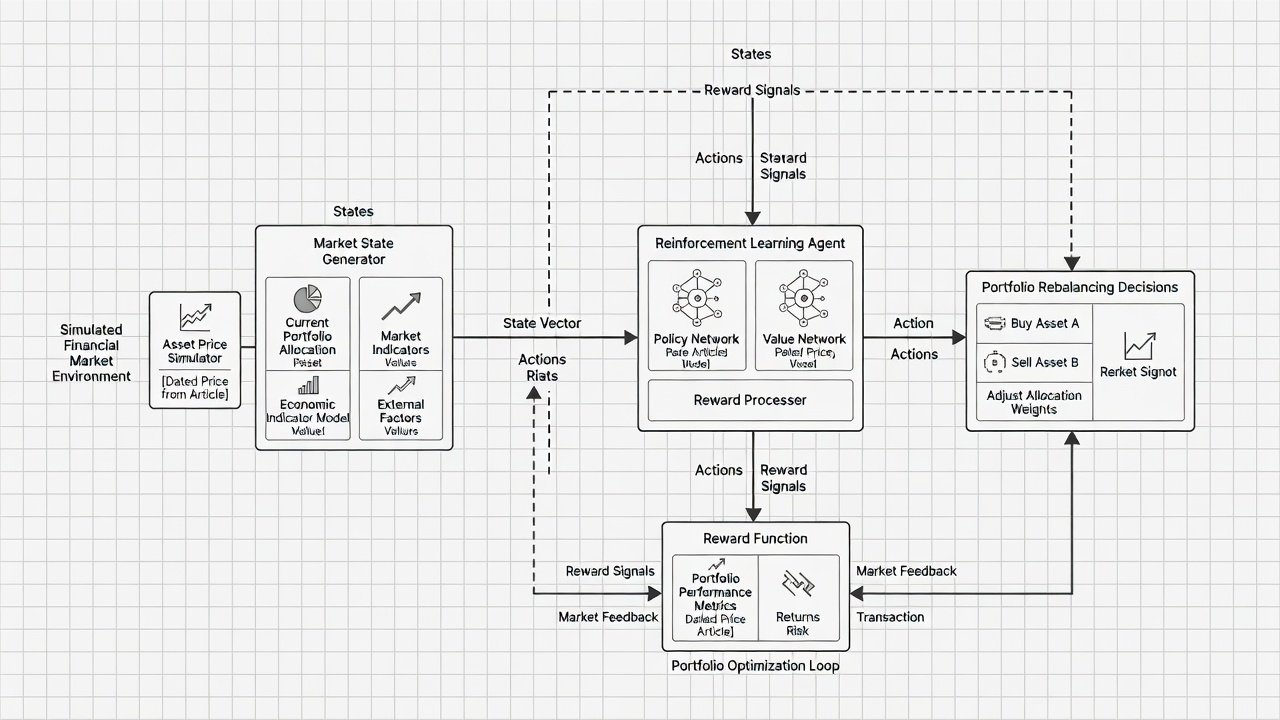
In 2026, financial markets continue to exhibit heightened volatility driven by geopolitical shifts, rapid technological changes, and evolving macroeconomic policies. Traditional asset allocation methods often struggle to adapt quickly enough. Reinforcement learning (RL) offers a dynamic alternative by enabling algorithms to learn optimal decisions through trial and error in simulated environments. This approach excels at handling the complexities of dynamic asset allocation, including equity-bond mixes and diversification across asset classes. RL agents interact with market environments by taking actions such as adjusting portfolio weights, receiving rewards based on performance metrics like returns minus risk penalties, and updating their policies iteratively. This continuous learning process allows for superior handling of uncertainty compared to static models that rely on fixed assumptions about correlations and volatilities.
Unlike static models, RL agents continuously refine strategies based on real-time feedback, making them particularly suited for unpredictable conditions. Institutional investors are increasingly exploring these methods to enhance risk-adjusted performance metrics such as Sharpe ratios and maximum drawdowns. The technology builds on advances in deep learning, enabling agents to process high-dimensional data including price histories, economic indicators, and even unstructured text from financial reports.
Key Reinforcement Learning Techniques for Asset Allocation
Two foundational RL methods stand out for portfolio optimization: Q-learning and policy gradients. Q-learning is a value-based approach where an agent learns the expected future rewards for each action-state pair, allowing it to select allocations that maximize long-term returns. It updates a Q-table or neural network approximation using the Bellman equation, gradually converging on optimal policies through exploration and exploitation balancing. In contrast, policy gradients directly optimize the policy by adjusting parameters to favor actions yielding higher cumulative rewards, often using algorithms like REINFORCE or actor-critic methods that reduce variance in gradient estimates.
These techniques differ from traditional mean-variance optimization, which relies on historical data and assumes normal distributions. RL can capture non-linear relationships and adapt to regime shifts without rigid assumptions. For example, in volatile periods, a Q-learning agent might learn to reduce equity exposure preemptively based on emerging patterns in volatility indices, whereas classical optimizers would require manual recalibration of covariance matrices.
Comparisons to Traditional Optimization Methods
Traditional methods like Modern Portfolio Theory provide clear mathematical frameworks but often underperform in non-stationary markets. They optimize for expected return and variance at a single point in time, ignoring sequential decision-making dynamics. RL models, however, demonstrate superior adaptability. For instance, studies show RL agents achieving better drawdown control during market stress compared to fixed-weight strategies. Policy gradient methods particularly shine when transaction costs are incorporated into the reward function, leading to more realistic rebalancing behaviors than quadratic programming approaches used in classic optimization.
Practical Implementation Steps Using Python Libraries
Implementing RL for asset allocation involves several structured steps. Begin by defining the environment using libraries like OpenAI Gym to simulate market states, actions (asset weights), and rewards (risk-adjusted returns). Next, select an algorithm such as Deep Q-Network or Proximal Policy Optimization from Stable-Baselines3. Data preprocessing is critical: normalize returns, handle missing values, and incorporate features like moving averages or macroeconomic releases. Training occurs over thousands of episodes where the agent explores random allocations initially before exploiting learned policies.
- Install required packages: gymnasium, stable-baselines3, pandas, numpy, and matplotlib for visualization.
- Prepare historical price data for equities, bonds, and alternatives from sources spanning multiple market regimes.
- Design a custom environment class inheriting from Gym spaces, defining observation space as a vector of normalized indicators and action space as continuous weights summing to one.
- Train the agent over multiple episodes, tuning hyperparameters like learning rate, discount factor, and exploration epsilon through grid search or Bayesian optimization.
- Backtest the policy on out-of-sample data to evaluate performance, comparing against benchmarks like buy-and-hold or constant-mix strategies.
- Deploy in a live paper-trading setup with safeguards such as position limits to prevent extreme allocations.
Code examples typically involve creating a custom Gym environment where the state includes normalized returns and volatility measures. Reward shaping often includes penalties for high turnover to simulate real-world frictions.
Real-World Case Studies on Equity-Bond Mixes
Consider a case study involving a 60/40 equity-bond portfolio rebalanced dynamically via RL. In simulated 2025-2026 conditions, the RL agent adjusted allocations toward bonds during equity downturns, improving overall Sharpe ratios by adapting faster than quarterly rebalancing rules. The agent learned to detect early signals of inflation spikes through bond yield changes and shifted accordingly, resulting in reduced maximum drawdowns by approximately 15 percent relative to static allocations. Another example from institutional settings highlights RL integration in multi-asset funds, where agents learned to incorporate momentum signals for better diversification outcomes across global equities, fixed income, and commodities. These cases underscore how RL handles path-dependent decisions that traditional optimizers overlook.
Integration with Alternative Data Sources
RL frameworks gain power when fused with alternative data such as satellite imagery, sentiment from news feeds, or supply chain metrics. This expands the state space, allowing agents to anticipate market moves beyond traditional price-volume data. For example, an agent might incorporate natural language processing outputs from earnings call transcripts to adjust sector weights dynamically. Federal Reserve resources on economic indicators can supplement these inputs for more robust training environments. Integration requires careful feature engineering to avoid introducing noise that could destabilize learning, often achieved through dimensionality reduction techniques like autoencoders.
Potential Pitfalls Including Overfitting
Common challenges include overfitting to historical patterns, which reduces out-of-sample performance. Mitigation strategies involve rigorous cross-validation, regularization techniques, and walk-forward optimization. Liquidity constraints and transaction costs must also be modeled realistically to avoid inflated results. Another pitfall is reward hacking, where agents exploit poorly defined reward functions by taking excessive risks. To counter this, practitioners implement multi-objective rewards balancing return, volatility, and drawdown simultaneously. Model interpretability remains essential for institutional adoption, often addressed by using attention mechanisms that highlight which features drive allocation decisions at any given time.
Conclusion
Reinforcement learning represents a transformative tool for dynamic asset allocation in 2026, offering adaptability that traditional methods lack. By following practical implementation steps and addressing pitfalls, investors can unlock superior risk-adjusted outcomes while maintaining compliance with evolving standards.
FAQ
What are the main adoption barriers for institutional investors?
Key barriers include data quality requirements, computational demands, and the need for explainability in regulated environments. Many firms start with hybrid systems that combine RL outputs with human oversight to build confidence gradually.
How do regulatory considerations impact RL use?
Regulators emphasize model risk management and auditability. SEC guidelines stress transparency, encouraging hybrid human-AI oversight frameworks. Institutions must document training data, validation procedures, and stress testing results to meet fiduciary standards.
Can RL replace traditional portfolio managers entirely?
No, RL serves as a powerful augmentation tool rather than a full replacement, enhancing decision-making with data-driven insights while human experts handle qualitative judgments and client-specific constraints.


No comments yet. Be the first!