 Bullish Portfolio

Introduction: Why Water Tech Stands Out in 2026
Investors chasing growth beyond AI, semiconductors, and renewables are turning to water technology. This sector combines urgent global needs with strong tailwinds, positioning select stocks for significant expansion. Water scarcity affects billions, while new regulations and infrastructure budgets create opportunities for innovative companies. Unlike saturated sectors, water tech remains relatively undiscovered by mainstream portfolios. Companies developing filtration, treatment, monitoring, and efficiency solutions benefit from both public and private spending. This article examines the drivers, highlights specific stocks, provides a valuation comparison, and offers actionable screening methods. The focus is on practical insights that help investors evaluate opportunities in an essential industry often overlooked during tech booms.
Key Growth Drivers for Water Technology
Global Water Scarcity Trends
Water stress impacts agriculture, industry, and households worldwide. The World Health Organization highlights how climate change and population growth intensify shortages, driving demand for advanced treatment and reuse technologies. Regions in the Middle East, Africa, and parts of the United States face chronic deficits that force municipalities and corporations to invest in desalination, recycling, and smart distribution systems. These pressures create multi-year revenue visibility for firms with proven solutions.
Regulatory Tailwinds
Governments are tightening standards on contaminants like PFAS and microplastics. In the United States and Europe, new rules require upgrades to existing systems, benefiting firms with proven compliance solutions. The Environmental Protection Agency continues to update guidelines that accelerate replacement of aging infrastructure and adoption of real-time monitoring tools. Companies that already meet or exceed these standards gain immediate competitive advantages through faster permitting and contract wins.
Infrastructure Spending Forecasts
Billions in planned investments target aging pipes, treatment plants, and smart metering. These multi-year programs provide predictable revenue streams for established players and growth companies alike. International development banks such as the World Bank are funding large-scale projects in emerging markets, further expanding addressable markets for filtration, automation, and data analytics providers.
Top Water Tech Stock Picks for 2026
Here are eight companies positioned for growth, selected for business models, competitive edges, and revenue visibility. Each offers distinct exposure within the broader water ecosystem.
1. Xylem (XYL)
Xylem leads in smart water infrastructure with pumps, sensors, and analytics platforms. Its competitive advantage lies in integrated solutions that reduce leakage and energy use. Revenue projections show steady double-digit growth from municipal contracts and industrial efficiency projects across North America and Europe.
2. Pentair (PNR)
Pentair focuses on residential and commercial water treatment, including filtration and pool systems. Strong brand positioning and recurring filter sales create stable margins and defensive characteristics even during economic slowdowns.
3. Ecolab (ECL)
Ecolab delivers water management programs to industrial clients. Its data-driven approach and global service network deliver high retention rates and expansion into emerging markets where manufacturing growth drives water treatment demand.
4. American Water Works (AWK)
As the largest U.S. water utility, AWK benefits from rate base growth and infrastructure modernization. Regulated returns provide visibility while technology investments improve efficiency and support dividend increases over time.
5. Veolia Environnement (VE)
Veolia offers full-cycle water services across Europe and beyond. Expertise in wastewater reuse and circular economy solutions positions it well for regulatory-driven demand in both developed and developing economies.
6. Badger Meter (BMI)
Badger Meter specializes in ultrasonic metering and flow measurement. Its technology enables utilities to detect leaks and optimize billing, supporting recurring software revenue and long-term customer relationships.
7. Watts Water Technologies (WTS)
Watts provides valves, controls, and safety products for plumbing and heating. Broad distribution and focus on energy-efficient solutions support steady organic growth through both new construction and retrofit markets.
8. Danaher (DHR) – Water Segment
Danaher’s water quality platform includes analytical instruments and purification tools. Its acquisition track record and R&D strength deliver margin expansion potential through continuous product innovation and geographic expansion.
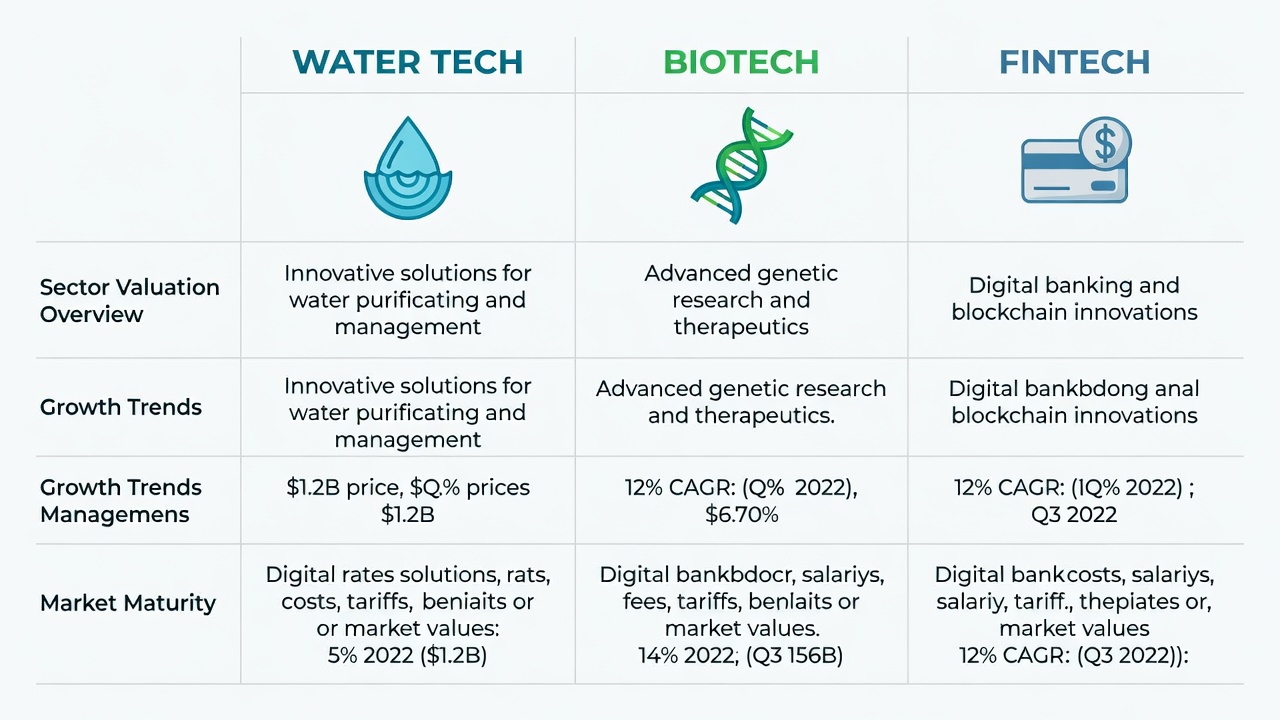
Valuation Comparison: Water Tech vs. Biotech and Fintech
| Sector | Avg. Forward P/E | Revenue Growth Outlook | Dividend Yield Range |
|---|---|---|---|
| Water Tech | 22-28x | 8-15% | 0.8-1.8% |
| Biotech | 35-55x | 12-25% | 0-0.5% |
| Fintech | 25-40x | 15-30% | 0-1.0% |
Water tech offers more attractive entry valuations with lower volatility than many biotech names and steadier cash flows than high-growth fintech firms. This balance appeals to investors seeking growth without extreme risk. Biotech valuations often reflect binary clinical outcomes, while fintech multiples can compress quickly when interest rates rise or user growth slows. Water companies, by contrast, enjoy regulated or contracted revenue that supports more consistent multiples. Investors comparing sectors should note that water tech also tends to exhibit lower correlation to broad technology sell-offs, providing portfolio diversification benefits during periods of market stress.
Practical Steps to Screen Water Tech Stocks
- Start with revenue growth above 7% annually and positive free cash flow margins to ensure the company can fund operations and R&D without excessive dilution.
- Review backlog and contract duration for visibility into future quarters, paying special attention to multi-year municipal agreements that reduce revenue uncertainty.
- Compare EV/EBITDA multiples against sector peers to identify reasonable valuations, focusing on firms trading at discounts to historical averages without fundamental deterioration.
- Assess regulatory exposure by checking recent filings and government spending plans, noting companies already aligned with upcoming PFAS or efficiency standards.
- Evaluate management track record on acquisitions and margin improvement through past earnings transcripts and capital allocation history.
- Use screening tools to filter for dividend growth or share repurchase activity as additional quality signals that management prioritizes shareholder returns.
Building a Diversified Water Tech Portfolio
Successful investors typically allocate across utilities for stability, equipment providers for growth, and service companies for recurring revenue. Position sizing should reflect individual risk tolerance, with larger holdings in companies that have demonstrated pricing power and strong balance sheets. Rebalancing annually helps capture gains from outperforming names while maintaining exposure to the full value chain from source to treatment to distribution.
FAQ: Risks and Entry Strategies
What are the main risks?
Policy delays, commodity cost swings, and slower municipal budgets can pressure near-term results. Diversification across several names reduces single-stock exposure and smooths volatility from project timing.
When is a good entry point?
Look for dips after earnings or during broader market corrections. Dollar-cost averaging over several months helps manage volatility while building positions at attractive prices.
Should investors focus on utilities or pure-play tech?
A blend works best: regulated utilities provide stability while equipment and software firms capture higher growth from technology adoption and international expansion.
How should investors handle currency and geopolitical risks?
Many water companies generate revenue globally, so monitoring currency hedges and regional exposure through quarterly reports helps mitigate unexpected swings in emerging markets.
Conclusion
Water technology offers a compelling mix of secular demand and reasonable valuations for 2026. By focusing on companies with strong competitive positions and visible revenue pipelines, investors can build exposure to an essential yet underfollowed sector. Use the screening framework above to identify opportunities aligned with your risk tolerance and time horizon, and consider gradual position building to navigate any short-term market fluctuations.

No comments yet. Be the first!