 Bullish Portfolio
The Expanding Hydrogen Economy in 2026
The hydrogen sector continues to gain momentum as global economies prioritize decarbonization and net-zero targets. Governments and corporations are scaling up investments in green hydrogen production, storage, and fuel cell technologies at an unprecedented pace. This creates compelling opportunities for investors seeking growth in clean energy stocks amid rising demand for low-carbon solutions across transportation, industry, and power generation.
According to the International Energy Agency, hydrogen demand is projected to rise significantly through the decade as countries implement ambitious climate policies. Policy support from initiatives like the U.S. Inflation Reduction Act and European Union hydrogen strategies further accelerates adoption by providing tax incentives and funding for infrastructure projects. Regional developments in Asia, particularly in Japan and South Korea, also highlight hydrogen's role in energy security and export strategies.
Market analysts note that the hydrogen economy is transitioning from pilot projects to commercial scale, with electrolyzer deployments increasing and fuel cell applications expanding into heavy-duty vehicles and stationary power. Investors who position early in well-managed companies stand to benefit from this structural shift, though success requires careful selection based on technology readiness and execution track records.
Top Bullish Hydrogen Stock Picks
Here are seven standout stocks positioned for growth in 2026, blending pure-play innovators with diversified industrial leaders. Each profile includes key catalysts and qualitative financial considerations based on recent sector trends.
1. Plug Power (PLUG)
A leading pure-play in hydrogen fuel cells and infrastructure, Plug Power has built a strong position through vertical integration in green hydrogen production. Catalysts include expanding green hydrogen plants and partnerships with major logistics firms for material handling equipment. The company continues to secure long-term supply agreements that support recurring revenue streams.
2. Ballard Power Systems (BLDP)
Specializes in proton exchange membrane fuel cells for heavy-duty applications. Recent commercial deployments in buses, trains, and marine vessels support revenue growth as governments fund zero-emission public transport. Ballard's focus on high-power density modules positions it well for scaling in global markets.
3. Linde plc (LIN)
A diversified industrial gas giant with substantial hydrogen operations, Linde benefits from both merchant hydrogen sales and project development in blue and green variants. Its global footprint and established customer base in refining and chemicals provide stable earnings that fund hydrogen expansion initiatives.
4. Air Products and Chemicals (APD)
Focuses on large-scale hydrogen projects worldwide, including multi-billion-dollar facilities in the Middle East and North America. Long-term contracts and technology leadership provide stability alongside growth as the company leverages its expertise in gas handling and liquefaction.
5. Bloom Energy (BE)
Known for solid oxide fuel cells, Bloom Energy is expanding into hydrogen blends and data center power solutions where reliability and efficiency matter most. Recent deployments demonstrate the technology's ability to operate on multiple fuels, offering flexibility during the energy transition.
6. FuelCell Energy (FCEL)
A pure-play developer of carbonate and solid oxide technologies, FuelCell Energy is positioned for utility-scale applications and carbon capture integration. Partnerships with utilities highlight its potential in baseload power generation with lower emissions profiles.
7. Chart Industries (GTLS)
Provides cryogenic equipment essential for hydrogen liquefaction and storage, serving both hydrogen and broader industrial gas markets. Its diversified exposure across energy transition markets reduces single-sector risk while capturing demand for specialized infrastructure components.
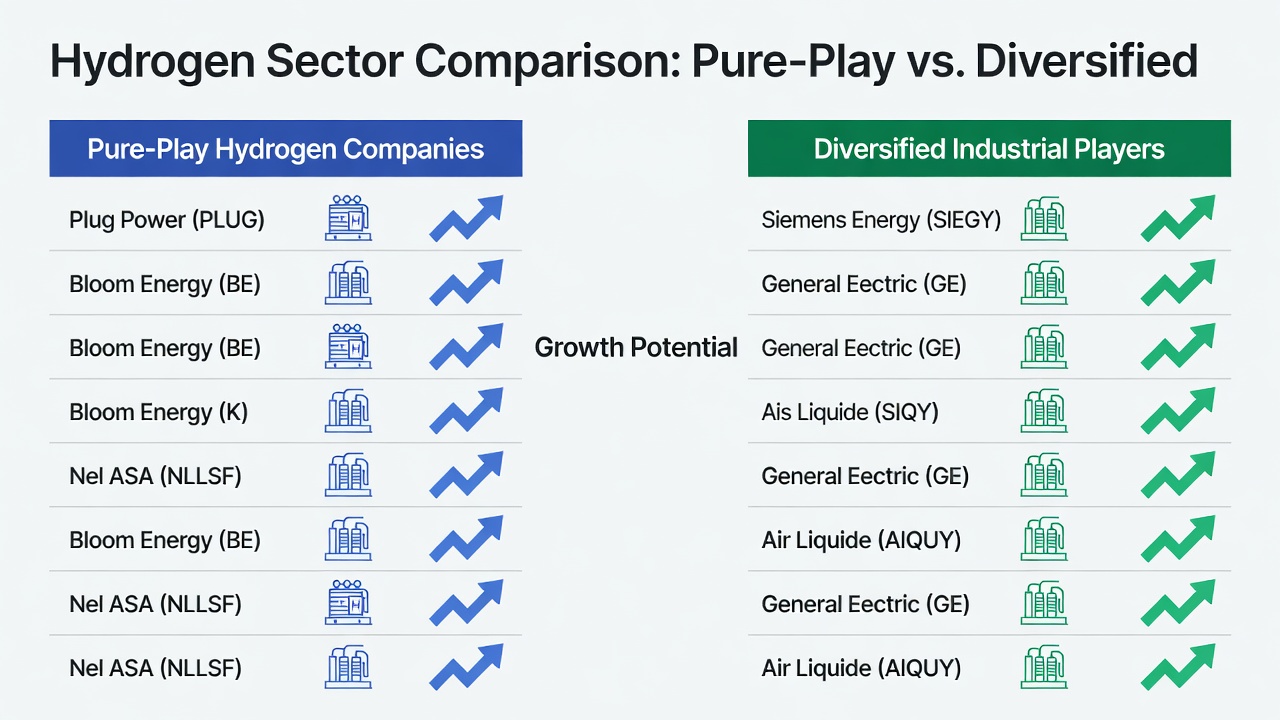
Pure-Play vs. Diversified Players: Key Comparison
- Pure-play advantages: Higher upside potential from focused hydrogen exposure but greater volatility tied to sector execution and funding cycles.
- Diversified advantages: More stable cash flows from established operations and lower single-technology risk, making them suitable for conservative portfolios.
- Valuation considerations: Pure-plays often trade at premium multiples reflecting growth expectations, while diversified names offer better downside protection during market corrections.
- Example allocation: An investor might combine 60 percent diversified holdings with 40 percent pure-plays to balance growth and resilience in a hydrogen-focused sleeve.
Practical Steps for Evaluating Entry Points
- Review quarterly earnings for revenue growth and gross margin trends in hydrogen segments, paying close attention to backlog and order flow.
- Assess project pipelines and signed offtake agreements for visibility into future demand and revenue recognition timelines.
- Compare enterprise value to projected hydrogen production capacity or installed fuel cell base to gauge relative valuation.
- Monitor policy developments and subsidy announcements from reliable sources such as the U.S. Department of Energy to anticipate regulatory tailwinds.
- Use technical analysis to identify support levels during market pullbacks and set disciplined entry rules based on moving averages.
- Track competitor announcements and technology milestones to understand relative positioning within the hydrogen value chain.
Risk Factors to Consider
Regulatory changes remain a primary risk, as shifts in tax credits or permitting rules can alter project economics and delay timelines. Supply chain constraints for electrolyzers and fuel cells may also delay commercial deployments, increasing execution risk for smaller pure-play companies. Commodity price fluctuations in natural gas and electricity affect green hydrogen competitiveness against fossil alternatives.
Technology risk is another consideration, particularly for companies still proving long-duration durability in real-world conditions. Investors should diversify across several names and maintain a multi-year horizon to navigate volatility inherent in emerging clean energy sectors.
How to Build a Balanced Hydrogen Portfolio
Start by defining your risk tolerance and time horizon, then allocate across pure-play growth names and diversified industrials. Rebalance annually or after major project announcements. Consider dollar-cost averaging into positions during sector-wide dips to manage entry prices. Consult recent industry reports for updated capacity forecasts before committing capital.
FAQ
How volatile are hydrogen stocks?
Hydrogen equities often experience sharp swings due to technology execution risks, policy dependence, and macroeconomic sensitivity. Position sizing and dollar-cost averaging help manage this volatility effectively over time.
What is the long-term potential?
The sector could see multi-fold expansion if hydrogen captures significant shares in transportation, industry, and power generation. Early leaders with strong balance sheets may compound returns substantially over a decade of infrastructure buildout.
Should beginners start with ETFs?
How do regulatory changes impact these stocks?
Changes in subsidies or emissions standards can accelerate or hinder project economics, directly affecting revenue forecasts and stock valuations in the near term.
Are there international opportunities beyond U.S. stocks?
Yes, European and Asian hydrogen companies offer additional diversification, though investors must account for currency and geopolitical factors when adding overseas exposure.
Conclusion
The 2026 outlook for bullish hydrogen stocks remains constructive as infrastructure builds and adoption accelerates across multiple end markets. By blending pure-play innovators with diversified industrial names, investors can capture growth while mitigating risks. Conduct thorough due diligence, align allocations with personal risk tolerance, and monitor policy developments for the best long-term results in this evolving sector.


No comments yet. Be the first!