 Bullish Portfolio

Introduction to Emerging Market Opportunities in 2026
Emerging markets continue to offer compelling growth stories amid global economic shifts. Investors seeking alpha are increasingly turning to regions such as India, Brazil, and Southeast Asia, where structural tailwinds in fintech, renewable energy, and consumer tech are accelerating. These markets benefit from demographic advantages, rising digital adoption, and supportive policy environments that developed economies often lack. This deep dive examines the most promising sectors in detail, provides evaluation frameworks with real-world application, highlights specific stocks with their catalysts, and outlines key risks alongside practical strategies for new and intermediate investors.
Fintech: Digital Transformation Driving Financial Inclusion
Fintech remains a standout sector across emerging economies due to massive gaps in traditional banking access. In India, digital payments and lending platforms benefit from widespread smartphone adoption and government initiatives like the Unified Payments Interface. Brazil’s open banking reforms have spurred innovation in payments and credit scoring, allowing smaller players to challenge legacy banks. Southeast Asia’s large unbanked populations create fertile ground for mobile-first financial services that leverage alternative data for credit decisions.
Valuation Approaches in Fintech
Valuation metrics to watch include price-to-sales ratios below 8x for growth-stage firms and return on equity above 15 percent. Investors should also examine user growth rates and average revenue per user trends. Risk factors encompass regulatory changes, such as new data localization rules, and competition from global players entering local markets.
Renewable Energy: Policy Support and Infrastructure Expansion
Renewable energy investments are surging due to national net-zero commitments and falling technology costs. India targets 500 GW of non-fossil capacity by 2030, creating opportunities for both utility-scale developers and component manufacturers. Brazil leverages its existing hydroelectric base while expanding solar and wind capacity in the northeast region. Southeast Asian nations are attracting foreign direct investment in offshore wind and solar projects, supported by improving grid infrastructure.
Use frameworks such as discounted cash flow models adjusted for country risk premiums and EBITDA multiples in the 10-14x range for mature operators. Additional considerations include power purchase agreement stability and local content requirements. Key risks include currency volatility affecting imported equipment costs and occasional delays in grid integration approvals.
Consumer Tech: Serving the Expanding Middle Class
Consumer tech encompasses e-commerce platforms, edtech solutions, and healthtech applications that serve growing middle classes across these regions. India’s digital economy continues its rapid expansion, Brazil benefits from social commerce trends on mobile devices, and Southeast Asia sees quick adoption of integrated super-apps that combine shopping, payments, and ride-hailing.
Focus on metrics like customer acquisition cost payback periods under 12 months and gross margins exceeding 40 percent. Regulatory considerations around data privacy and cross-border data flows are paramount and can materially impact business models.
Seven Stock Examples with Performance Catalysts
Reliance Industries in India offers a diversified play in renewables and digital services, with the primary catalyst being its aggressive green energy capital expenditure ramp-up across solar and hydrogen projects. Nu Holdings in Brazil stands out as a digital banking leader whose catalyst includes further open finance expansion and new credit product launches targeting underserved segments. Sea Limited operates across Southeast Asia with e-commerce and fintech arms through Shopee and SeaMoney; its catalyst centers on achieving sustained profitability in core markets after years of heavy investment.
Adani Green Energy focuses on solar and wind development in India, supported by a large-scale project pipeline and ongoing debt refinancing efforts. MercadoLibre extends its reach across Brazil and broader Latin America in e-commerce and payments, with catalysts tied to logistics network scaling and credit services growth. Grab Holdings in Southeast Asia continues to build its super-app ecosystem, where monetization of mobility and delivery segments represents the key upside driver. Finally, Tata Power in India benefits from renewable utility expansion, international project wins, and rollout of electric vehicle charging infrastructure.
Evaluation Frameworks and Valuation Metrics
Apply a multi-factor approach that combines PEG ratios under 1.5 with debt-to-equity ratios below 0.8. Incorporate ESG scores and local GDP growth forecasts from sources such as the World Bank. Compare forward P/E multiples against developed market peers while adjusting for liquidity premiums and political risk factors. Scenario analysis that models both base and downside cases helps quantify potential drawdowns during regional stress periods.
Risk Factors Specific to Each Region
In India, policy execution delays and persistent inflation pressures can affect margins and project timelines. Brazil faces fiscal deficit concerns and commodity price swings that influence broader economic sentiment. Southeast Asia must navigate geopolitical tensions and uneven regulatory harmonization across member countries. Currency depreciation remains a cross-cutting concern that can erode returns for foreign investors unless actively managed.
Beginner Tips on Currency Hedging and Regulatory Considerations
Beginners should use currency-hedged ETFs or forward contracts to mitigate foreign exchange risk when exposure exceeds a modest portfolio allocation. Monitoring central bank policies through official channels provides early signals of rate shifts. Regulatory due diligence involves reviewing securities filings, local compliance requirements, and tax treaties before committing capital. A practical first step is allocating no more than 5 percent to any single emerging market name while gradually building positions over several quarters.
Portfolio Allocation Strategies for Emerging Market Exposure
Effective allocation often starts with broad ETFs covering multiple countries before adding individual stocks. Rebalancing annually helps lock in gains from outperforming sectors. Investors should also consider liquidity profiles, as some smaller emerging market equities trade thinly and can experience wide bid-ask spreads during volatility spikes. Diversifying across fintech, renewables, and consumer tech within the same region reduces single-sector concentration risk.
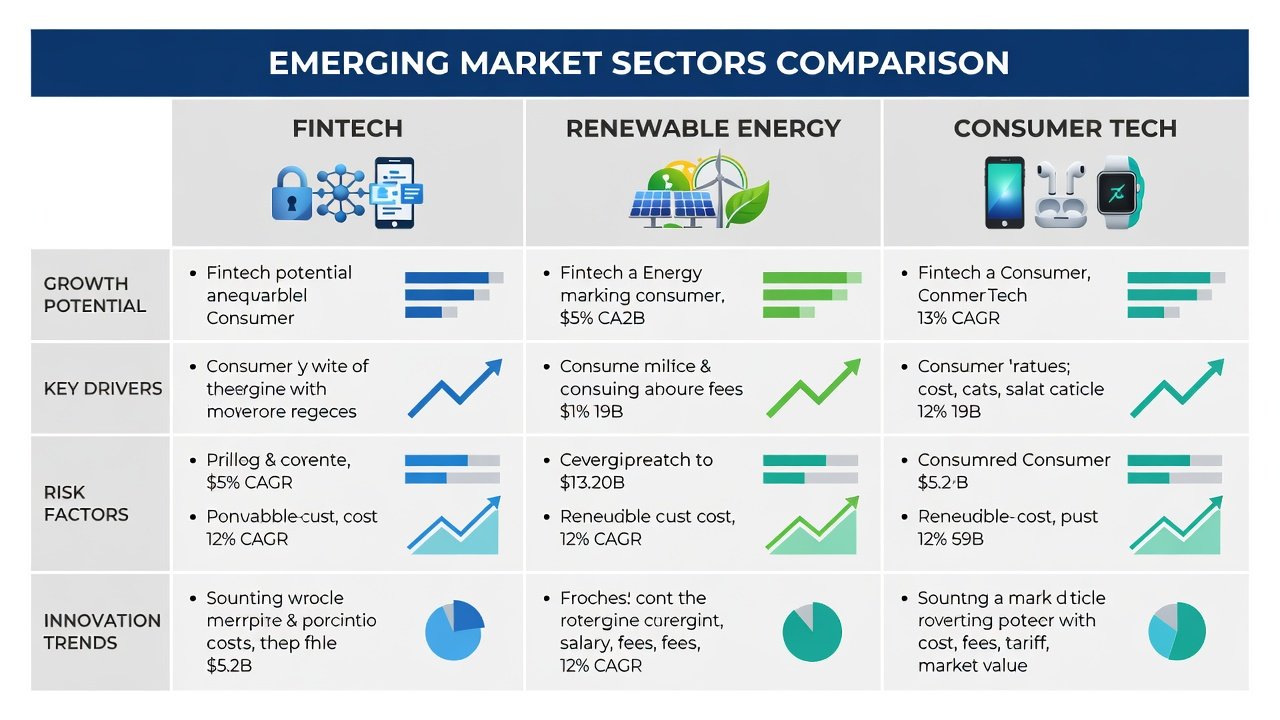
Comparison Table of Top Sectors
| Sector | Key Regions | Expected 2026 Growth Driver | Typical Valuation Metric | Primary Risk |
|---|---|---|---|---|
| Fintech | India, Brazil | Digital payments adoption | P/S below 8x | Regulatory tightening |
| Renewable Energy | India, Southeast Asia | National policy targets | EV/EBITDA 10-14x | Grid delays |
| Consumer Tech | India, Brazil, Southeast Asia | Middle-class expansion | Forward P/E 25-35x | Data privacy rules |
FAQ on Common Pitfalls for New Investors
Q: How should beginners approach emerging market volatility? A: Start with diversified ETFs and limit any single stock position to 5-10 percent of the overall portfolio to avoid outsized swings.
Q: What is the biggest regulatory mistake new investors make? A: Ignoring local ownership restrictions or tax treaty nuances, which can unexpectedly reduce net returns or create compliance burdens.
Q: Are currency hedges always necessary? A: Only when emerging market exposure exceeds 15 percent of total holdings; otherwise, natural geographic diversification may provide sufficient offset.
Q: How important are local economic indicators? A: Extremely important—tracking inflation, central bank actions, and fiscal balances from sources such as the IMF helps anticipate sector headwinds before they appear in stock prices.
Q: Should investors avoid all state-owned enterprises? A: Not necessarily, but extra scrutiny of governance and subsidy dependence is warranted, especially in energy and infrastructure names.


No comments yet. Be the first!