 Bullish Portfolio

Introduction to Risk Management in Compounding Wealth
Building wealth through compounding requires consistent growth over decades, but market volatility and downturns can erode gains if left unchecked. Investors pursuing financial independence must prioritize risk management strategies that specifically protect the compounding process. Without proper safeguards, even strong average returns can be undermined by large drawdowns that force investors to recover from a smaller base. This comprehensive guide explores in-depth tactics including diversification, position sizing, stop-loss integration, and scenario modeling to help maintain upward trajectories despite market turbulence.
Diversification Principles for Compounding Portfolios
Diversification spreads investments across asset classes to reduce unsystematic risk while allowing compounding to work effectively. Core principles include allocating across equities, fixed income, real estate, and alternatives. A well-diversified portfolio might hold 60% equities, 20% bonds, 10% real estate, and 10% commodities to balance growth and protection. Beyond simple percentages, true diversification considers correlations between holdings and geographic exposure. For example, combining U.S. large-cap stocks with international emerging markets and inflation-protected securities can smooth returns over multi-year periods. Investors should regularly review correlation matrices to ensure allocations remain effective as market regimes shift.
Asset Class Correlation Analysis
Understanding how different assets move together during stress periods is essential. Historical data shows that equities and bonds often exhibit low or negative correlations, providing a natural hedge. Adding real assets like commodities further diversifies exposure to inflation and supply shocks. Practical implementation involves selecting low-cost vehicles such as broad index funds and periodically rebalancing to target weights.
Position Sizing Formulas and Calculations
Effective position sizing prevents any single asset from derailing compounding trajectories. The Kelly Criterion offers one formula: edge divided by odds, adjusted conservatively for safety. Investors often use a simplified version limiting any position to 5-10% of total portfolio value. Step-by-step worksheets begin with calculating portfolio volatility, then determining maximum drawdown tolerance before assigning sizes. Consider an investor with a $300,000 portfolio and a 15% maximum acceptable drawdown. Using volatility estimates, individual equity positions might be capped at 4% while bond allocations reach 8%. This disciplined approach preserves capital during corrections and allows the remaining portfolio to continue compounding at a steady rate.
Practical Position Sizing Example
Suppose an investor identifies a high-conviction stock with strong fundamentals. Rather than allocating 20%, the sizing worksheet recommends splitting the position into three tranches over several months. Each tranche respects the 5% limit, reducing the impact of immediate price reversals. This method integrates directly with compounding calculators to project long-term outcomes under different volatility assumptions.
Integrating Stop-Loss Orders with Compounding Models
Stop-loss mechanisms protect gains without interrupting the compounding engine. Trailing stops set at 15-20% below peak prices allow room for normal fluctuations while capping losses. When integrated with compounding calculators, these tools recalculate future projections after each adjustment to maintain realistic growth assumptions. Advanced users combine stop-losses with options collars to define both downside protection and upside participation. Regular backtesting against historical drawdowns helps refine these rules for specific asset classes.
Real-World Portfolio Examples Across Asset Classes
Consider a balanced example: a $500,000 portfolio with broad-market ETFs, dividend stocks, and Treasury bonds. During a simulated 20% market drop, diversification limited losses to 12%, allowing quicker recovery and continued compounding. Another case compares a concentrated tech portfolio versus a multi-asset allocation, showing how the latter preserved more capital for long-term growth. A third example involves adding a small allocation to international real estate investment trusts, which provided income stability during domestic equity declines. These cases illustrate how thoughtful construction across equities, fixed income, and alternatives supports uninterrupted compounding toward financial independence.
Comparing Hedged Versus Unhedged Compounding Scenarios
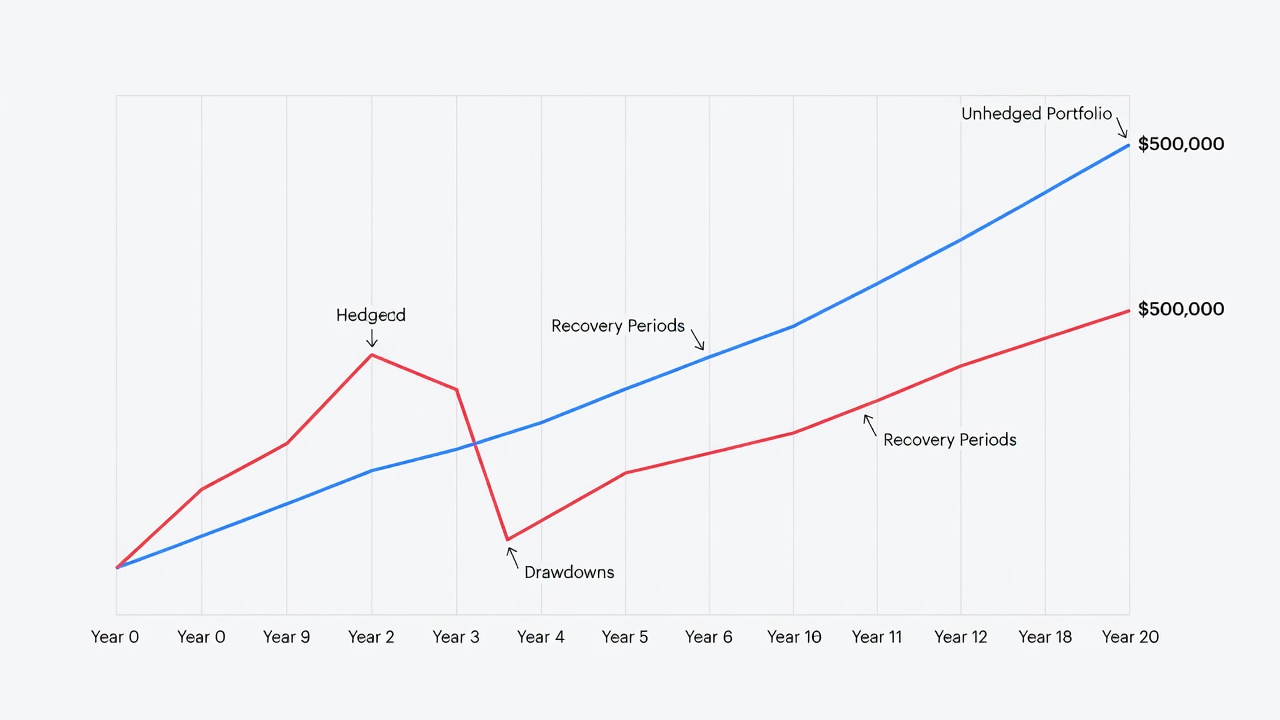
Hedged approaches using options or inverse ETFs reduce downside exposure but may cap upside. Unhedged compounding delivers higher average returns in bull markets yet faces steeper drawdowns. Side-by-side modeling reveals hedged scenarios often outperform over full market cycles by preserving capital during sequence-of-returns risk periods. Detailed comparisons should include Monte Carlo simulations that run thousands of market paths to estimate probabilities of reaching independence goals under each strategy. Investors can then decide based on personal risk tolerance and time horizon.
Step-by-Step Risk Assessment Worksheets
- Identify personal risk tolerance through questionnaires covering sleep-well-at-night thresholds and withdrawal needs.
- Map current asset correlations using historical data from sources such as Federal Reserve economic data.
- Stress-test the portfolio against 2008-style or 2020-style events by applying percentage declines to each allocation.
- Adjust allocations and re-run compounding projections to compare outcomes.
- Review quarterly and rebalance as needed, documenting changes in a simple spreadsheet.
- Incorporate behavioral checks to avoid emotional overrides of the plan during volatility spikes.
Addressing Sequence-of-Returns Risk
Sequence-of-returns risk poses a particular threat near the transition to withdrawals. Poor returns early in retirement can permanently impair the portfolio even if long-term averages recover. Mitigation includes maintaining a cash buffer equivalent to two to three years of spending and using flexible withdrawal rates that adjust with market conditions. Layering in annuity products or dividend-growth stocks can further stabilize income streams during adverse sequences.
Behavioral Pitfalls and How to Avoid Them
Common mistakes include chasing recent winners, ignoring correlations during calm markets, and abandoning stop-loss rules after small breaches. Maintaining a written investment policy statement helps counteract these tendencies. Regular education through reputable outlets such as SEC investor resources reinforces disciplined decision-making.
Common Pitfalls and FAQ
Sequence-of-returns risk remains a top concern for those nearing withdrawal phases. Over-concentration in single sectors frequently destroys compounding momentum. How often should portfolios be rebalanced? Annual reviews typically suffice unless major market shifts occur. What is the ideal stop-loss percentage? It depends on volatility but commonly falls between 10% and 25%. Should hedging always be used? Not necessarily; moderate allocations may suffice for younger investors with long horizons. How does inflation factor into risk models? Real returns must be modeled after accounting for rising costs, often by including Treasury inflation-protected securities.
Conclusion
Implementing these risk management strategies ensures compounding wealth continues uninterrupted toward financial independence goals. Regular application of diversification, sizing rules, and protective measures builds resilience against volatility. Investors who treat risk management as an ongoing process rather than a one-time exercise position themselves for sustainable long-term success.


No comments yet. Be the first!